/images/ppid_59c68470-image-178515510051066342.webp)


/images/ppid_59c68470-image-178489009130889079.webp)

What is the story about?
Tata Consumer Products expects revenue growth to move towards the mid-teens by the end of the financial year 2026-27 (FY27) while maintaining its target of expanding earnings before interest, taxes, depreciation, and amortisation (EBITDA) margins by 50-70 basis points, Managing Director and CEO Sunil D'Souza said after the company reported its April-June 2026 quarter results.
He said the company remains confident of exceeding its 30% growth target for its growth portfolio while continuing to invest in distribution, innovation and recently acquired businesses.
He added that Tata Consumer remains focused on profitability alongside growth.
The company's growth businesses, which now contribute 36% of its India business, expanded 47% during the quarter. D'Souza said the portfolio, comprising Sampann, ready-to-drink beverages, Capital Foods, Organic India and Soulfull, continues to perform well across categories.
D'Souza acknowledged that scaling the Capital Foods and Organic India businesses has taken longer than initially expected because of category-building and go-to-market initiatives. However, he said the company has addressed those challenges and remains confident of delivering 25-30% growth.
Indian fast-moving consumer goods (FMCG) company is also expanding its frozen foods business, beginning with the National Capital Region (NCR) before entering Mumbai and later other cities after validating its cold-chain model.
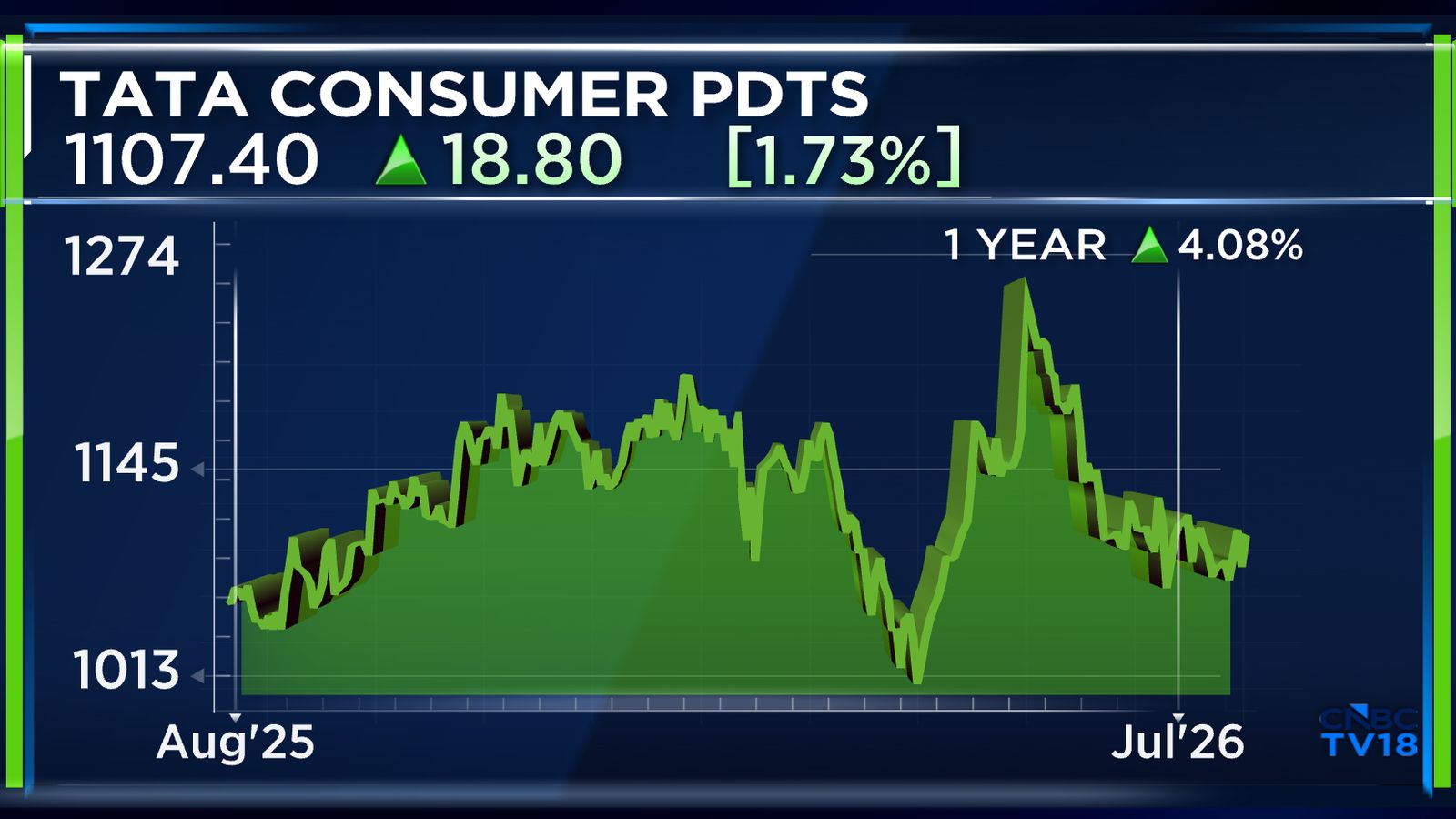
Tata Consumer Products currently has a market capitalisation of ₹1,09,594.06 crore. The stock has gained more than 4% over the last year.
This is an edited transcript of the interview.Q: Why is your guidance so muted, after a 47% growth in your growth portfolio, which now contributes 36%. Even if you take the seasonality out of RTD, Sampann has grown 58%. So, after the first quarter, which has performed very well with 47% growth, why are you still holding on to that 30% growth guidance? I'm sure you can do better this year. A: Overall, we had a good quarter with 12% top-line growth and 29% EBITDA growth. Our growth businesses grew 47% and now contribute 36% of the India business, more than tea and salt.
That said, the growth businesses are a portfolio by themselves. We've got Sampann, we've got ready-to-drink, Capital Foods, Organic India, and Soulfull. While overall, we would like to cross the 30% mark from time to time, it's good to be practical and give a good guidance.
We would hope to beat this number on a consistent basis. The good part is that this quarter all the businesses fired. You did mention Sampann. Sampann grew 58%, ready-to-drink grew 41%, Capital Foods grew 40%, and Organic India grew 27%. So overall, good growth. We remain focused on growing distribution, innovation, and making sure we're building equity in these businesses.
Q: Just a two-part question before we go. What does this do to your overall guidance for this year? You've said double-digit. Yes, I get that. Can you get a little more specific? The first quarter has been 12%. Would you go to the low teens by the end of this year because tea inflation is coming through as well? And secondly, regarding Capital Foods and Organic India, we've been speaking about this aspirational run rate of ₹500 crore per quarter. Yes, on a low base, they have been growing well. But by when do you get to that ₹500 crore run rate per quarter? Because the Street is a little worried about the time it has taken since you acquired these companies to grow them at the pace you had aspired to grow them. So, for Capital Foods and Organic India, when do they get to ₹500 crore? And this entire year, what's your growth guidance? If you could give us a specific band as against just an open-ended double-digit.A: Right now we've delivered 12% growth. We are very hopeful that we will be inching towards the mid-teens by the end of the year.
The more critical part is that while doing this, we're targeting a 50-70 bps improvement in EBITDA margin going forward. And this quarter we delivered 70 bps. We remain quite confident that we'll deliver the same number for the full year. So that's number one.
On Capital Foods and Organic India, yes, it's taken a little bit more time than what we expected because we had some learnings in terms of go-to-market, the categories, category building, and category shaping. But now, broadly we remain confident that we've ticked all the boxes. This quarter it was 40% for Capital Foods and 27% for Organic India.
Organic India’s India business grew quite well. We had a bit of an issue in the US business where we sold psyllium extremely well, and then we ran short of product. But that will come back very quickly. The aspiration remains to grow 25% to 30%. We are at about a ₹400 crore annual run rate right now for Capital Foods, and for Organic India, there's no reason we shouldn't grow 25-30% and therefore hit that ₹500 crore run-rate number. We remain quite confident.
More importantly, these businesses are accretive to our gross margin. They deliver gross margins of 45% to 50% versus about 35% in my base portfolio. And with innovation, over the weekend we've listed the frozen business for Capital Foods in the NCR and on quick commerce, we will be going on to modern trade as well, and you could expect to see that in large cities very quickly.
Q: By when does that happen across pan-India? That's one. And when does that start contributing to growth? Secondly, how much of your cost increases have you passed on? Considering the fact that there has been tea inflation as well, along with premiumisation and the acquisition synergies. How does that impact your margins going forward?A: So, to answer your first question on frozen, right now we're in the NCR. We'll soon be coming to Mumbai. We'll stay in these two cities because we've got to prove the model, including the cold chain, etc. We expect this will be accretive to the business. Most importantly, with quick commerce deliveries, frozen is a huge growth category, and we expect that to play out for us as well.
Now, your second question was with regard to costs. We've had roughly 60 bps of impact in the first quarter. Tea—we're a long way off from buying for the whole year. We have bought only about 15-20% of the year, but tea is seeing about 7-10% inflation.
More importantly, if crude remains at around $92 per barrel, you would expect to see inflation across downstream products in packaging, raw materials, etc.
That said, Tata Consumer is no stranger to volatility in commodity costs. For salt, we've already taken a ₹2 price increase as Indonesian coal and the rupee have impacted our cost of goods. We remain agile in terms of making sure we tailor our mix and, more importantly, move pricing in a calibrated fashion to offset costs and maintain our margin. Most importantly, 50-70 bps EBITDA margin growth is what we're targeting.
Q: The international business is growing in double digits. Margins have softened a bit there. Can you provide any outlook for the rest of the year?A: So the good part is that over the past few quarters, the international business has been growing. Our US business, for example, has recorded its seventh successive quarter of market share gain. The impact on margins is primarily because of US coffee costs. While coffee has come off its highs—it went up to about $4.30 last quarter. By the quarter-end, it was $2.80, and has now moved slightly higher to $3.30. But it takes about 15 weeks or so for it to unwind. So, you would see the margins coming back in the second half of the year.
More importantly, market share gains and top-line growth, coupled with softer commodity prices as we move into the second half, should support good performance in the international business.
For the full interview, watch the accompanying videoCatch all the latest updates from the stock market here
He said the company remains confident of exceeding its 30% growth target for its growth portfolio while continuing to invest in distribution, innovation and recently acquired businesses.
He added that Tata Consumer remains focused on profitability alongside growth.
The company's growth businesses, which now contribute 36% of its India business, expanded 47% during the quarter. D'Souza said the portfolio, comprising Sampann, ready-to-drink beverages, Capital Foods, Organic India and Soulfull, continues to perform well across categories.
D'Souza acknowledged that scaling the Capital Foods and Organic India businesses has taken longer than initially expected because of category-building and go-to-market initiatives. However, he said the company has addressed those challenges and remains confident of delivering 25-30% growth.
Indian fast-moving consumer goods (FMCG) company is also expanding its frozen foods business, beginning with the National Capital Region (NCR) before entering Mumbai and later other cities after validating its cold-chain model.
Tata Consumer Products currently has a market capitalisation of ₹1,09,594.06 crore. The stock has gained more than 4% over the last year.
This is an edited transcript of the interview.Q: Why is your guidance so muted, after a 47% growth in your growth portfolio, which now contributes 36%. Even if you take the seasonality out of RTD, Sampann has grown 58%. So, after the first quarter, which has performed very well with 47% growth, why are you still holding on to that 30% growth guidance? I'm sure you can do better this year. A: Overall, we had a good quarter with 12% top-line growth and 29% EBITDA growth. Our growth businesses grew 47% and now contribute 36% of the India business, more than tea and salt.
That said, the growth businesses are a portfolio by themselves. We've got Sampann, we've got ready-to-drink, Capital Foods, Organic India, and Soulfull. While overall, we would like to cross the 30% mark from time to time, it's good to be practical and give a good guidance.
We would hope to beat this number on a consistent basis. The good part is that this quarter all the businesses fired. You did mention Sampann. Sampann grew 58%, ready-to-drink grew 41%, Capital Foods grew 40%, and Organic India grew 27%. So overall, good growth. We remain focused on growing distribution, innovation, and making sure we're building equity in these businesses.
Q: Just a two-part question before we go. What does this do to your overall guidance for this year? You've said double-digit. Yes, I get that. Can you get a little more specific? The first quarter has been 12%. Would you go to the low teens by the end of this year because tea inflation is coming through as well? And secondly, regarding Capital Foods and Organic India, we've been speaking about this aspirational run rate of ₹500 crore per quarter. Yes, on a low base, they have been growing well. But by when do you get to that ₹500 crore run rate per quarter? Because the Street is a little worried about the time it has taken since you acquired these companies to grow them at the pace you had aspired to grow them. So, for Capital Foods and Organic India, when do they get to ₹500 crore? And this entire year, what's your growth guidance? If you could give us a specific band as against just an open-ended double-digit.A: Right now we've delivered 12% growth. We are very hopeful that we will be inching towards the mid-teens by the end of the year.
The more critical part is that while doing this, we're targeting a 50-70 bps improvement in EBITDA margin going forward. And this quarter we delivered 70 bps. We remain quite confident that we'll deliver the same number for the full year. So that's number one.
On Capital Foods and Organic India, yes, it's taken a little bit more time than what we expected because we had some learnings in terms of go-to-market, the categories, category building, and category shaping. But now, broadly we remain confident that we've ticked all the boxes. This quarter it was 40% for Capital Foods and 27% for Organic India.
Organic India’s India business grew quite well. We had a bit of an issue in the US business where we sold psyllium extremely well, and then we ran short of product. But that will come back very quickly. The aspiration remains to grow 25% to 30%. We are at about a ₹400 crore annual run rate right now for Capital Foods, and for Organic India, there's no reason we shouldn't grow 25-30% and therefore hit that ₹500 crore run-rate number. We remain quite confident.
More importantly, these businesses are accretive to our gross margin. They deliver gross margins of 45% to 50% versus about 35% in my base portfolio. And with innovation, over the weekend we've listed the frozen business for Capital Foods in the NCR and on quick commerce, we will be going on to modern trade as well, and you could expect to see that in large cities very quickly.
Q: By when does that happen across pan-India? That's one. And when does that start contributing to growth? Secondly, how much of your cost increases have you passed on? Considering the fact that there has been tea inflation as well, along with premiumisation and the acquisition synergies. How does that impact your margins going forward?A: So, to answer your first question on frozen, right now we're in the NCR. We'll soon be coming to Mumbai. We'll stay in these two cities because we've got to prove the model, including the cold chain, etc. We expect this will be accretive to the business. Most importantly, with quick commerce deliveries, frozen is a huge growth category, and we expect that to play out for us as well.
Now, your second question was with regard to costs. We've had roughly 60 bps of impact in the first quarter. Tea—we're a long way off from buying for the whole year. We have bought only about 15-20% of the year, but tea is seeing about 7-10% inflation.
More importantly, if crude remains at around $92 per barrel, you would expect to see inflation across downstream products in packaging, raw materials, etc.
That said, Tata Consumer is no stranger to volatility in commodity costs. For salt, we've already taken a ₹2 price increase as Indonesian coal and the rupee have impacted our cost of goods. We remain agile in terms of making sure we tailor our mix and, more importantly, move pricing in a calibrated fashion to offset costs and maintain our margin. Most importantly, 50-70 bps EBITDA margin growth is what we're targeting.
Q: The international business is growing in double digits. Margins have softened a bit there. Can you provide any outlook for the rest of the year?A: So the good part is that over the past few quarters, the international business has been growing. Our US business, for example, has recorded its seventh successive quarter of market share gain. The impact on margins is primarily because of US coffee costs. While coffee has come off its highs—it went up to about $4.30 last quarter. By the quarter-end, it was $2.80, and has now moved slightly higher to $3.30. But it takes about 15 weeks or so for it to unwind. So, you would see the margins coming back in the second half of the year.
More importantly, market share gains and top-line growth, coupled with softer commodity prices as we move into the second half, should support good performance in the international business.
For the full interview, watch the accompanying videoCatch all the latest updates from the stock market here
/images/ppid_59c68470-image-17851476299495412.webp)
/images/ppid_59c68470-image-178515255883426312.webp)
/images/ppid_59c68470-image-178513002672226113.webp)
/images/ppid_59c68470-image-178513021847811385.webp)
/images/ppid_59c68470-image-178513270164667864.webp)
/images/ppid_59c68470-image-17851300633255318.webp)
/images/ppid_59c68470-image-178511506177731300.webp)
/images/ppid_59c68470-image-178512527180174190.webp)
/images/ppid_59c68470-image-178489510498646453.webp)
