/images/ppid_59c68470-image-177866503354713249.webp)

/images/ppid_59c68470-image-17786626840811738.webp)
/images/ppid_59c68470-image-177866275295783408.webp)
/images/ppid_59c68470-image-177866271741131878.webp)
What is the story about?
Ramesh Gopalan, MD and Group CEO of technology-enabled healthcare services provider Sagility, expects revenue growth to remain in the low double digits in 2026-27 (FY27) as US healthcare clients continue to focus on reducing operating costs.
Sagility’s artificial intelligence (AI)-led transformation offerings and focus on business outcomes are helping drive deal momentum, and the company expects double-digit client additions after adding 17 clients in 2025-26 (FY26).
Despite continued investments in AI and technology, the adjusted margin for FY27 is expected to be at 24-25%.
Sagility is also evaluating acquisition opportunities focused on AI capabilities and market access, with a couple of active deals currently under diligence, he said.
The profits are likely to grow faster than the top line as debt repayment in FY27 is expected to support faster earnings growth, he said, while adding that a 15% return on capital employed by FY28 is possible.
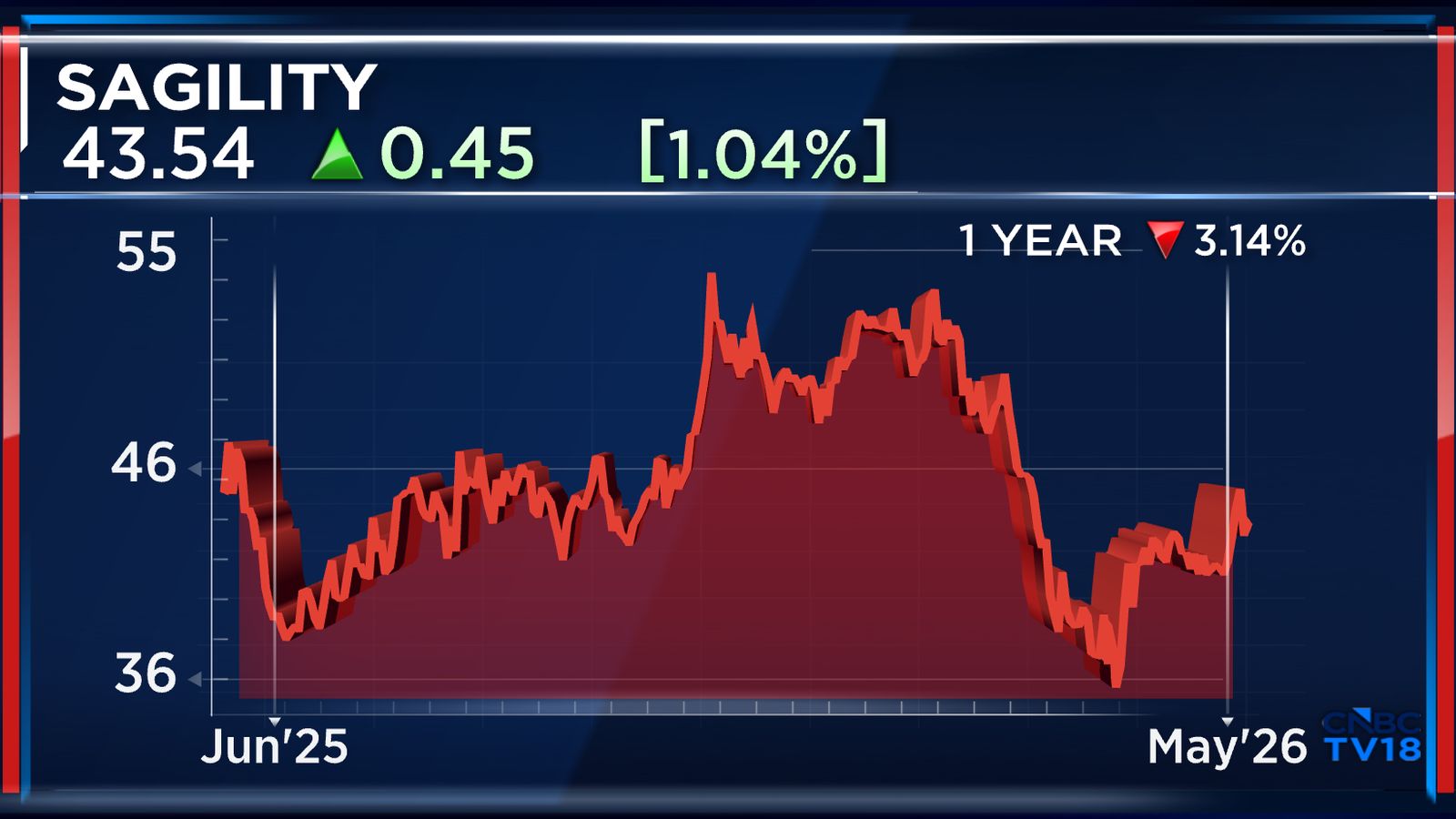
Sagility reported its earnings numbers for the January-March 2026 quarter of the financial year 2025-26 (FY26). The company currently has a market capitalisation of ₹20,387.19 crore, while its shares have declined more than 3% over the last year.
This is an edited transcript of the interview.Q: You are guiding for mid-teens constant currency growth for the coming year with EBITDA margins of 24% to 25%. Can you tell us what's gone into your topline guidance? How much of the existing pipeline of $570.5 million will you be able to convert? When does the rest come in, and what will help you push your margins above 25% structurally?
A: We've guided to a low double-digit guidance for FY27. As I've said before, the healthcare industry in the US is undergoing a lot of change. There's a lot of cost pressure, both because of medical utilisation as well as regulatory changes, and in this environment, clients are basically looking at taking costs out of operations, and that's where someone like Sagility comes in, because we have deep domain expertise. We lead with transformation, which is more AI-led, and we also are willing to commit to business outcomes. So, all of this sets us up for growth, and that's what has been factored into the guidance.
So broadly, some of the deals that we are working on, the timing may be a little uncertain. That's why we've given a broad range of guidance, which is low double digits. But through the year, as we are successful in closing more deals, we will update the guidance.
On the margin front, yes, we've guided to 24% to 25% adjusted EBITDA margins. Again, a lot of factors go in there. There are obviously salary increments that will play out. We are also investing a lot more in technology and AI, and the forex situation is a little uncertain. But if the forex stays in the current range, we think we can remain towards the upper end of that 24% to 25% range.
For the full interview, watch the accompanying videoQ: Give us a few more details. What's the new client addition you're factoring in for this year? If you could help us out with the revenue per employee — last year, I think it was up close to 4%. What does it go up by? And employee addition, on the whole, if there is a number, if you could help us out.
A: On the employee front, look, it all depends on the geography mix, right? We deliver from multiple geographies. So, depending on how the revenue stacks up across these geographies, the revenue mix, the revenue per employee could shift. Obviously, tech and AI also improve the productivity of employees. So that's another reason why the revenue per employee will go up.
So, it's very difficult to put an exact number on the increase in revenue per employee, but directionally, it is likely to keep increasing.
On the client addition front, typically, we add about 8-10 clients every year. That's increased in the last couple of years. We added 17 clients in FY26, so we are looking again at double-digit additions of clients.
Also Read | Nazara Tech targets 25% margin by end of FY27 as Bluetile deal and AI drive growth
But more importantly, the nature of work that we sign up for is also changing. It's no more effort-based work. There is a lot more interest in end-to-end accountability of business outcomes, and clients are looking for partners who can help transform their operations and reduce costs overall. So yeah, we expect double-digit client additions.
Q: I wanted to ask you, because many believe that there is some inorganic growth in the works, and you have not shied away from that. Is there something that you could be closing out in the first half of the year?
A: Look, there are always deals in the pipeline. So, we are constantly evaluating deals. So, it's very difficult to give you a timing, but yes, there are a couple of active deals that we're working on. So, depending on how the diligence goes, we could close them in the first half of the year.
But in terms of the nature of deals, like I've mentioned before, we are looking at more capability additions. So, anything that helps us in our transformational story — anything to do with our tech and AI, as well as any acquisition that will give us better market access. These are the two vectors on which we look at M&A. And like I said, yes, a couple of deals are actively being diligenced as we speak.
Q: On the one hand, you have client additions, which are expected to be in double digits. But a big trigger for you is getting more revenue from existing clients as well. Your top five clients account for nearly 70% of your revenue. And out there, there is a likelihood of a 40% upside from client number two, and about 80% to 90% upside from clients three, four and five. Have you heard from them on upsizing those contracts, and by when can we hear more on that?
A: So, we are constantly working with all of our top clients and trying to figure out white spaces that we can expand into.
As I mentioned, our top five clients grew at 11.7% year on year in FY26. And like you said, these clients account for 70% of our revenues, and the average tenure of these five clients is 18 years. So, we still continue to find opportunities to grow with them, and we are constantly in touch with them. We'll continue growing these top five, but the focus is also shifting to trying to penetrate the mid and small market. So, we are rather aggressive in adding to the total number of clients and also pushing for aggressive growth in the mid-market.
Also Read | Canara Bank says asset quality is stable, can absorb ₹10,000 crore ECL impact
Q: Final question before we let you go. The return ratios have improved. I'm looking at your RoCE — I think it's in low double digits now — but the Street believes that it can go to say 15%-16% by FY28. Is that possible? The improvement in the RoCE — and a couple of brokerage notes, are factoring in that you do around ₹1,500 crore of net profit in FY28. Is it headed in that direction?
A: If you can see our numbers, over the last couple of years, we've grown tremendously. So, the debt burden is going to come down completely. We are planning that all of the debt will be repaid in FY27. So, given all of that, yes, the profits are likely to grow faster than the top line. But beyond that, it'll be difficult to give an exact number on FY28. But we are very bullish on the bottom-line growth as well.
Q: And the return ratio has improved by around 100-200 basis points.
A: Yes, likely.
Q: 15% RoCE — that's possible, right?
A: That's possible.
Catch all the latest updates from the stock market here
Sagility’s artificial intelligence (AI)-led transformation offerings and focus on business outcomes are helping drive deal momentum, and the company expects double-digit client additions after adding 17 clients in 2025-26 (FY26).
Despite continued investments in AI and technology, the adjusted margin for FY27 is expected to be at 24-25%.
Sagility is also evaluating acquisition opportunities focused on AI capabilities and market access, with a couple of active deals currently under diligence, he said.
The profits are likely to grow faster than the top line as debt repayment in FY27 is expected to support faster earnings growth, he said, while adding that a 15% return on capital employed by FY28 is possible.
Sagility reported its earnings numbers for the January-March 2026 quarter of the financial year 2025-26 (FY26). The company currently has a market capitalisation of ₹20,387.19 crore, while its shares have declined more than 3% over the last year.
This is an edited transcript of the interview.Q: You are guiding for mid-teens constant currency growth for the coming year with EBITDA margins of 24% to 25%. Can you tell us what's gone into your topline guidance? How much of the existing pipeline of $570.5 million will you be able to convert? When does the rest come in, and what will help you push your margins above 25% structurally?
A: We've guided to a low double-digit guidance for FY27. As I've said before, the healthcare industry in the US is undergoing a lot of change. There's a lot of cost pressure, both because of medical utilisation as well as regulatory changes, and in this environment, clients are basically looking at taking costs out of operations, and that's where someone like Sagility comes in, because we have deep domain expertise. We lead with transformation, which is more AI-led, and we also are willing to commit to business outcomes. So, all of this sets us up for growth, and that's what has been factored into the guidance.
So broadly, some of the deals that we are working on, the timing may be a little uncertain. That's why we've given a broad range of guidance, which is low double digits. But through the year, as we are successful in closing more deals, we will update the guidance.
On the margin front, yes, we've guided to 24% to 25% adjusted EBITDA margins. Again, a lot of factors go in there. There are obviously salary increments that will play out. We are also investing a lot more in technology and AI, and the forex situation is a little uncertain. But if the forex stays in the current range, we think we can remain towards the upper end of that 24% to 25% range.
For the full interview, watch the accompanying videoQ: Give us a few more details. What's the new client addition you're factoring in for this year? If you could help us out with the revenue per employee — last year, I think it was up close to 4%. What does it go up by? And employee addition, on the whole, if there is a number, if you could help us out.
A: On the employee front, look, it all depends on the geography mix, right? We deliver from multiple geographies. So, depending on how the revenue stacks up across these geographies, the revenue mix, the revenue per employee could shift. Obviously, tech and AI also improve the productivity of employees. So that's another reason why the revenue per employee will go up.
So, it's very difficult to put an exact number on the increase in revenue per employee, but directionally, it is likely to keep increasing.
On the client addition front, typically, we add about 8-10 clients every year. That's increased in the last couple of years. We added 17 clients in FY26, so we are looking again at double-digit additions of clients.
Also Read | Nazara Tech targets 25% margin by end of FY27 as Bluetile deal and AI drive growth
But more importantly, the nature of work that we sign up for is also changing. It's no more effort-based work. There is a lot more interest in end-to-end accountability of business outcomes, and clients are looking for partners who can help transform their operations and reduce costs overall. So yeah, we expect double-digit client additions.
Q: I wanted to ask you, because many believe that there is some inorganic growth in the works, and you have not shied away from that. Is there something that you could be closing out in the first half of the year?
A: Look, there are always deals in the pipeline. So, we are constantly evaluating deals. So, it's very difficult to give you a timing, but yes, there are a couple of active deals that we're working on. So, depending on how the diligence goes, we could close them in the first half of the year.
But in terms of the nature of deals, like I've mentioned before, we are looking at more capability additions. So, anything that helps us in our transformational story — anything to do with our tech and AI, as well as any acquisition that will give us better market access. These are the two vectors on which we look at M&A. And like I said, yes, a couple of deals are actively being diligenced as we speak.
Q: On the one hand, you have client additions, which are expected to be in double digits. But a big trigger for you is getting more revenue from existing clients as well. Your top five clients account for nearly 70% of your revenue. And out there, there is a likelihood of a 40% upside from client number two, and about 80% to 90% upside from clients three, four and five. Have you heard from them on upsizing those contracts, and by when can we hear more on that?
A: So, we are constantly working with all of our top clients and trying to figure out white spaces that we can expand into.
As I mentioned, our top five clients grew at 11.7% year on year in FY26. And like you said, these clients account for 70% of our revenues, and the average tenure of these five clients is 18 years. So, we still continue to find opportunities to grow with them, and we are constantly in touch with them. We'll continue growing these top five, but the focus is also shifting to trying to penetrate the mid and small market. So, we are rather aggressive in adding to the total number of clients and also pushing for aggressive growth in the mid-market.
Also Read | Canara Bank says asset quality is stable, can absorb ₹10,000 crore ECL impact
Q: Final question before we let you go. The return ratios have improved. I'm looking at your RoCE — I think it's in low double digits now — but the Street believes that it can go to say 15%-16% by FY28. Is that possible? The improvement in the RoCE — and a couple of brokerage notes, are factoring in that you do around ₹1,500 crore of net profit in FY28. Is it headed in that direction?
A: If you can see our numbers, over the last couple of years, we've grown tremendously. So, the debt burden is going to come down completely. We are planning that all of the debt will be repaid in FY27. So, given all of that, yes, the profits are likely to grow faster than the top line. But beyond that, it'll be difficult to give an exact number on FY28. But we are very bullish on the bottom-line growth as well.
Q: And the return ratio has improved by around 100-200 basis points.
A: Yes, likely.
Q: 15% RoCE — that's possible, right?
A: That's possible.
Catch all the latest updates from the stock market here