/images/ppid_59c68470-image-178877752997031985.webp)

/images/ppid_59c68470-image-178876008479092341.webp)
/images/ppid_59c68470-image-178879261431941521.webp)

What is the story about?
Rahul Dhanuka, Managing Director of Dhanuka Agritech, said the company is holding its full-year guidance steady even after a weak April-June 2026 quarter. "We are looking at a single-digit growth this year, and that is what we are sticking to," he said, addressing concerns over delayed monsoon and falling farm demand.
The company had already cut its 2023—24 (FY24) outlook once, moving from a lower double-digit growth target to a lower single-digit one. Dhanuka confirmed there is no further downgrade planned, even though the July-August 2026 quarter has also seen weak rainfall.
Dhanuka Agritech is headquartered in Gurugram, Haryana, and manufactures agrochemical products across more than 90 brands.
Margins will still take a hit. Dhanuka said the company expects a 200-basis point decline in margins this year — a basis point is one-hundredth of a percentage point, so 200 basis points equals 2 percentage points. "So, at Dhanuka we have more than 90 brands. Our products are spread out across all 90 brands... But 200 bps shortfall is going to stay," he said.
El Niño is a weather pattern that reduces rainfall over India, and it has hurt farmers and agrochemical demand this year. Dhanuka said rising commodity prices have partly offset the drop-in demand, but reduced rainfall and shrinking cropland have pulled results down overall.
Raw material costs, which had risen sharply due to the Russia-Ukraine war, have since stabilised and fallen in some segments. Dhanuka said the company is passing on both cost increases and decreases to customers, which keeps the net impact on margins neutral from pricing alone. The 200 basis point margin pressure is coming from lower sales volumes, not input costs.
Herbicides, which make up about 40% of Dhanuka's business, were the worst-hit product category this year because dry conditions reduce their use. Insecticides have performed better in the same period. Dhanuka pointed to newer products including Lanevo, Decide, and a paddy insecticide called Mortar as drivers of this quarter's insecticide demand.
Exports currently make up about 1% of company revenue; Dhanuka said the share will rise to roughly 1.5-2% by the end of this year. He said agrochemicals are a globally regulated industry, so entering new countries requires product registrations that take time. The company has already appointed distributors and channel partners in some markets, with more in progress. Dhanuka also pointed to the acquisition of two Bayer products, Triadimenol and Iprovalicarb, as an opportunity to grow both the Bayer product line and output from the company's Dahej plant.
The Dahej plant, built partly to support exports, is more than 75% utilised. It generated about ₹50 crore in revenue last year, below an original target of ₹100 crore. Dhanuka said the company had already lowered this year's Dahej revenue target to ₹75 crore in view of El Niño, and expects to meet or exceed that figure. Plant revenue is expected to grow by about 50% this year.
The company is also building a new plant in Nagpur, expected to come online in April 2028. Dhanuka said the company will invest ₹150-200 crore in the facility, funded entirely through internal accruals — meaning the company will not take on debt, consistent with its current debt-free balance sheet. "This would be contributing about ₹400 to 500 crore revenue in about 2 years’ time after coming online," Dhanuka said.
For the full interview, watch the accompanying video
Catch all the latest updates from the stock market here
The company had already cut its 2023—24 (FY24) outlook once, moving from a lower double-digit growth target to a lower single-digit one. Dhanuka confirmed there is no further downgrade planned, even though the July-August 2026 quarter has also seen weak rainfall.
Dhanuka Agritech is headquartered in Gurugram, Haryana, and manufactures agrochemical products across more than 90 brands.
Margins will still take a hit. Dhanuka said the company expects a 200-basis point decline in margins this year — a basis point is one-hundredth of a percentage point, so 200 basis points equals 2 percentage points. "So, at Dhanuka we have more than 90 brands. Our products are spread out across all 90 brands... But 200 bps shortfall is going to stay," he said.
El Niño is a weather pattern that reduces rainfall over India, and it has hurt farmers and agrochemical demand this year. Dhanuka said rising commodity prices have partly offset the drop-in demand, but reduced rainfall and shrinking cropland have pulled results down overall.
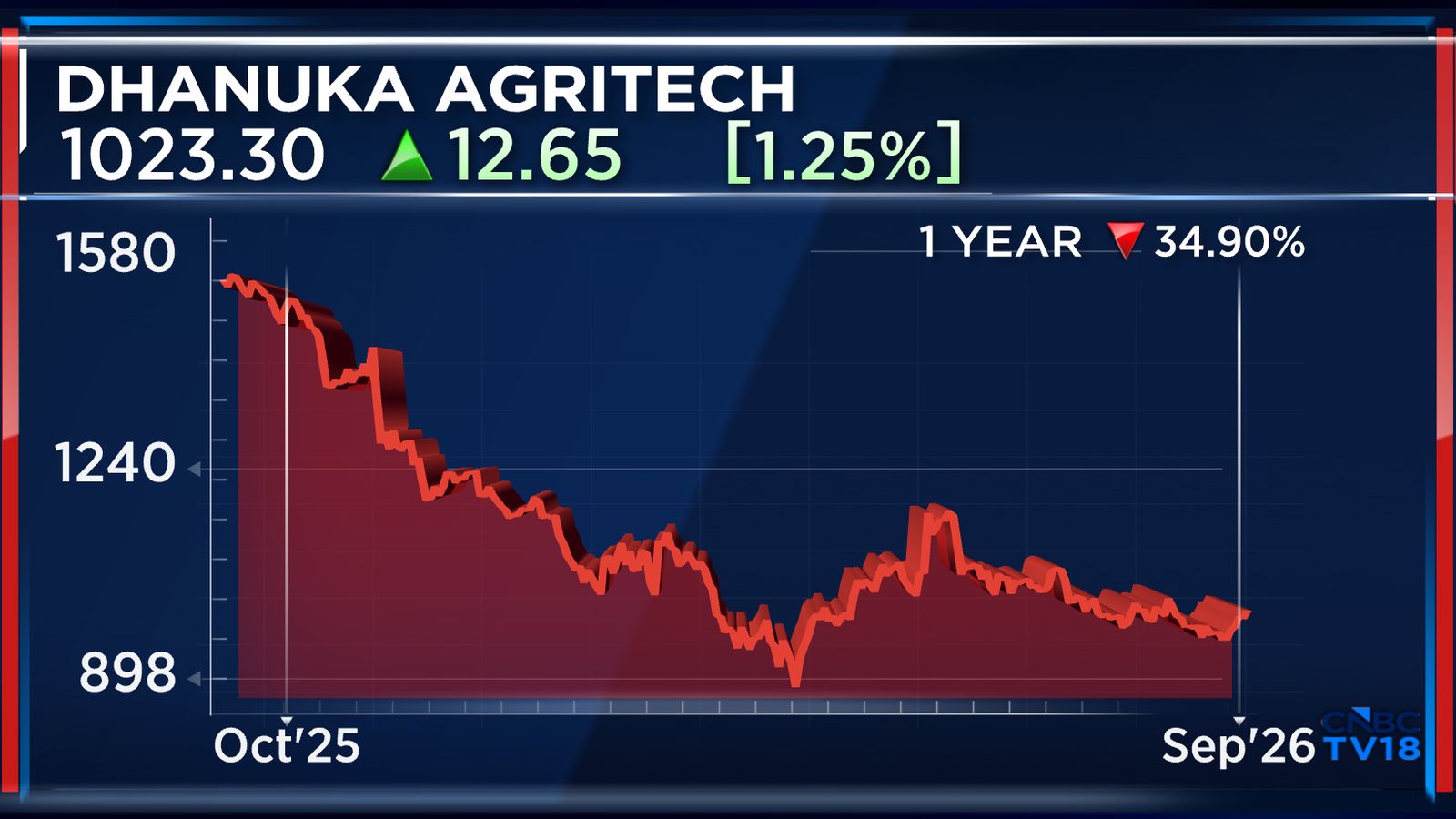
Shares of the company were trading at ₹1,029.65 as of 2:44 pm on the NSE, valuing the company at ₹4,560.36 crore in market capitalisation. The stock has fallen more than 34% over the past year.
Raw material costs, which had risen sharply due to the Russia-Ukraine war, have since stabilised and fallen in some segments. Dhanuka said the company is passing on both cost increases and decreases to customers, which keeps the net impact on margins neutral from pricing alone. The 200 basis point margin pressure is coming from lower sales volumes, not input costs.
Herbicides, which make up about 40% of Dhanuka's business, were the worst-hit product category this year because dry conditions reduce their use. Insecticides have performed better in the same period. Dhanuka pointed to newer products including Lanevo, Decide, and a paddy insecticide called Mortar as drivers of this quarter's insecticide demand.
Exports currently make up about 1% of company revenue; Dhanuka said the share will rise to roughly 1.5-2% by the end of this year. He said agrochemicals are a globally regulated industry, so entering new countries requires product registrations that take time. The company has already appointed distributors and channel partners in some markets, with more in progress. Dhanuka also pointed to the acquisition of two Bayer products, Triadimenol and Iprovalicarb, as an opportunity to grow both the Bayer product line and output from the company's Dahej plant.
The Dahej plant, built partly to support exports, is more than 75% utilised. It generated about ₹50 crore in revenue last year, below an original target of ₹100 crore. Dhanuka said the company had already lowered this year's Dahej revenue target to ₹75 crore in view of El Niño, and expects to meet or exceed that figure. Plant revenue is expected to grow by about 50% this year.
The company is also building a new plant in Nagpur, expected to come online in April 2028. Dhanuka said the company will invest ₹150-200 crore in the facility, funded entirely through internal accruals — meaning the company will not take on debt, consistent with its current debt-free balance sheet. "This would be contributing about ₹400 to 500 crore revenue in about 2 years’ time after coming online," Dhanuka said.
For the full interview, watch the accompanying video
Catch all the latest updates from the stock market here
/images/ppid_59c68470-image-178884759568650989.webp)


/images/ppid_59c68470-image-17888650784866886.webp)
/images/ppid_59c68470-image-178887505981726584.webp)
/images/ppid_59c68470-image-178874511880615939.webp)
/images/ppid_59c68470-image-178874758826397556.webp)
/images/ppid_59c68470-image-178875259343142113.webp)
/images/ppid_59c68470-image-178874252709286077.webp)
/images/ppid_59c68470-image-178875012212046842.webp)