



What is the story about?
Bank of India (BoI) expects the Reserve Bank of India's (RBI) October rate hike to support margins in the October-December 2026 quarter, with Managing Director & CEO Rajneesh Karnatak saying the lender expects around an 11.5-basis-point improvement in its domestic net interest margin (NIM).
The bank also expects deposit and credit growth of 16-17% and 15-16%, respectively, for the financial year 2026-27 (FY27), while targeting a global NIM closer to 3% over the next two to three years.
Karnatak said the October 7 repo rate hike has not yet been reflected in the bank's financials and will begin contributing from the third quarter. He added that while higher deposit costs will offset part of the benefit, the overall impact on margins will remain positive. The lender remains focused on improving loan yields and lowering funding costs to strengthen profitability.
Karnatak said the bank's asset quality continues to improve, recoveries remain healthy, and growth guidance factors in the possibility of additional interest rate hikes later this year.
The executive explained that around 63% of Bank of India's loan book is linked to the repo rate, allowing lending rates to reprice quickly after policy changes. About 30% of the portfolio is linked to the marginal cost of funds-based lending rate (MCLR).
Karnatak said the bank's domestic NIM stands at about 2.75%, while the global NIM is around 2.47%. He expects the lender to gradually improve margins by increasing higher-yielding advances and optimising funding costs.
Apart from margins, the lender also reported strong growth in recoveries from written-off accounts, which helped lift non-interest income. Karnatak said while the current level may not be repeated every year, recoveries are expected to remain on a growth path because of stronger internal recovery mechanisms.
The CEO also downplayed the impact of the draft IRDAI regulations on insurance commissions, estimating the hit to non-interest income at only around ₹50 crore.
He said the bank remains confident of maintaining current SMA levels and does not expect a sharp deterioration in slippages during the December quarter.
On business growth, Karnatak said the revised guidance reflects the impact of FCNR deposits raised during the year and the possibility of further policy tightening. Excluding FCNR deposits, deposit growth remains healthy, he added.
The lender now expects deposit growth of 16-17% and credit growth of 15-16% for the current financial year.
[faq type="interview" title="This is an edited transcript of the interview."][ques][/ques][ans][/ans][/faq][faq type="interview"][ques]I read through your investor call and guidance, but if you could repeat it for us. There was a rate hike on October 7, which is not yet factored in. That will come in the Q3 numbers. The widespread expectation is for at least another 25-basis-point hike in December, maybe even more, maybe even 50 basis points. So, what's your sense? If you can tell us, for every 25-basis-point hike, what is the improvement in margins we can expect?[/ques][ans]So, as far as the margins are concerned with respect to the repo rate hike of 25 basis points, we expect around 10-12 basis points of improvement because of that. This is because 63% of our book is linked to the repo rate, if you see our presentation, and the MCLR book is around 30%. So, an immediate increase has happened by 25 basis points on that 63% book. So, we expect at least a 10-12 basis-point improvement in the NIM because of the 25-basis-point increase in the repo rate. However, there will also be an increase in the cost of deposits. That is why I am saying that the full 25-basis-point improvement in NIM will not be there, but a 10-12-basis-point improvement in NIM will be there. Similarly, if future hikes also take place, then if you see the last five-year trajectory, whenever the repo rate has increased by the RBI, you will always see that when the repo rate increased by around 2.5%, the increase in the weighted average lending rate was 1.9%. So that has been the pass-through that lenders normally do in the market. Similarly, when the repo rate declined by 125 basis points, the fall in the weighted average MCLR lending rate was around 93 basis points.[/ans][/faq][faq type="interview"][ques]This is too much data you're giving me. Can you make it simpler for us? For every 25-basis-point hike, can we say it is about 7 basis points? Since you said 10-12 basis points, are you saying that for every 25-basis-point hike, you get a 10-basis-point increase in your margin?[/ques][ans]In this quarter, we are expecting that there may be a 10-12-basis-point increase in the domestic NIM.[/ans][/faq][faq type="interview"][ques]So, assuming another 25-basis-point hike in December.[/ques][ans]I am not factoring that in because we are not yet clear about that. I am talking only about what happened on October 7.[/ans][/faq][faq type="interview"][ques]There is a clarification I want from your non-interest income numbers. From recovery in written-off accounts, you've shown a very big growth. It is ₹978 crore. Never before has it been so good. Should we take that as the standard going forward — around ₹1,000 crore in recoveries?[/ques][ans]Our non-interest income has grown by around 25%, if you see our presentation, out of which, as you rightly said, there has been a big improvement in the recovery from written-off accounts. So, there are 2-3 lumpy accounts in that. But nonetheless, let me share with you that we have done a lot of internal work as far as the recovery in written-off accounts is concerned. In small accounts of up to ₹1 crore, we have got good recoveries from the entire bank and from our Asset Recovery Branches (ARBs). We are very confident that we will be able to maintain, if not match, the ₹900-crore number, but definitely the growth will be there in the recovery from written-off accounts.[/ans][/faq]
For the full interview, watch the accompanying video
Catch all the latest updates from the stock market here
The bank also expects deposit and credit growth of 16-17% and 15-16%, respectively, for the financial year 2026-27 (FY27), while targeting a global NIM closer to 3% over the next two to three years.
Karnatak said the October 7 repo rate hike has not yet been reflected in the bank's financials and will begin contributing from the third quarter. He added that while higher deposit costs will offset part of the benefit, the overall impact on margins will remain positive. The lender remains focused on improving loan yields and lowering funding costs to strengthen profitability.
Karnatak said the bank's asset quality continues to improve, recoveries remain healthy, and growth guidance factors in the possibility of additional interest rate hikes later this year.
The executive explained that around 63% of Bank of India's loan book is linked to the repo rate, allowing lending rates to reprice quickly after policy changes. About 30% of the portfolio is linked to the marginal cost of funds-based lending rate (MCLR).
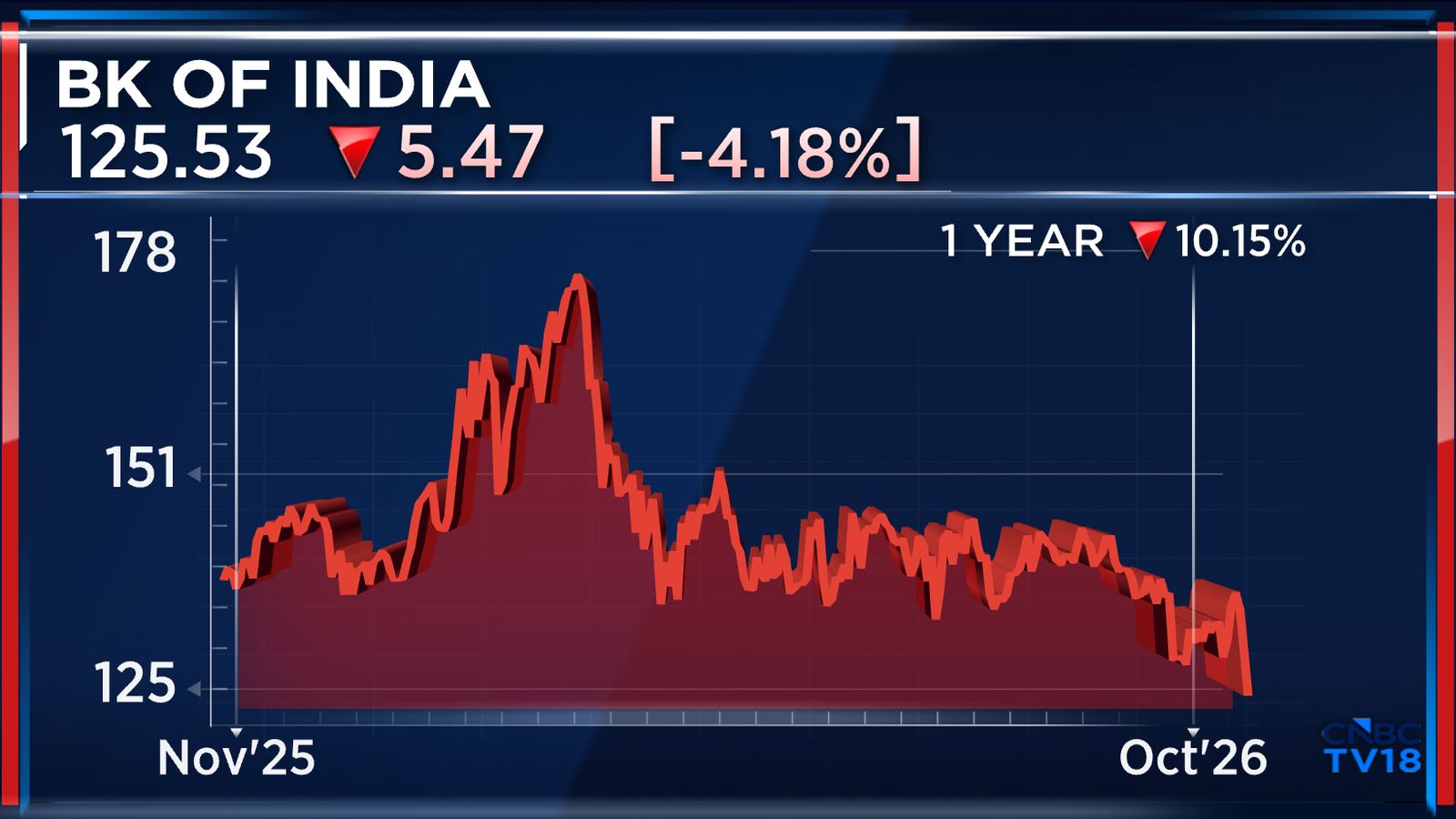
Bank of India shares were trading at ₹125.57 as of 11 am on the NSE. The company, which has a current market capitalisation of ₹57,227.04 crore, has seen its shares decline more than 10% over the last year.
Karnatak said the bank's domestic NIM stands at about 2.75%, while the global NIM is around 2.47%. He expects the lender to gradually improve margins by increasing higher-yielding advances and optimising funding costs.
Apart from margins, the lender also reported strong growth in recoveries from written-off accounts, which helped lift non-interest income. Karnatak said while the current level may not be repeated every year, recoveries are expected to remain on a growth path because of stronger internal recovery mechanisms.
The CEO also downplayed the impact of the draft IRDAI regulations on insurance commissions, estimating the hit to non-interest income at only around ₹50 crore.
He said the bank remains confident of maintaining current SMA levels and does not expect a sharp deterioration in slippages during the December quarter.
On business growth, Karnatak said the revised guidance reflects the impact of FCNR deposits raised during the year and the possibility of further policy tightening. Excluding FCNR deposits, deposit growth remains healthy, he added.
The lender now expects deposit growth of 16-17% and credit growth of 15-16% for the current financial year.
[faq type="interview" title="This is an edited transcript of the interview."][ques][/ques][ans][/ans][/faq][faq type="interview"][ques]I read through your investor call and guidance, but if you could repeat it for us. There was a rate hike on October 7, which is not yet factored in. That will come in the Q3 numbers. The widespread expectation is for at least another 25-basis-point hike in December, maybe even more, maybe even 50 basis points. So, what's your sense? If you can tell us, for every 25-basis-point hike, what is the improvement in margins we can expect?[/ques][ans]So, as far as the margins are concerned with respect to the repo rate hike of 25 basis points, we expect around 10-12 basis points of improvement because of that. This is because 63% of our book is linked to the repo rate, if you see our presentation, and the MCLR book is around 30%. So, an immediate increase has happened by 25 basis points on that 63% book. So, we expect at least a 10-12 basis-point improvement in the NIM because of the 25-basis-point increase in the repo rate. However, there will also be an increase in the cost of deposits. That is why I am saying that the full 25-basis-point improvement in NIM will not be there, but a 10-12-basis-point improvement in NIM will be there. Similarly, if future hikes also take place, then if you see the last five-year trajectory, whenever the repo rate has increased by the RBI, you will always see that when the repo rate increased by around 2.5%, the increase in the weighted average lending rate was 1.9%. So that has been the pass-through that lenders normally do in the market. Similarly, when the repo rate declined by 125 basis points, the fall in the weighted average MCLR lending rate was around 93 basis points.[/ans][/faq][faq type="interview"][ques]This is too much data you're giving me. Can you make it simpler for us? For every 25-basis-point hike, can we say it is about 7 basis points? Since you said 10-12 basis points, are you saying that for every 25-basis-point hike, you get a 10-basis-point increase in your margin?[/ques][ans]In this quarter, we are expecting that there may be a 10-12-basis-point increase in the domestic NIM.[/ans][/faq][faq type="interview"][ques]So, assuming another 25-basis-point hike in December.[/ques][ans]I am not factoring that in because we are not yet clear about that. I am talking only about what happened on October 7.[/ans][/faq][faq type="interview"][ques]There is a clarification I want from your non-interest income numbers. From recovery in written-off accounts, you've shown a very big growth. It is ₹978 crore. Never before has it been so good. Should we take that as the standard going forward — around ₹1,000 crore in recoveries?[/ques][ans]Our non-interest income has grown by around 25%, if you see our presentation, out of which, as you rightly said, there has been a big improvement in the recovery from written-off accounts. So, there are 2-3 lumpy accounts in that. But nonetheless, let me share with you that we have done a lot of internal work as far as the recovery in written-off accounts is concerned. In small accounts of up to ₹1 crore, we have got good recoveries from the entire bank and from our Asset Recovery Branches (ARBs). We are very confident that we will be able to maintain, if not match, the ₹900-crore number, but definitely the growth will be there in the recovery from written-off accounts.[/ans][/faq]
For the full interview, watch the accompanying video
Catch all the latest updates from the stock market here