/images/ppid_59c68470-image-178453252668478922.webp)

/images/ppid_59c68470-image-178444002807275188.webp)
/images/ppid_59c68470-image-178436760860839321.webp)



What is the story about?
Kochi-based private sector lender Federal Bank expects its current account/savings account (CASA) ratio to improve to 35-36% over the next two to three years, supported by higher customer engagement, growth in the micro, small and medium enterprises (MSME) segment and a stronger deposit mix, said Harsh Dugar, Executive Director of the bank.
Dugar also retained a positive outlook on loan growth and said foreign currency non-resident bank (FCNR(B)) deposit inflows are likely to accelerate ahead of the September 30 deadline.
On business growth, Dugar said the lender continues to guide for mid-teen loan growth with a positive bias, while expecting retail deposits to grow at around 11.5-12%.
Dugar said the bank is maintaining its credit cost guidance of 50-60 basis points, with a positive bias towards the lower end, while remaining watchful of developments in West Asia.
He also expects the gold loan portfolio to continue growing, although at a more moderate pace, and said it could account for 15-18% of the overall loan book over time.
These are edited excerpts from the interview.Q: I want to start with CASA. It is down on a quarter-on-quarter basis, but up on a year-on-year basis. Could you talk to us a little bit about where this is headed? Your reliance on current accounts, your reliance on wholesale deposits. Just give us some sense of that, and what is the aspiration here? A: As we've been guiding, CASA is one of the key areas that we have been focusing on to improve our ratio. And if I look at it on a YoY basis, it has actually been up by about 188 basis points; there are many factors that have been contributing towards that. Increasing the products per customer, focusing on the mid markets and the small MSME segment have resulted in that. We continue on that trajectory in terms of improving our CASA ratio over the medium term to about the mid-30s, around 36%.
35%-36% in the medium term is what we are guiding for, with quarter-on-quarter improvement. What you saw in quarter one versus quarter four is a seasonal impact because quarter four typically tends to be a segment that is typically very high, and quarter one and quarter two typically tend to be a little weaker compared to quarter four.
But if I look at it on a year-on-year basis, it has been strong.
And one more thing that doesn't get often commented on is the average CASA. What you saw was the level, but if I look at the averages, the average CASA has been pulling on very strongly, which has actually resulted in our cost of funds going on significantly more and also contributing towards a NIM improvement.
Q: What is medium term?A: Two to three years, 24 to 36 months.
Q: Just talk to us a little bit about the FCNR(B) scheme. How much has come through the Federal Bank channel?A: So, we have launched our scheme. We have launched FCNR Max, and we have offered the leveraged product to our customers. We just recently did that, and we had to tie up our lines to provide leverage to our customers.
While the general feeling was that the FCNR(B) deposits growth would be very high, it has been slower than expectations. But there have been a variety of reasons. One of the main reasons was the tax implications in the US and European markets. Interest income is taxed on a gross basis, which leaves out a small segment, which is largely in West Asia and Singapore.
Second, the West Asia crisis is also weighing on people. That was one of the reasons for the slower growth. Also, compared to 2013, if you look at it, this time around the differential, or the delta, between the US rates and the Indian rates was significantly higher last time around, and hence this time even the leveraged product doesn't give a significantly higher return.
Having said that, it's too early to comment on that, and we still have two and a half months to go. So, I'm reasonably confident that this flow will actually increase substantially as we go forward.
Q: So, when did you launch this, and could you give us some sense of what has happened so far?A: We launched that last quarter itself, and we started offering this to our customers. We've seen traction, but like I told you, this is going to pick up because customers also tend to compare one bank with another. They also want to get advice on the tax implications and be very sure about it.
So, I do see traction coming in. Obviously, September 30 is the cutoff date, so you will see a lot of traction happening towards the end of this month, and in August and September in particular. It will be significantly higher.
And what we are gathering is that our share in the FCNR(B) market is what we will be garnering as well.
Q: What was that share?A: Our share in the FCNR(B) segment in the banking system is about 2.5%. So, 2.5%-3% is what we would be able to garner on the incremental FCNR(B) coming in.
Earlier, the guidance was $60 billion to $80 billion, and now people are talking about $50 billion to $55 billion. So, this is the range in which the market, or the industry, is broadly talking about.
Q: You think you will get to $50 billion to $55 billion?A: That's what the industry is expecting, and I would think so.
Q: And you think the two reasons are tax implications in the US and Europe, and second is the interest rate differential being not as attractive as it was in 2013.
A: And, in addition, there's the overhang from the West Asia. Unfortunately, that is also a segment that has a bearing on flows.
Q: Dollar rates have also moved up recently. They have moved up more, so that makes it even tougher, I imagine. I'm talking about the last two to three weeks.A: The FCNR(B) technically gives a dollar-denominated return, so that should not really impact them. But yes, the markets were expecting a larger inflow earlier on, which did not happen. And after seeing the rupee appreciate after the RBI announcement, it has actually depreciated in the last one week or so.
Q: Loan growth at 15%, deposit growth at 11.4%. What's the outlook for the full year? And are you comfortable with this gap between loan growth and deposit growth?A: Let me give you a colour on that. While we have been guiding loan growth at about mid-teens, we stand by the guidance with a positive bias.
On the deposit side, 11.5%-12% is what it looks like. But our retail deposit growth was at about 14.5%-15%, which was reasonably strong.
The corporate deposit, or wholesale deposit growth, we have consciously kept low for two reasons. First, it comes at a higher pricing, and we want our deposit base to be granular. Second, with the FCNR(B) funds coming in, we do not want to offer a higher rate or a premium to wholesale deposits.
If you look at the granular retail deposit growth, it has been quite strong. Apart from that, within the deposit growth, CASA has been improving on a YoY basis. Our share of CA and SA has moved up by about 60 to 90 basis points on a YoY basis. So that's contributing not just to growth but also to lowering the cost of funds.
Q: Credit cost was at 41 basis points. Your guidance is 50-60 basis points. Is there scope to reduce it?A: We are not changing our guidance at this point in time, but I can say that we have a positive bias. So, we'll probably be at the lower end of our guidance, but we are not guiding for it.
We also need to keep in mind that there could be some impact from the West Asia crisis. We really do not know how this will unfold, if at all, and we are being watchful about it. But at this point in time, our guidance of 50 to 60 basis points holds, with a positive bias toward the lower end.
For the full interview, watch the accompanying videoCatch all the latest updates from the stock market here
Dugar also retained a positive outlook on loan growth and said foreign currency non-resident bank (FCNR(B)) deposit inflows are likely to accelerate ahead of the September 30 deadline.
On business growth, Dugar said the lender continues to guide for mid-teen loan growth with a positive bias, while expecting retail deposits to grow at around 11.5-12%.
Dugar said the bank is maintaining its credit cost guidance of 50-60 basis points, with a positive bias towards the lower end, while remaining watchful of developments in West Asia.
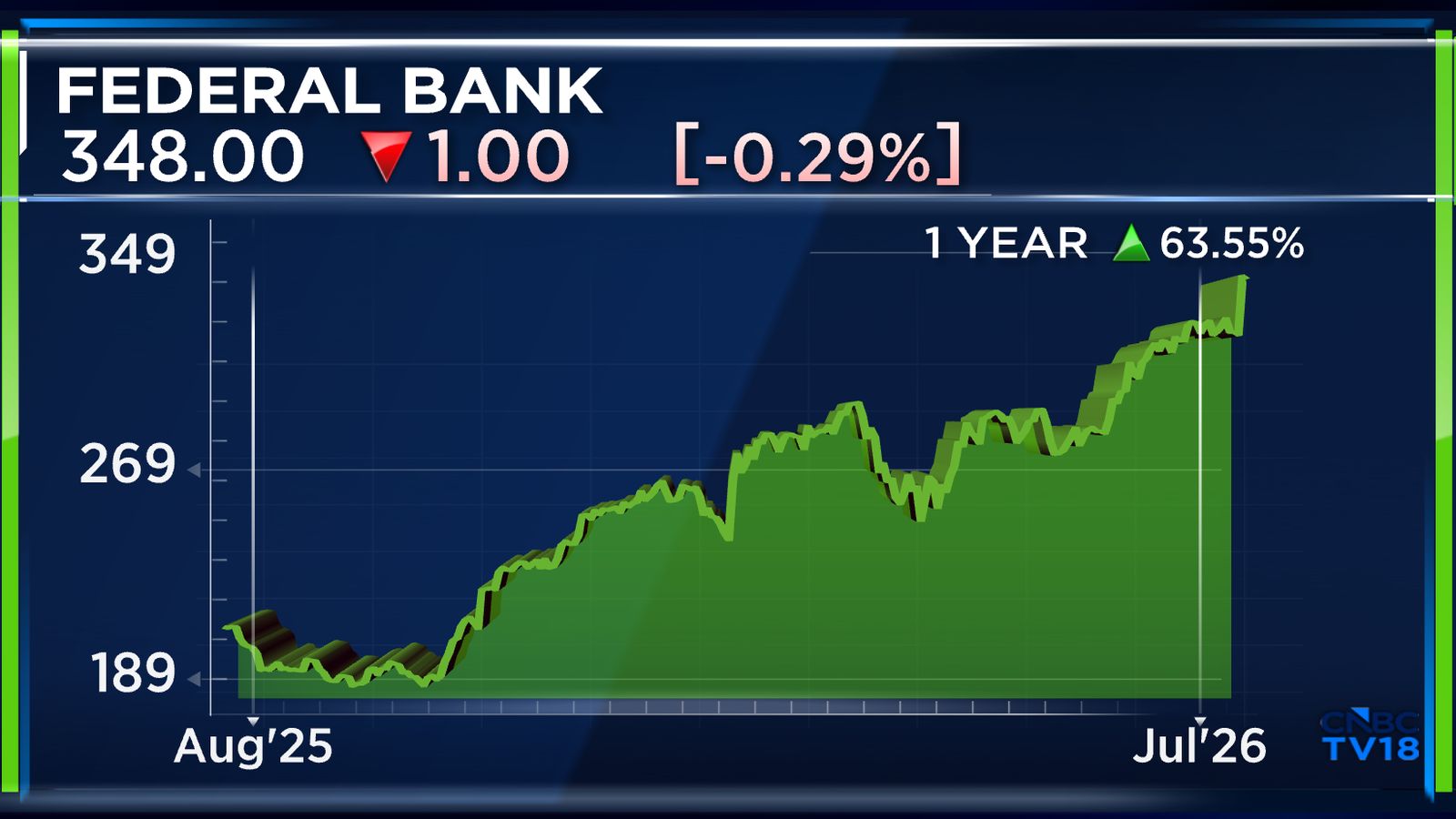
Federal Bank, which has a market capitalisation of ₹85,772.96 crore, has delivered over 63% returns in the last one year.
He also expects the gold loan portfolio to continue growing, although at a more moderate pace, and said it could account for 15-18% of the overall loan book over time.
These are edited excerpts from the interview.Q: I want to start with CASA. It is down on a quarter-on-quarter basis, but up on a year-on-year basis. Could you talk to us a little bit about where this is headed? Your reliance on current accounts, your reliance on wholesale deposits. Just give us some sense of that, and what is the aspiration here? A: As we've been guiding, CASA is one of the key areas that we have been focusing on to improve our ratio. And if I look at it on a YoY basis, it has actually been up by about 188 basis points; there are many factors that have been contributing towards that. Increasing the products per customer, focusing on the mid markets and the small MSME segment have resulted in that. We continue on that trajectory in terms of improving our CASA ratio over the medium term to about the mid-30s, around 36%.
35%-36% in the medium term is what we are guiding for, with quarter-on-quarter improvement. What you saw in quarter one versus quarter four is a seasonal impact because quarter four typically tends to be a segment that is typically very high, and quarter one and quarter two typically tend to be a little weaker compared to quarter four.
But if I look at it on a year-on-year basis, it has been strong.
And one more thing that doesn't get often commented on is the average CASA. What you saw was the level, but if I look at the averages, the average CASA has been pulling on very strongly, which has actually resulted in our cost of funds going on significantly more and also contributing towards a NIM improvement.
Q: What is medium term?A: Two to three years, 24 to 36 months.
Q: Just talk to us a little bit about the FCNR(B) scheme. How much has come through the Federal Bank channel?A: So, we have launched our scheme. We have launched FCNR Max, and we have offered the leveraged product to our customers. We just recently did that, and we had to tie up our lines to provide leverage to our customers.
While the general feeling was that the FCNR(B) deposits growth would be very high, it has been slower than expectations. But there have been a variety of reasons. One of the main reasons was the tax implications in the US and European markets. Interest income is taxed on a gross basis, which leaves out a small segment, which is largely in West Asia and Singapore.
Second, the West Asia crisis is also weighing on people. That was one of the reasons for the slower growth. Also, compared to 2013, if you look at it, this time around the differential, or the delta, between the US rates and the Indian rates was significantly higher last time around, and hence this time even the leveraged product doesn't give a significantly higher return.
Having said that, it's too early to comment on that, and we still have two and a half months to go. So, I'm reasonably confident that this flow will actually increase substantially as we go forward.
Q: So, when did you launch this, and could you give us some sense of what has happened so far?A: We launched that last quarter itself, and we started offering this to our customers. We've seen traction, but like I told you, this is going to pick up because customers also tend to compare one bank with another. They also want to get advice on the tax implications and be very sure about it.
So, I do see traction coming in. Obviously, September 30 is the cutoff date, so you will see a lot of traction happening towards the end of this month, and in August and September in particular. It will be significantly higher.
And what we are gathering is that our share in the FCNR(B) market is what we will be garnering as well.
Q: What was that share?A: Our share in the FCNR(B) segment in the banking system is about 2.5%. So, 2.5%-3% is what we would be able to garner on the incremental FCNR(B) coming in.
Earlier, the guidance was $60 billion to $80 billion, and now people are talking about $50 billion to $55 billion. So, this is the range in which the market, or the industry, is broadly talking about.
Q: You think you will get to $50 billion to $55 billion?A: That's what the industry is expecting, and I would think so.
Q: And you think the two reasons are tax implications in the US and Europe, and second is the interest rate differential being not as attractive as it was in 2013.
A: And, in addition, there's the overhang from the West Asia. Unfortunately, that is also a segment that has a bearing on flows.
Q: Dollar rates have also moved up recently. They have moved up more, so that makes it even tougher, I imagine. I'm talking about the last two to three weeks.A: The FCNR(B) technically gives a dollar-denominated return, so that should not really impact them. But yes, the markets were expecting a larger inflow earlier on, which did not happen. And after seeing the rupee appreciate after the RBI announcement, it has actually depreciated in the last one week or so.
Q: Loan growth at 15%, deposit growth at 11.4%. What's the outlook for the full year? And are you comfortable with this gap between loan growth and deposit growth?A: Let me give you a colour on that. While we have been guiding loan growth at about mid-teens, we stand by the guidance with a positive bias.
On the deposit side, 11.5%-12% is what it looks like. But our retail deposit growth was at about 14.5%-15%, which was reasonably strong.
The corporate deposit, or wholesale deposit growth, we have consciously kept low for two reasons. First, it comes at a higher pricing, and we want our deposit base to be granular. Second, with the FCNR(B) funds coming in, we do not want to offer a higher rate or a premium to wholesale deposits.
If you look at the granular retail deposit growth, it has been quite strong. Apart from that, within the deposit growth, CASA has been improving on a YoY basis. Our share of CA and SA has moved up by about 60 to 90 basis points on a YoY basis. So that's contributing not just to growth but also to lowering the cost of funds.
Q: Credit cost was at 41 basis points. Your guidance is 50-60 basis points. Is there scope to reduce it?A: We are not changing our guidance at this point in time, but I can say that we have a positive bias. So, we'll probably be at the lower end of our guidance, but we are not guiding for it.
We also need to keep in mind that there could be some impact from the West Asia crisis. We really do not know how this will unfold, if at all, and we are being watchful about it. But at this point in time, our guidance of 50 to 60 basis points holds, with a positive bias toward the lower end.
For the full interview, watch the accompanying videoCatch all the latest updates from the stock market here


/images/ppid_59c68470-image-178451755711968935.webp)
/images/ppid_59c68470-image-178446004159525278.webp)



/images/ppid_59c68470-image-178430002196324636.webp)