/images/ppid_59c68470-image-178128256699043409.webp)





What is the story about?
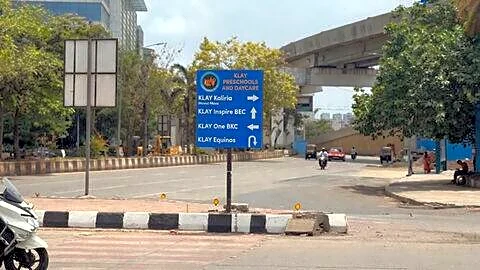
Mumbai's ambitious push towards sustainable commuting got off to a mixed start on Friday as the Mumbai Metropolitan Region Development Authority's (MMRDA) 'No Car Friday' initiative in the Bandra Kurla Complex (BKC) witnessed a lukewarm response from commuters, despite officials claiming a noticeable reduction in traffic.
The initiative, launched to encourage the use of public transport and reduce vehicular congestion in one of Mumbai's busiest business districts, urged office-goers and visitors to avoid using private vehicles on Fridays and instead opt for public transport.
MMRDA Commissioner Sanjay Mukherjee said the authority observed a significant decline in traffic volumes during the morning peak hours on the first day of the campaign.
"Today, in the morning, the load was 30% of the traffic that is normally there during office hours in the morning. So that's what I felt. I may be right, I may be wrong, because I didn't note the figures, but that is what it appeared to me visually. So I think the response has been pretty encouraging," Mukherjee said.
While acknowledging that participation could improve further, he described the initial response as encouraging for the first day of the initiative.
However, the situation on the ground painted a somewhat different picture, with several commuters continuing to rely on private vehicles. One of the key factors cited was the challenge of last-mile connectivity between public transport hubs and office locations within BKC.
Addressing concerns around walking distances from metro stations and other public transport points, Mukherjee suggested that perceptions of convenience vary among commuters.
"If a half-kilometre or one-kilometre walk is a big problem for someone, or a three-minute walk is a big problem for someone, it may not be a problem for others," he said.
Commuters also pointed to Mumbai's harsh weather conditions as a deterrent. High temperatures, humidity and the prospect of long walks in exposed areas reduced the attractiveness of public transport for some office-goers, particularly during peak hours.
The experience of the first No Car Friday underscores a broader challenge facing urban mobility initiatives across Indian cities: encouraging behavioural change while ensuring seamless last-mile connectivity.
Also Read | Mumbai's BKC starts no-car Fridays: All you need to know
Despite the subdued turnout, MMRDA remains optimistic that participation will improve over time as commuters become more familiar with the initiative and supporting infrastructure continues to evolve.
The authority believes that as more people adopt public transport regularly, the campaign could contribute to easing congestion, reducing emissions and promoting sustainable mobility in Mumbai's premier business district.
The initiative, launched to encourage the use of public transport and reduce vehicular congestion in one of Mumbai's busiest business districts, urged office-goers and visitors to avoid using private vehicles on Fridays and instead opt for public transport.
MMRDA Commissioner Sanjay Mukherjee said the authority observed a significant decline in traffic volumes during the morning peak hours on the first day of the campaign.
"Today, in the morning, the load was 30% of the traffic that is normally there during office hours in the morning. So that's what I felt. I may be right, I may be wrong, because I didn't note the figures, but that is what it appeared to me visually. So I think the response has been pretty encouraging," Mukherjee said.
While acknowledging that participation could improve further, he described the initial response as encouraging for the first day of the initiative.
However, the situation on the ground painted a somewhat different picture, with several commuters continuing to rely on private vehicles. One of the key factors cited was the challenge of last-mile connectivity between public transport hubs and office locations within BKC.
Addressing concerns around walking distances from metro stations and other public transport points, Mukherjee suggested that perceptions of convenience vary among commuters.
"If a half-kilometre or one-kilometre walk is a big problem for someone, or a three-minute walk is a big problem for someone, it may not be a problem for others," he said.
Commuters also pointed to Mumbai's harsh weather conditions as a deterrent. High temperatures, humidity and the prospect of long walks in exposed areas reduced the attractiveness of public transport for some office-goers, particularly during peak hours.
The experience of the first No Car Friday underscores a broader challenge facing urban mobility initiatives across Indian cities: encouraging behavioural change while ensuring seamless last-mile connectivity.
Also Read | Mumbai's BKC starts no-car Fridays: All you need to know
Despite the subdued turnout, MMRDA remains optimistic that participation will improve over time as commuters become more familiar with the initiative and supporting infrastructure continues to evolve.
The authority believes that as more people adopt public transport regularly, the campaign could contribute to easing congestion, reducing emissions and promoting sustainable mobility in Mumbai's premier business district.





/images/ppid_59c68470-image-178124505979711190.webp)