/images/ppid_59c68470-image-178073756465312579.webp)




What is the story about?
Rajesh Ganesh, MD & CEO of Bajel Projects, expects revenue and EBITDA to continue growing in 2026-27 (FY27) despite challenges from commodity volatility and geopolitical uncertainty.
He said the company remains focused on its "Rasta 2030" strategy, with execution at the centre of its growth plans after delivering a record 17 projects in the previous financial year.
Ganesh also expects capacity expansion at the company's Ranjangaon facility to support future growth. The project, which will increase manufacturing capacity for transmission towers and monopoles, is progressing in phases, with most of the planned capital expenditure expected to be incurred during the current financial year.
In the January-March quarter of 2026 (Q4FY26), Bajel Projects reported a 26% year-on-year (YoY) increase in revenue to ₹995.3 crore. Earnings before interest, taxes, depreciation, and amortisation (EBITDA) rose 51.2% to ₹31.3 crore, while EBITDA margin improved to 3.1% from 2.6% a year earlier. Profit after tax (PAT) nearly tripled to ₹14.1 crore from ₹4.8 crore in the corresponding quarter last year.
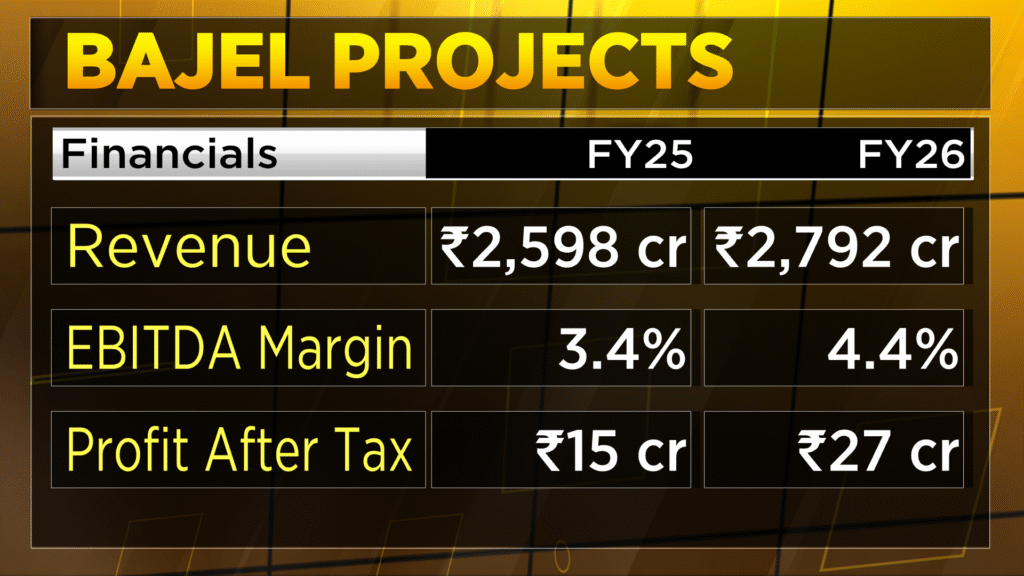
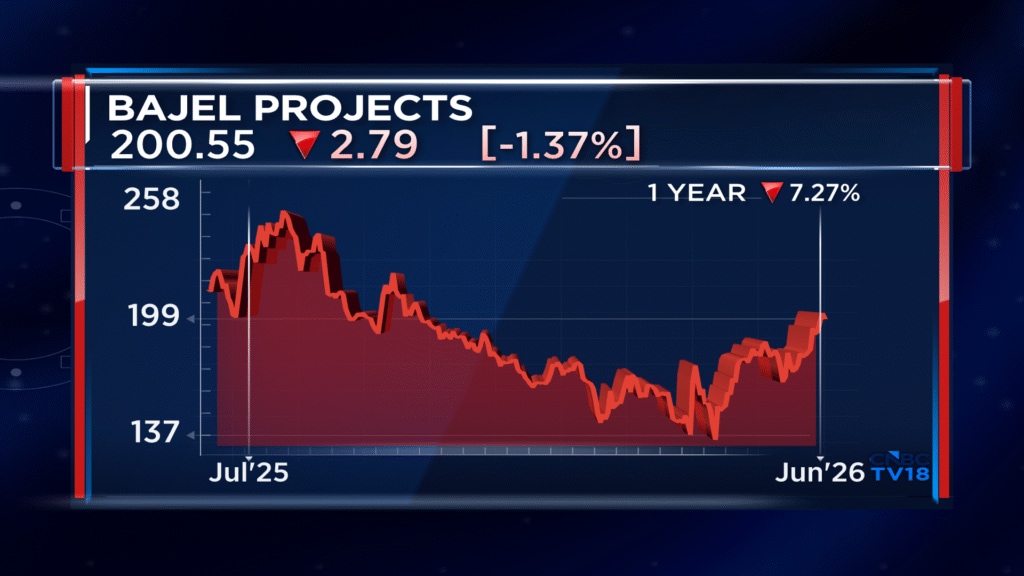
Bajel Projects shares have declined nearly 8% over the past year, giving the Mumbai-based power transmission and infrastructure company a market capitalisation of about ₹2,325 crore.
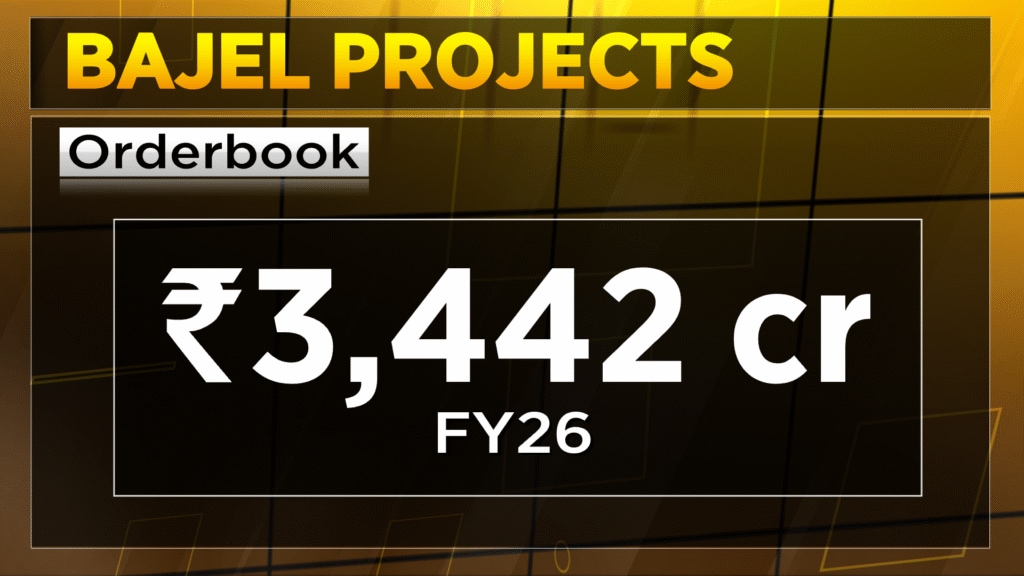
This is an edited transcript of the interview.Q: Going into FY27 with the order book you have in hand, can you give us guidance on revenue growth and EBITDA margins, especially given supply-chain volatility and profitability concerns?
A: The numbers are trending in the right direction for us. As I have said several times in the past, we are working on a strategy called "Rasta 2030". As part of that strategy, we are focused not only on improving the top line but also on delivering a profitable bottom line.
There were several challenges last year, and some of those continue this year as well. Developments in West Asia, their impact on oil prices and the resulting pressure on commodities remain significant challenges.
Also Watch | Power and defence stocks still have long-term growth runway: PL Capital
Despite that, our focus has been on execution. That is really where we would like to differentiate ourselves. We executed 17 projects last year, which was a record for us, and we hope to continue that trend this year as well.
We expect to see revenue growth and improvement in EBITDA, PBT and PAT margins. It is difficult to quantify numbers this early in the year, especially given the uncertainties around us, but that remains the direction of travel.
Q: How much contribution will come from export markets? What is the domestic-versus-export split in the order book, and is there a margin difference between the two geographies?
A: Fortunately, we are not heavily exposed to international markets at this stage. We have only recently started our international journey compared with some of our peers who are much more established overseas.
We have announced a joint venture in Saudi Arabia and won a 500 kV transmission-line order in Egypt. However, neither project has started yet, and we are proceeding cautiously given the geopolitical and macroeconomic environment.
As of now, the vast majority of our order book remains domestic.
Q: Do your projects have price-escalation clauses, or are they fixed-price contracts? Could rising commodity prices lead to a temporary margin hit?
A: The majority of our contracts are fixed-price contracts.
For aluminium, we are fairly well hedged, although there is still some exposure. Steel and zinc are the areas where we remain exposed.
Also Watch | Transrail Lighting sees strong order inflows as power infra demand stays robust
We will need to find ways to take costs out of the system to offset any increase in commodity prices. It is still early in the year, and for now, we believe a wait-and-watch approach is appropriate. We should be able to manage through these challenges.
Watch the full conversation hereQ: Can you give us a sense of the capex planned for the Ranjangaon plant and how it will be funded? Are there any other capex projects in the pipeline?
A: Yes, the expansion is at our Ranjangaon facility near Pune.
We are increasing our capacity to manufacture transmission towers and monopoles. The project is being executed in three phases.
The first phase involves installing a galvanising bath, where towers and poles are dipped in zinc. That facility should be ready by August. After that, work on the tower manufacturing facility will begin.
Also Watch | Dipan Mehta sees long-term opportunity in PG Electroplast, Kitex and power plays
Around 60–70% of the planned capex is expected to be spent during this financial year, with the balance carrying over into the next year.
Catch all the latest updates from the stock market here
He said the company remains focused on its "Rasta 2030" strategy, with execution at the centre of its growth plans after delivering a record 17 projects in the previous financial year.
Ganesh also expects capacity expansion at the company's Ranjangaon facility to support future growth. The project, which will increase manufacturing capacity for transmission towers and monopoles, is progressing in phases, with most of the planned capital expenditure expected to be incurred during the current financial year.
In the January-March quarter of 2026 (Q4FY26), Bajel Projects reported a 26% year-on-year (YoY) increase in revenue to ₹995.3 crore. Earnings before interest, taxes, depreciation, and amortisation (EBITDA) rose 51.2% to ₹31.3 crore, while EBITDA margin improved to 3.1% from 2.6% a year earlier. Profit after tax (PAT) nearly tripled to ₹14.1 crore from ₹4.8 crore in the corresponding quarter last year.
Bajel Projects shares have declined nearly 8% over the past year, giving the Mumbai-based power transmission and infrastructure company a market capitalisation of about ₹2,325 crore.
This is an edited transcript of the interview.Q: Going into FY27 with the order book you have in hand, can you give us guidance on revenue growth and EBITDA margins, especially given supply-chain volatility and profitability concerns?
A: The numbers are trending in the right direction for us. As I have said several times in the past, we are working on a strategy called "Rasta 2030". As part of that strategy, we are focused not only on improving the top line but also on delivering a profitable bottom line.
There were several challenges last year, and some of those continue this year as well. Developments in West Asia, their impact on oil prices and the resulting pressure on commodities remain significant challenges.
Also Watch | Power and defence stocks still have long-term growth runway: PL Capital
Despite that, our focus has been on execution. That is really where we would like to differentiate ourselves. We executed 17 projects last year, which was a record for us, and we hope to continue that trend this year as well.
We expect to see revenue growth and improvement in EBITDA, PBT and PAT margins. It is difficult to quantify numbers this early in the year, especially given the uncertainties around us, but that remains the direction of travel.
Q: How much contribution will come from export markets? What is the domestic-versus-export split in the order book, and is there a margin difference between the two geographies?
A: Fortunately, we are not heavily exposed to international markets at this stage. We have only recently started our international journey compared with some of our peers who are much more established overseas.
We have announced a joint venture in Saudi Arabia and won a 500 kV transmission-line order in Egypt. However, neither project has started yet, and we are proceeding cautiously given the geopolitical and macroeconomic environment.
As of now, the vast majority of our order book remains domestic.
Q: Do your projects have price-escalation clauses, or are they fixed-price contracts? Could rising commodity prices lead to a temporary margin hit?
A: The majority of our contracts are fixed-price contracts.
For aluminium, we are fairly well hedged, although there is still some exposure. Steel and zinc are the areas where we remain exposed.
Also Watch | Transrail Lighting sees strong order inflows as power infra demand stays robust
We will need to find ways to take costs out of the system to offset any increase in commodity prices. It is still early in the year, and for now, we believe a wait-and-watch approach is appropriate. We should be able to manage through these challenges.
Watch the full conversation hereQ: Can you give us a sense of the capex planned for the Ranjangaon plant and how it will be funded? Are there any other capex projects in the pipeline?
A: Yes, the expansion is at our Ranjangaon facility near Pune.
We are increasing our capacity to manufacture transmission towers and monopoles. The project is being executed in three phases.
The first phase involves installing a galvanising bath, where towers and poles are dipped in zinc. That facility should be ready by August. After that, work on the tower manufacturing facility will begin.
Also Watch | Dipan Mehta sees long-term opportunity in PG Electroplast, Kitex and power plays
Around 60–70% of the planned capex is expected to be spent during this financial year, with the balance carrying over into the next year.
Catch all the latest updates from the stock market here




/images/ppid_59c68470-image-178089756597256635.webp)
/images/ppid_59c68470-image-17808850285391185.webp)