/images/ppid_59c68470-image-17847150993348698.webp)

/images/ppid_59c68470-image-178470252392671022.webp)

What is the story about?
JSW Energy reported a weaker bottom line for the June quarter as profit declined sharply from a year earlier, even as revenue and operating performance remained resilient. The company also continued to strengthen its growth pipeline through renewable capacity additions, strategic acquisitions and fresh capital raising, signalling confidence in its long-term expansion plans.
The company posted a 36.6% year-on-year decline in reported net profit to ₹471 crore for the quarter ended June, compared with ₹743.1 crore in the corresponding period last year. Revenue from operations rose 1.2% to ₹5,207.1 crore, while EBITDA increased 3% to ₹2,873.2 crore. EBITDA margin improved to 55.18% from 54.22% a year earlier.
Following the results, shares of JSW Energy fell to an intraday low of ₹557.60, down 1.52% on the NSE.
Generation moderates as renewable business gathers pace
Electricity generation during the quarter stood at 12.9 billion units (BU), down 5% year-on-year, although it improved 10% sequentially. Renewable generation continued to remain the standout performer, rising 11% to 3.4 BU on the back of higher solar and wind output, while thermal generation declined 6% to 8 BU.
Power supplied under long-term power purchase agreements (PPAs) slipped 4% year-on-year to 11.2 BU, while short-term PPA generation fell 7% to 1.6 BU.
Despite softer generation, the company said India witnessed robust electricity demand during the quarter, with nationwide consumption rising 8.5% year-on-year to 483 BU amid an extended heatwave and delayed monsoon. Peak power demand touched a record 271 GW in May before remaining elevated at 265 GW in June.
Expansion gathers momentum
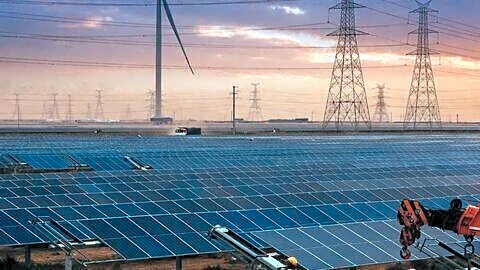
JSW Energy said it has already achieved more than one-third of its planned capacity addition target for FY27. Renewable capacity increased by 1,081 MW through additions across solar, wind, hybrid and hydro projects, taking the company's total installed capacity to 14,535 MW.
Among the key milestones during the quarter, the company fully commissioned the 150 MW Tidong hydro project ahead of schedule, operationalised its Halol wind blade manufacturing facility to strengthen backward integration, and signed a definitive agreement to acquire the 300 MW Maruti Thermal Plant.
The company also secured its first major third-party battery storage order for a 200 MW/400 MWh project, expanding its presence in the fast-growing energy storage segment.
Balance sheet strengthened to fund growth
JSW Energy undertook several capital market initiatives during the quarter to support its ambitious expansion plans. It raised ₹4,000 crore through a qualified institutional placement (QIP) and monetised part of its holding in JSW Steel, generating gross proceeds of ₹3,150 crore to improve liquidity.
Also Read: Adani Power Q1 Results: Higher power sales lift profit by 42%; board approves ₹15,000 crore QIP
The company also announced a ₹3,000 crore preferential allotment to promoters, of which ₹1,125 crore has already been received. Cash and cash equivalents stood at ₹12,881 crore at the end of the quarter, providing a sizeable liquidity cushion to fund its planned capital expenditure through FY30.
Management added that improving operational leverage, a stronger balance sheet and continued investments across renewable energy, storage and manufacturing position the company well to capitalise on India's growing power demand over the coming years.
The company posted a 36.6% year-on-year decline in reported net profit to ₹471 crore for the quarter ended June, compared with ₹743.1 crore in the corresponding period last year. Revenue from operations rose 1.2% to ₹5,207.1 crore, while EBITDA increased 3% to ₹2,873.2 crore. EBITDA margin improved to 55.18% from 54.22% a year earlier.
Following the results, shares of JSW Energy fell to an intraday low of ₹557.60, down 1.52% on the NSE.
Generation moderates as renewable business gathers pace
Electricity generation during the quarter stood at 12.9 billion units (BU), down 5% year-on-year, although it improved 10% sequentially. Renewable generation continued to remain the standout performer, rising 11% to 3.4 BU on the back of higher solar and wind output, while thermal generation declined 6% to 8 BU.
Power supplied under long-term power purchase agreements (PPAs) slipped 4% year-on-year to 11.2 BU, while short-term PPA generation fell 7% to 1.6 BU.
Despite softer generation, the company said India witnessed robust electricity demand during the quarter, with nationwide consumption rising 8.5% year-on-year to 483 BU amid an extended heatwave and delayed monsoon. Peak power demand touched a record 271 GW in May before remaining elevated at 265 GW in June.
Expansion gathers momentum
JSW Energy said it has already achieved more than one-third of its planned capacity addition target for FY27. Renewable capacity increased by 1,081 MW through additions across solar, wind, hybrid and hydro projects, taking the company's total installed capacity to 14,535 MW.
Among the key milestones during the quarter, the company fully commissioned the 150 MW Tidong hydro project ahead of schedule, operationalised its Halol wind blade manufacturing facility to strengthen backward integration, and signed a definitive agreement to acquire the 300 MW Maruti Thermal Plant.
The company also secured its first major third-party battery storage order for a 200 MW/400 MWh project, expanding its presence in the fast-growing energy storage segment.
Balance sheet strengthened to fund growth
JSW Energy undertook several capital market initiatives during the quarter to support its ambitious expansion plans. It raised ₹4,000 crore through a qualified institutional placement (QIP) and monetised part of its holding in JSW Steel, generating gross proceeds of ₹3,150 crore to improve liquidity.
Also Read: Adani Power Q1 Results: Higher power sales lift profit by 42%; board approves ₹15,000 crore QIP
The company also announced a ₹3,000 crore preferential allotment to promoters, of which ₹1,125 crore has already been received. Cash and cash equivalents stood at ₹12,881 crore at the end of the quarter, providing a sizeable liquidity cushion to fund its planned capital expenditure through FY30.
Management added that improving operational leverage, a stronger balance sheet and continued investments across renewable energy, storage and manufacturing position the company well to capitalise on India's growing power demand over the coming years.
/images/ppid_59c68470-image-178471255945836649.webp)
/images/ppid_59c68470-image-178456508229844048.webp)
/images/ppid_59c68470-image-178471002184321673.webp)


/images/ppid_59c68470-image-178454755954034822.webp)
/images/ppid_59c68470-image-178469502597052050.webp)
/images/ppid_59c68470-image-178454257133782031.webp)
/images/ppid_59c68470-image-178453752787869167.webp)