/images/ppid_59c68470-image-178539753881784481.webp)

/images/ppid_59c68470-image-178534512879928476.webp)
/images/ppid_59c68470-image-178533255983978474.webp)
/images/ppid_59c68470-image-178532002520951614.webp)
What is the story about?
Vinati Saraf Mutreja, Managing Director of Mumbai-based speciality chemicals manufacturer Vinati Organics, said the company expects at least 15% revenue growth in the financial year 2026-27 (FY27), supported by capacity expansion, improving demand and higher utilisation of new facilities.
The company also expects its return on capital employed (ROCE) to improve as recently commissioned capacities ramp up over the next two to three years.
The company reported a 28% increase in revenue in the April-June 2026 quarter, while earnings before interest, taxes, depreciation, and amortisation (EBITDA) rose 7% and net profit increased 4.5%, as higher raw material costs and currency movements weighed on margins.
Mutreja said the revenue growth during the quarter was driven by multiple factors, including the depreciation of the rupee, which benefited exports that account for 55% of total revenue, along with price hikes and higher volumes in antioxidants and other new products.
She explained that raw material prices increased sharply following the West Asia conflict, limiting the company's ability to expand margins despite higher sales. "The EBITDA margin did not grow by as much because most of it was just rupee depreciation as well as raw material cost increasing," she said.
Despite these headwinds, the company reiterated its profitability guidance. "I think that we should be able to maintain... around 26% EBITDA margin," Mutreja said, adding that the guidance reflects contributions from the company's entire product portfolio, including 2-acrylamido 2-methylapropane sulphonic acid (ATBS), antioxidants, butyl phenols, IBB and other derivatives.
Vinati Organics expects the second half of 2026-27 to outperform the first as higher ATBS demand, contributions from Viral Organics and new product launches support revenue growth, while the speciality chemicals maker remains on track to maintain its EBITDA margin guidance of 26-27%.
Vinati Organics has expanded its ATBS capacity from 30,000 tonne to 50,000 tonne and expects demand recovery to begin from October. Meanwhile, the Veeral Organics facility is undergoing re-engineering, which is expected to be completed by December, with revenue contributions beginning in January.
Mutreja said the Veeral Organics business could generate around ₹500 crore annually at 70-80% capacity utilisation. For 2027-28 (FY28), she expects approximately ₹150 crore in revenue from the business.
Addressing concerns around anisole, a key raw material for new products, she said the company will continue to follow a flexible sourcing strategy. If importing anisole is cheaper than manufacturing it internally, the company will import it instead. She added that the decision would not materially impact revenue or EBITDA growth.
Mutreja said Vinati Organics currently generates a ROCE of 15-16%, which could improve to around 20% over the next two to three years as utilisation of existing capacities increases. The company is also investing in downstream products, including butyl phenols, monomethyl ether of hydroquinone (MEHQ), 4-methoxy acetophenone, isoamylene-based derivatives and additional antioxidant products.
She added that the antioxidants business has seen better market conditions over the past three months, with improving realisations, and expects the additives business itself to deliver 15-20% ROCE as utilisation improves.
For the full interview, watch the accompanying videoCatch all the latest updates from the stock market here
The company also expects its return on capital employed (ROCE) to improve as recently commissioned capacities ramp up over the next two to three years.
The company reported a 28% increase in revenue in the April-June 2026 quarter, while earnings before interest, taxes, depreciation, and amortisation (EBITDA) rose 7% and net profit increased 4.5%, as higher raw material costs and currency movements weighed on margins.
Mutreja said the revenue growth during the quarter was driven by multiple factors, including the depreciation of the rupee, which benefited exports that account for 55% of total revenue, along with price hikes and higher volumes in antioxidants and other new products.
She explained that raw material prices increased sharply following the West Asia conflict, limiting the company's ability to expand margins despite higher sales. "The EBITDA margin did not grow by as much because most of it was just rupee depreciation as well as raw material cost increasing," she said.
Despite these headwinds, the company reiterated its profitability guidance. "I think that we should be able to maintain... around 26% EBITDA margin," Mutreja said, adding that the guidance reflects contributions from the company's entire product portfolio, including 2-acrylamido 2-methylapropane sulphonic acid (ATBS), antioxidants, butyl phenols, IBB and other derivatives.
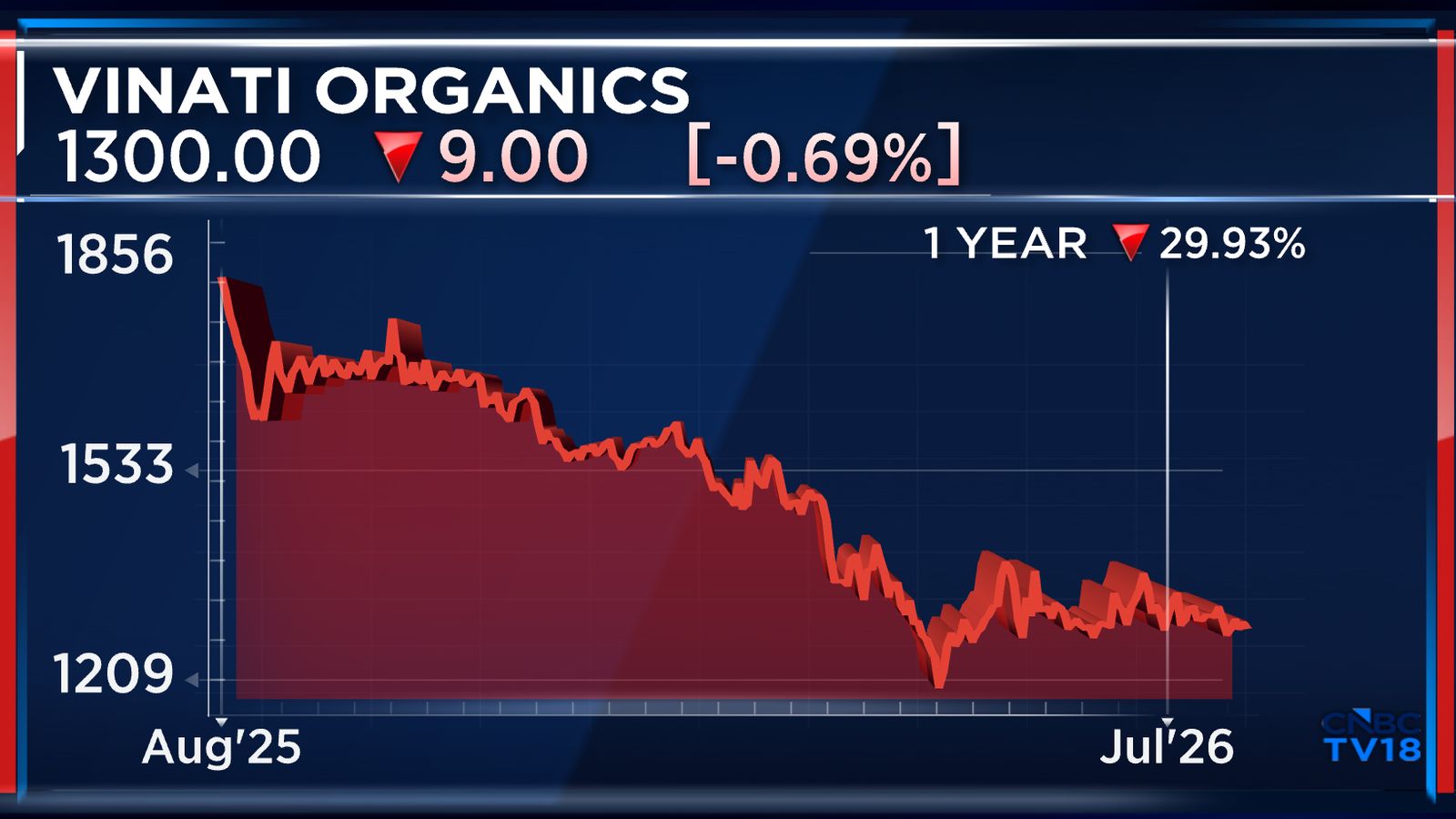
Vinati Organics, which has a market capitalisation of ₹13,461.50 crore, has seen its shares decline more than 29% over the past year.
Vinati Organics expects the second half of 2026-27 to outperform the first as higher ATBS demand, contributions from Viral Organics and new product launches support revenue growth, while the speciality chemicals maker remains on track to maintain its EBITDA margin guidance of 26-27%.
Vinati Organics has expanded its ATBS capacity from 30,000 tonne to 50,000 tonne and expects demand recovery to begin from October. Meanwhile, the Veeral Organics facility is undergoing re-engineering, which is expected to be completed by December, with revenue contributions beginning in January.
Mutreja said the Veeral Organics business could generate around ₹500 crore annually at 70-80% capacity utilisation. For 2027-28 (FY28), she expects approximately ₹150 crore in revenue from the business.
Addressing concerns around anisole, a key raw material for new products, she said the company will continue to follow a flexible sourcing strategy. If importing anisole is cheaper than manufacturing it internally, the company will import it instead. She added that the decision would not materially impact revenue or EBITDA growth.
Mutreja said Vinati Organics currently generates a ROCE of 15-16%, which could improve to around 20% over the next two to three years as utilisation of existing capacities increases. The company is also investing in downstream products, including butyl phenols, monomethyl ether of hydroquinone (MEHQ), 4-methoxy acetophenone, isoamylene-based derivatives and additional antioxidant products.
She added that the antioxidants business has seen better market conditions over the past three months, with improving realisations, and expects the additives business itself to deliver 15-20% ROCE as utilisation improves.
For the full interview, watch the accompanying videoCatch all the latest updates from the stock market here
/images/ppid_59c68470-image-178548752822211593.webp)
/images/ppid_59c68470-image-178550255793893957.webp)
/images/ppid_59c68470-image-178541752573129572.webp)
/images/ppid_59c68470-image-178540755508946985.webp)
/images/ppid_59c68470-image-178540252327625312.webp)




/images/ppid_59c68470-image-178534764914419765.webp)