/images/ppid_59c68470-image-177876007237095289.webp)


What is the story about?
Amit Agarwal, ED & Group CFO of a diversified Indian conglomerate operating in agribusiness, chemicals, and value-added sectors, DCM Shriram, said that its diversified chemicals business may help reduce the impact of volatility linked to West Asia.
Speaking after the company’s January-March 2026 quarter earnings for FY26, Agarwal said sugar exports remain a small part of the business and are unlikely to materially affect operations, adding that lower cane availability had affected production in the current year.
Agarwal said rising energy prices have increased production costs by around 9-10% in the chemicals business, though pricing support has partly offset the impact. He added that DCM Shriram’s investments in downstream chemicals and multiple revenue streams are helping the business manage volatility.
He also outlined fresh investments across renewable energy, chlorine downstream operations, aluminium extrusion and polymer compounding. Agarwal said DCM Shriram has a current investment pipeline of ₹1,000-1,500 crore.
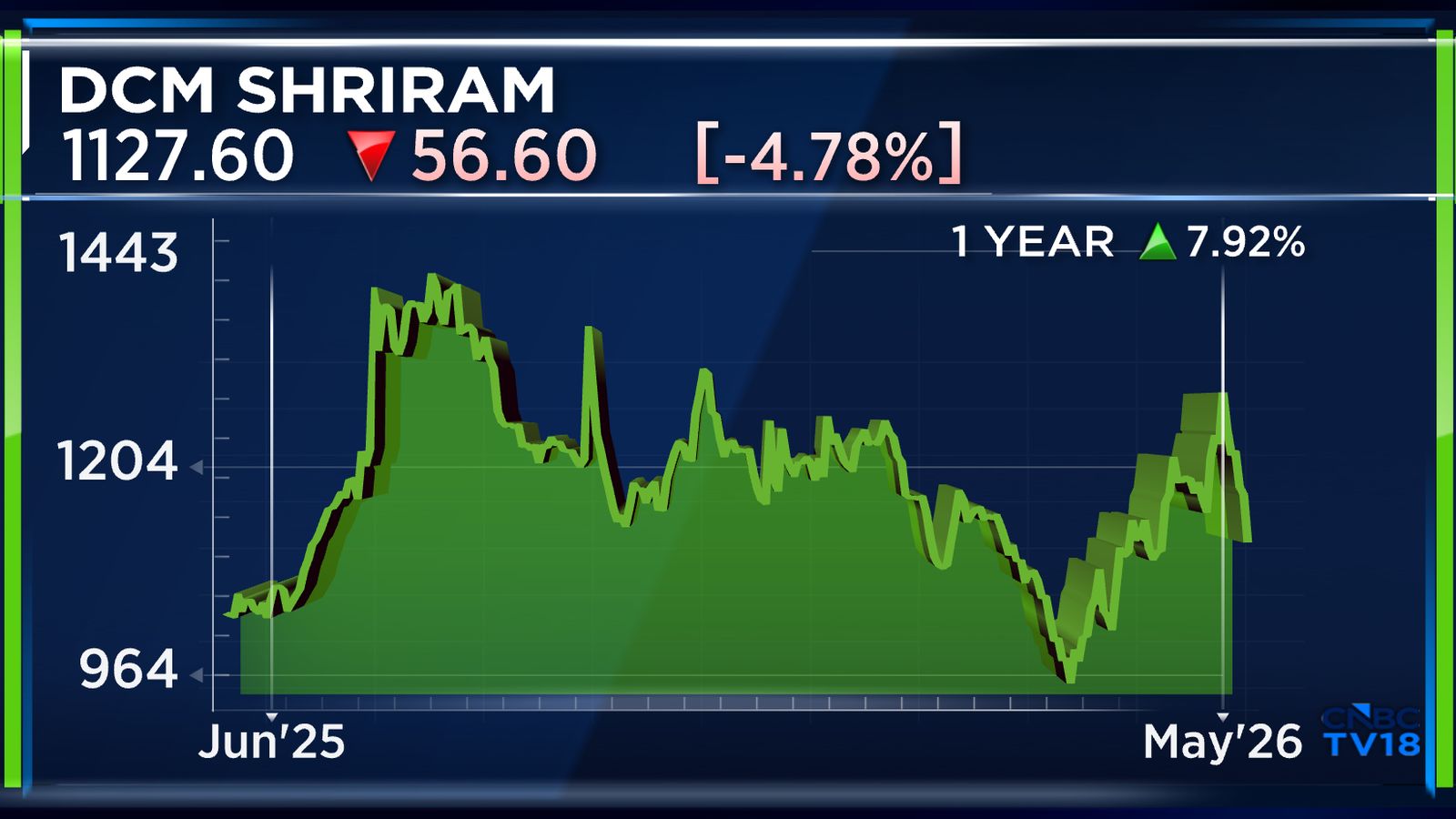
The company has a market capitalisation of ₹17,637.07 crore, and its shares have gained more than 7% over the last year.
This is an edited transcript of the interview.Q: The first question, of course, is the latest overnight development that we witnessed with regard to the ban on exports of sugar. Although sugar exports are a very small part of your business, what sort of impact do you see, and are you expecting any further government intervention with regard to this?
A: Sugar exports are a very small part of our business. The government had allowed about 2 million tonne of exports, and only about 0.8 million tonne got exported, and that was because the export prices were much lower than the domestic prices. So fundamentally, I don't see any significant impact. Also, the demand and supply in the current season are almost matching, and we are sitting at a very low inventory of about 4-4.5 million tonne. I think it's coming because of that. So, I don't think there will be any significant impact, either on prices or otherwise. It's more of a sentimental value.
Q: On to business, then. There has been this forecast of El Niño this time around, of a tepid or subpar monsoon. And this comes after we have had five to six consecutive years of very good rains for the country during the monsoons. How do you see this impacting production this time around with regard to this?
A: Currently, it's the beginning of the season. I would say the season hasn't even begun for a lot of our agri businesses. So, we will have to see how it pans out. Yes, if it is a severe El Nino, subpar, then there will be an impact on businesses. We'll have to see how the agrarian economy goes on that basis. It is too early to comment.
For the full interview, watch the accompanying videoQ: What kind of margin and volume growth should we expect, especially in the sugar segment? And if you could clarify for us, your sugar export contribution is about 3% of revenues, or has it come down more?
A: Sugar exports are insignificant in terms of our total volumes.
Q: If you could give us an outlook on margin and volumes.
A: In sugar, I would say next year we do expect the volumes to be a little better in terms of production, because in the current year we've seen the total volumes of production coming down, given that the overall cane availability was lower. So, we are working towards improving the cane availability. However, it's a function of climate, varietal balance, crop economics, and a lot of factors. And it's not something where overnight volumes come down and they go up the very next year. But we do expect some improvement in volumes next year.
Also Read | Vinati Organics targets 15% volume growth in FY27 on demand recovery
Q: I also wanted to get a sense of your outlook for the chemicals business. Last time we spoke, you also flagged that what's happening in West Asia could impact the business there, chemical prices and demand. After that, are you already seeing some disruption in export orders there, or what's really happening on the ground?
A: Our chemical business is largely domestic. However, it is exposed to what happens globally as well. Currently, the impact is not very significant till the month of May. What we're seeing is that because energy prices have gone up, about 9% to 10% of the cost of production has gone up, but then that is being supported by prices. However, the situation is very volatile. Yes, there is an impact, as I said, on energy prices. There is an impact on chlorine consumption because the chlorine consumers have a problem in their feedstock, and therefore, they may buy less chlorine going forward. So, there are challenges. It's something which one has to see every day, how it pans out, because the war is changing almost every day.
Q: Since you have mentioned for the caustic soda segment, at least the volume growth has been healthy. But this time around, do you expect that trend to continue? And for your overall business, which segment are you expecting the growth to be led from?
A: On chemicals, I would like to point out that about two years back, almost 100% of my revenue was coming from the caustic soda business - that revenue stream. In Q4, 66% came from that business or that revenue stream. So, the investments that we have done over the last three to four years, which got commissioned in the last one to two years, are adding significantly to the revenue, and they will strengthen the business and the value chain that we are capturing.
If you also see our numbers for the full year as a whole, our revenues in chemicals went up by about 38% and earnings went up by about 50%. So, even if there's a West Asia crisis, because we have multiple revenue streams and we are capturing the value chain, some part of the impact would be hedged because of the strategy that we have had for this business.
Also Read | Borosil Renewables sees modest FY27 growth before new capacity kicks in
Q: If you could leave us with what's the latest on that MoU you had signed with Bio India? What sort of benefits do you see accruing from that? And overall, what are your capex plans for the new fiscal year as it has started?
A: I would like to answer the second question. In the last five years, we've invested close to ₹6,500 crore in acquisitions as well as organic growth. Now that all has been completed in the last one-and-a-half years, we see the impacts coming in going forward. As of date, we have a pipeline of about ₹1,000 to ₹1,500 crore of investment. We are investing in about 115 megawatts of renewable energy. We are investing in chlorine downstream. We are investing in aluminium extrusion. We have recently done a joint venture in polymer compounding, where we want to scale up with high-tech products. So, there is a lot happening on the ground to make sure that the business grows despite what happens in geopolitics or the overall economic environment, and our balance sheet is pretty strong to ensure that we can continue to invest in growth.
Q: What about Fenesta? Your margins there dropped to 10% from 14%. You had guided for 14% this time around as well. But what led to that drop in margins, and do they normalise as we go into the new year?
A: There are two or three things that have happened. One, if we see the full year, for instance, input materials like PVC, glass, and aluminium have all gone up in the range of 15% to 20%, and aluminium is almost 50% to 60% increase in prices. Now, all of that cannot be passed on to the customer. So that is one reason.
Second is that we are getting into newer platforms, which have also now grown in scale. One is aluminium windows, then it is facades. They have lower margins.
And third, we are also getting into more project-based platforms and institutional clients, where the volumes are higher, so the margin profile will change. And it's important to mention here that we have achieved a milestone of crossing ₹1,000 crore of turnover. We ended with about ₹1,100 crore in this financial year for this business. So, I feel we are healthy.
I would also like to point out here that if you look at some of the other established building materials players, the margins are in the range of around 12%, and we expect in the next one to two years, once we have stabilised this high growth and these new platforms, we should be in the range of around 12% to 13%.
Catch all the latest updates from the stock market here
Speaking after the company’s January-March 2026 quarter earnings for FY26, Agarwal said sugar exports remain a small part of the business and are unlikely to materially affect operations, adding that lower cane availability had affected production in the current year.
Agarwal said rising energy prices have increased production costs by around 9-10% in the chemicals business, though pricing support has partly offset the impact. He added that DCM Shriram’s investments in downstream chemicals and multiple revenue streams are helping the business manage volatility.
He also outlined fresh investments across renewable energy, chlorine downstream operations, aluminium extrusion and polymer compounding. Agarwal said DCM Shriram has a current investment pipeline of ₹1,000-1,500 crore.
The company has a market capitalisation of ₹17,637.07 crore, and its shares have gained more than 7% over the last year.
This is an edited transcript of the interview.Q: The first question, of course, is the latest overnight development that we witnessed with regard to the ban on exports of sugar. Although sugar exports are a very small part of your business, what sort of impact do you see, and are you expecting any further government intervention with regard to this?
A: Sugar exports are a very small part of our business. The government had allowed about 2 million tonne of exports, and only about 0.8 million tonne got exported, and that was because the export prices were much lower than the domestic prices. So fundamentally, I don't see any significant impact. Also, the demand and supply in the current season are almost matching, and we are sitting at a very low inventory of about 4-4.5 million tonne. I think it's coming because of that. So, I don't think there will be any significant impact, either on prices or otherwise. It's more of a sentimental value.
Q: On to business, then. There has been this forecast of El Niño this time around, of a tepid or subpar monsoon. And this comes after we have had five to six consecutive years of very good rains for the country during the monsoons. How do you see this impacting production this time around with regard to this?
A: Currently, it's the beginning of the season. I would say the season hasn't even begun for a lot of our agri businesses. So, we will have to see how it pans out. Yes, if it is a severe El Nino, subpar, then there will be an impact on businesses. We'll have to see how the agrarian economy goes on that basis. It is too early to comment.
For the full interview, watch the accompanying videoQ: What kind of margin and volume growth should we expect, especially in the sugar segment? And if you could clarify for us, your sugar export contribution is about 3% of revenues, or has it come down more?
A: Sugar exports are insignificant in terms of our total volumes.
Q: If you could give us an outlook on margin and volumes.
A: In sugar, I would say next year we do expect the volumes to be a little better in terms of production, because in the current year we've seen the total volumes of production coming down, given that the overall cane availability was lower. So, we are working towards improving the cane availability. However, it's a function of climate, varietal balance, crop economics, and a lot of factors. And it's not something where overnight volumes come down and they go up the very next year. But we do expect some improvement in volumes next year.
Also Read | Vinati Organics targets 15% volume growth in FY27 on demand recovery
Q: I also wanted to get a sense of your outlook for the chemicals business. Last time we spoke, you also flagged that what's happening in West Asia could impact the business there, chemical prices and demand. After that, are you already seeing some disruption in export orders there, or what's really happening on the ground?
A: Our chemical business is largely domestic. However, it is exposed to what happens globally as well. Currently, the impact is not very significant till the month of May. What we're seeing is that because energy prices have gone up, about 9% to 10% of the cost of production has gone up, but then that is being supported by prices. However, the situation is very volatile. Yes, there is an impact, as I said, on energy prices. There is an impact on chlorine consumption because the chlorine consumers have a problem in their feedstock, and therefore, they may buy less chlorine going forward. So, there are challenges. It's something which one has to see every day, how it pans out, because the war is changing almost every day.
Q: Since you have mentioned for the caustic soda segment, at least the volume growth has been healthy. But this time around, do you expect that trend to continue? And for your overall business, which segment are you expecting the growth to be led from?
A: On chemicals, I would like to point out that about two years back, almost 100% of my revenue was coming from the caustic soda business - that revenue stream. In Q4, 66% came from that business or that revenue stream. So, the investments that we have done over the last three to four years, which got commissioned in the last one to two years, are adding significantly to the revenue, and they will strengthen the business and the value chain that we are capturing.
If you also see our numbers for the full year as a whole, our revenues in chemicals went up by about 38% and earnings went up by about 50%. So, even if there's a West Asia crisis, because we have multiple revenue streams and we are capturing the value chain, some part of the impact would be hedged because of the strategy that we have had for this business.
Also Read | Borosil Renewables sees modest FY27 growth before new capacity kicks in
Q: If you could leave us with what's the latest on that MoU you had signed with Bio India? What sort of benefits do you see accruing from that? And overall, what are your capex plans for the new fiscal year as it has started?
A: I would like to answer the second question. In the last five years, we've invested close to ₹6,500 crore in acquisitions as well as organic growth. Now that all has been completed in the last one-and-a-half years, we see the impacts coming in going forward. As of date, we have a pipeline of about ₹1,000 to ₹1,500 crore of investment. We are investing in about 115 megawatts of renewable energy. We are investing in chlorine downstream. We are investing in aluminium extrusion. We have recently done a joint venture in polymer compounding, where we want to scale up with high-tech products. So, there is a lot happening on the ground to make sure that the business grows despite what happens in geopolitics or the overall economic environment, and our balance sheet is pretty strong to ensure that we can continue to invest in growth.
Q: What about Fenesta? Your margins there dropped to 10% from 14%. You had guided for 14% this time around as well. But what led to that drop in margins, and do they normalise as we go into the new year?
A: There are two or three things that have happened. One, if we see the full year, for instance, input materials like PVC, glass, and aluminium have all gone up in the range of 15% to 20%, and aluminium is almost 50% to 60% increase in prices. Now, all of that cannot be passed on to the customer. So that is one reason.
Second is that we are getting into newer platforms, which have also now grown in scale. One is aluminium windows, then it is facades. They have lower margins.
And third, we are also getting into more project-based platforms and institutional clients, where the volumes are higher, so the margin profile will change. And it's important to mention here that we have achieved a milestone of crossing ₹1,000 crore of turnover. We ended with about ₹1,100 crore in this financial year for this business. So, I feel we are healthy.
I would also like to point out here that if you look at some of the other established building materials players, the margins are in the range of around 12%, and we expect in the next one to two years, once we have stabilised this high growth and these new platforms, we should be in the range of around 12% to 13%.
Catch all the latest updates from the stock market here


/images/ppid_a911dc6a-image-177913402919088441.webp)

/images/ppid_a911dc6a-image-17791340687665127.webp)








/images/ppid_a911dc6a-image-177913052688726823.webp)