/images/ppid_59c68470-image-17798701141967714.webp)




What is the story about?
India’s largest oil producer, Oil and Natural Gas Corporation (ONGC), could finally be seeing a turnaround in its production outlook after years of slow growth and declining output from older fields.
According to Probal Sen, Oil and Gas Analyst at ICICI Securities, the company’s expanded partnership with the UK's BP and the ramp-up of key offshore projects could help boost production growth over the next two years.
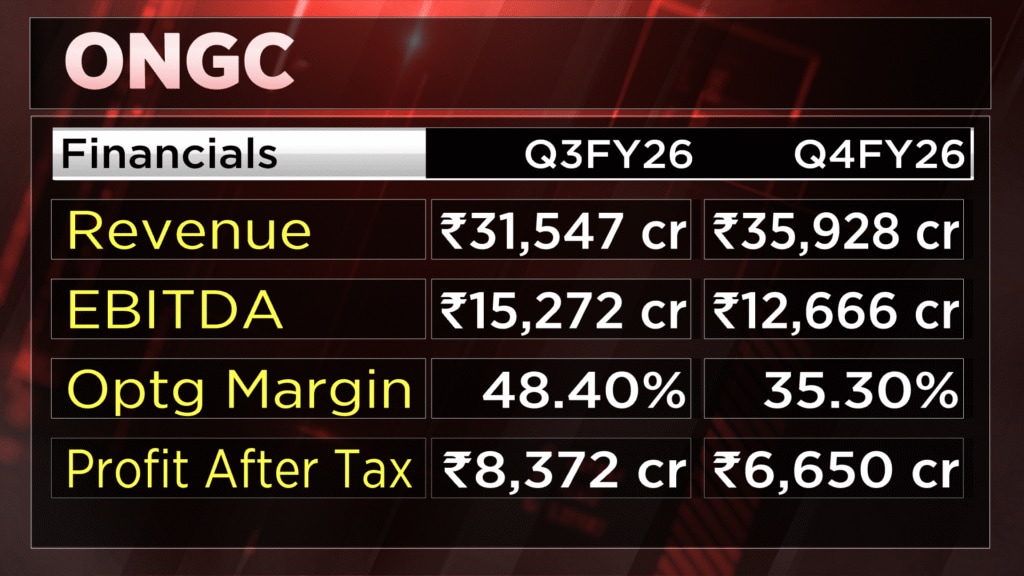
Sen said ONGC’s latest quarterly earnings, the January-March quarter of 2026 (Q4FY26), were weaker than expected because of higher operating costs, but added that the bigger focus should be on future production growth and stronger earnings visibility.
“The Daman offshore project should ramp up steadily over the next year,” Sen said. He added that “most remaining hiccups” related to the KG Basin development appear to have been resolved, which could start reflecting in production numbers going forward.
A key positive, according to Sen, is ONGC’s decision to expand its technical services agreement with BP across the entire Western Offshore region. These offshore fields are among ONGC’s oldest and largest producing assets, where output has been gradually declining for several years.
Also Read | BofA says India could emerge among market winners if oil prices cool
“What we understand from the management is that at least on the Mumbai offshore assets, the decline has already been stemmed to a certain extent,” Sen said.
He believes BP’s involvement could help improve production efficiency and reduce decline rates in mature oil fields.
Sen also said the Indian government has started creating a more supportive environment for upstream oil and gas companies. Measures such as royalty reforms, incentives for deepwater exploration and initiatives like Samudra Manthan are aimed at encouraging fresh investments in exploration and production.
As per ICICI Securities’ estimates, ONGC could see annual production growth of around 2-3% in 2026-27 (FY27) and 2027-28 (FY28) if these projects continue to scale up successfully.
Also Watch | Brent slips below $100 as US-Iran deal hopes cool crude oil rally
Apart from production growth, ONGC is also benefiting from stronger oil and gas realisations. Sen noted that there have been no government measures so far to cap earnings from higher prices, while royalty changes are also supporting profitability.
He cautioned investors against reading too much into one quarter’s earnings because year-end adjustments, higher exploration spending and depreciation costs may have impacted reported numbers.
Watch the full conversation here
Sen also spoke about oil marketing companies (OMCs), saying recent fuel price hikes have significantly reduced losses for companies selling petrol and diesel.
“These price increases… have actually reduced the potential annualised losses by more than ₹1 trillion for petrol and diesel,” he said.
However, he added that further fuel price hikes may depend on how the West Asia conflict evolves and whether crude oil prices cool in the coming weeks.

Catch all the latest updates from the stock market here
According to Probal Sen, Oil and Gas Analyst at ICICI Securities, the company’s expanded partnership with the UK's BP and the ramp-up of key offshore projects could help boost production growth over the next two years.
Sen said ONGC’s latest quarterly earnings, the January-March quarter of 2026 (Q4FY26), were weaker than expected because of higher operating costs, but added that the bigger focus should be on future production growth and stronger earnings visibility.
“The Daman offshore project should ramp up steadily over the next year,” Sen said. He added that “most remaining hiccups” related to the KG Basin development appear to have been resolved, which could start reflecting in production numbers going forward.
A key positive, according to Sen, is ONGC’s decision to expand its technical services agreement with BP across the entire Western Offshore region. These offshore fields are among ONGC’s oldest and largest producing assets, where output has been gradually declining for several years.
Also Read | BofA says India could emerge among market winners if oil prices cool
“What we understand from the management is that at least on the Mumbai offshore assets, the decline has already been stemmed to a certain extent,” Sen said.
He believes BP’s involvement could help improve production efficiency and reduce decline rates in mature oil fields.
Sen also said the Indian government has started creating a more supportive environment for upstream oil and gas companies. Measures such as royalty reforms, incentives for deepwater exploration and initiatives like Samudra Manthan are aimed at encouraging fresh investments in exploration and production.
As per ICICI Securities’ estimates, ONGC could see annual production growth of around 2-3% in 2026-27 (FY27) and 2027-28 (FY28) if these projects continue to scale up successfully.
Also Watch | Brent slips below $100 as US-Iran deal hopes cool crude oil rally
Apart from production growth, ONGC is also benefiting from stronger oil and gas realisations. Sen noted that there have been no government measures so far to cap earnings from higher prices, while royalty changes are also supporting profitability.
He cautioned investors against reading too much into one quarter’s earnings because year-end adjustments, higher exploration spending and depreciation costs may have impacted reported numbers.
Watch the full conversation here
Sen also spoke about oil marketing companies (OMCs), saying recent fuel price hikes have significantly reduced losses for companies selling petrol and diesel.
“These price increases… have actually reduced the potential annualised losses by more than ₹1 trillion for petrol and diesel,” he said.
However, he added that further fuel price hikes may depend on how the West Asia conflict evolves and whether crude oil prices cool in the coming weeks.
Catch all the latest updates from the stock market here



/images/ppid_59c68470-image-177981503530738288.webp)
/images/ppid_a911dc6a-image-177968707439881308.webp)




/images/ppid_a911dc6a-image-17797052274572278.webp)