/images/ppid_59c68470-image-177815260407164404.webp)

/images/ppid_a911dc6a-image-177842009252829676.webp)
/images/ppid_a911dc6a-image-177842005896917009.webp)

What is the story about?
Newgen Software Technologies Ltd expects business growth to improve in FY27 after a slowdown in large licence deals impacted performance in the previous year, according to CEO Virender Jeet.
The company, which has a market capitalisation of ₹7,163.57 crore, has seen its shares decline more than 53% over the last year.
Jeet said Newgen’s historical growth trend remains intact despite a softer FY26, where revenue growth stood at 6%.
“We should be able to come to our historical growth rates,” Jeet said, adding that the company expects better performance once conditions stabilise in the Middle East, which contributes nearly one-third of its revenue.
Also Read | Newgen Software Q4 Results: Shares rise up to 10% after US, APAC lead growth, margin expansion
The company also expects AI-led products and operational efficiencies to support margins and future deal growth.
“50% of all the use cases we sell would have AI as a significant part of that sale,” Jeet said.
According to Jeet, Newgen is embedding agentic AI capabilities into its Newgen ONE platform and continues to see larger deal sizes as customers adopt AI-driven solutions.
The company also said productivity gains and AI-led efficiencies helped optimise manpower costs during FY26, while maintaining investments in research and development.
Jeet added that Newgen could deliver stronger profitability if revenue growth returns to the high-teen range over the next two years.
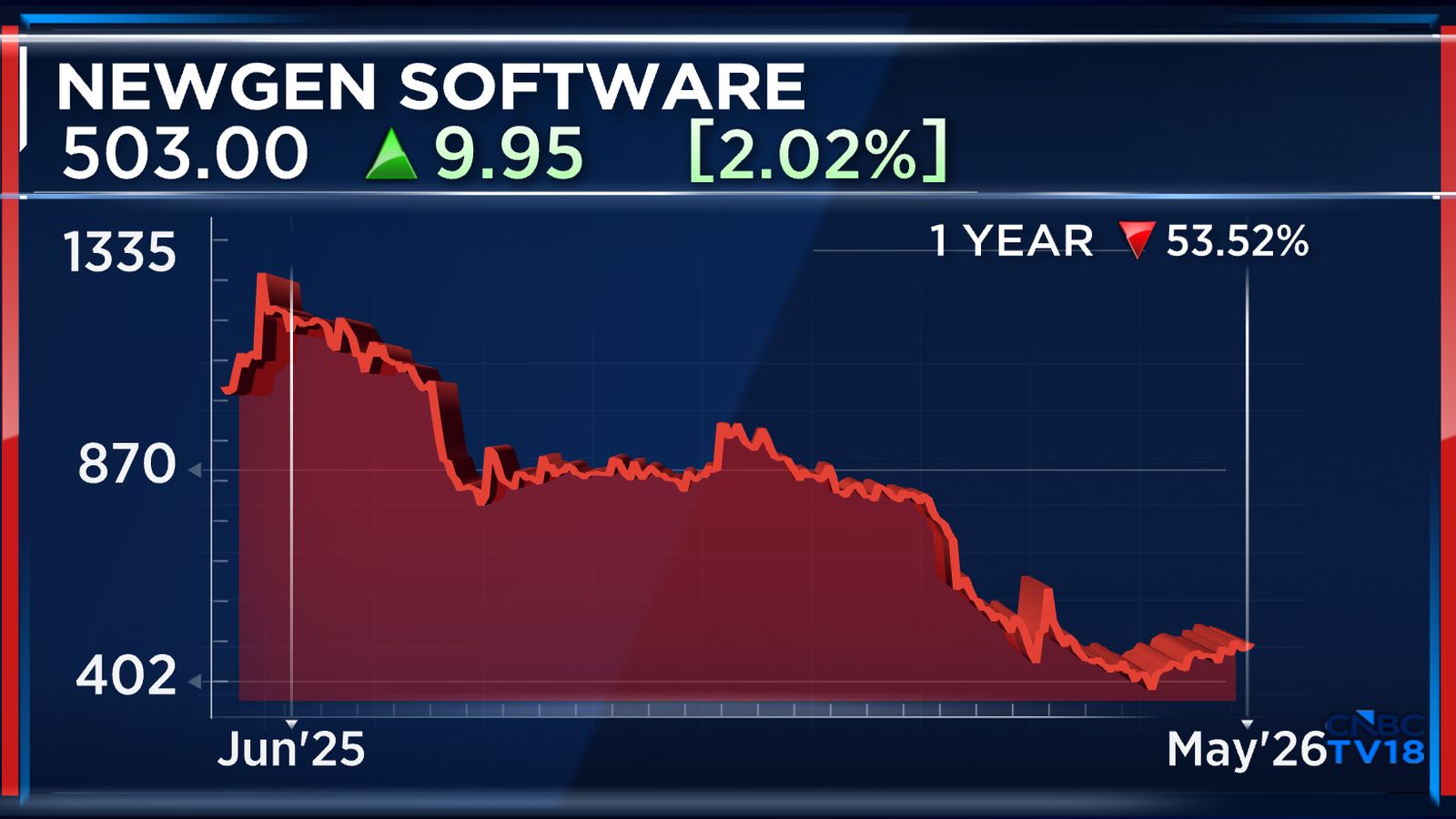
The company, which has a current market capitalisation of ₹7,163.57 crore, has seen its shares lose more than 53% over the last year.
These are the edited excerpts from the interview.Q: If I look at FY26, it's about 6% in terms of revenue growth that you've reported, but prior to that, you've done a lot better, and a large part of your business is actually growing much higher, in the over-20s. So, what is your growth target that you have for FY27, and at what margins do you think the operating leverage benefit comes in? A: You're right. Our historical growth trends are much higher than what we did last year, and in a way, it's also a function of what we have done. Over the last two, three years, we have grown at a much higher rate, and one of the contributors to that growth has been the larger licence deals coming out of India and the West Asia.
What's happening last year, as the bases have been reset, because it's been a strong year, it has been difficult to grow at 40% at the same rate out there. So, while you will see various parts of the business growing at 20%, it is the licence business where we had an impact, and we had a kind of degrowth out there.
Now, going into next year, some of the bases have been reset, and we expect now, in a shorter period of time, to come back to our historical growth trajectories. We are hopeful that with all the challenges, even in the market this year, especially in territories like the West Asia, which is one of the core regions for us, we should still be able to do much better growth than what we have done last year.
Q: When you say historical trajectory, what do you mean? Because the three-year CAGR has been 17%, while the five-year CAGR has been 19%.A: We should be able to come to our historical growth rates. There are just some headwinds in the market, especially if you understand that almost 33% of our revenue comes from West Asia. And even in the last quarter and the last financial year, we had a significant impact on our deal wins out there.
We are also looking at a weaker Q1, and we are factoring in that. But if that problem continues, that is the headwind we are looking at. Otherwise, we should be back to our historical growth rates.
Q: So, you will be at least double-digit this year. Is that correct in terms of a growth rate?A: We do intend to aim for that.
For the full interview, watch the accompanying videoQ: Low teens or high teens?A: Difficult to predict. If you ask me, probably at the end of Q2, I should be able to give you a better picture. But yes, all the bases have been reset. So, we are organically poised to do better, especially if the West Asia stabilises.
Q: I like when managements actually alert the market and say that this quarter may not be that good. That's precisely what you're doing, that the first quarter you're telling us will be weak.A: I'm not saying that. The first quarter for us, if you understand the company, we also have kind of lopsided revenue streams, in terms of Q3 and Q4 becoming significant.
So Q3, in spite of having challenges across, still should be a better quarter for us.
Q: I want to talk about two markets. One is the India market and EMEA. Both of them have been under pressure. There's been some degrowth that's taking place. However, in Q4, on a sequential basis, there was an improvement, which is encouraging. Do you expect both these two markets to see a recovery from hereon for the year?A: Yes, that's what I was referring to. That's the area where we had weakness last year. This year, in both the markets, we should be doing a better growth rate than what we've done last year.
Also Read | Radico Khaitan targets higher margins, 25% growth in luxury portfolio for FY27
Q: Your headcount as well, it's come down by close to around 6% to 7%. So, you have highlighted that there are AI-driven efficiencies that you're looking at. More of the same in the coming year?A: Yes. One of the advantages is that we spend a lot on our R&D, and that's where we are getting the maximum efficiencies. We are able to push our product roadmaps. We are excited about the product downstream roadmaps which are going to come in the next six to seven months. So, a lot of acceleration is happening.
But also on the service side of the business, we see efficiency, which will come into the bottom line of the business. We have been able to optimise last year around our overall manpower costs, which have got a bit optimised and have not gone along with the growth. We have stayed more stable. I think we'll see some amount of optimisation and productivity gains even this year.
Q: What do you mean when you say productivity gains? Because there has been a 6% to 7% decline in headcount. Do you pass it on to clients, or do you let your margins improve from here on?A: I think typically, we are not in a time-and-materials business. Most of it is a fixed-cost business and selling of product licences. So, customers eventually will be able to benefit from some margins, but in the short term, it comes more into your P&L, and we have a better opportunity to keep on investing and expanding our R&D, sales and marketing costs, because those are our long-term growth drivers, and that's what drives growth for the future for us.
Q: But your subscription and annuity revenues, which are 60% of your business, still saw margin compression for FY26. Now you're getting some productivity, you're reinvesting back in R&D, it's about 8.5% of your sales. What we're trying to understand is, at what revenue growth threshold does this model start to give you operating leverage and we get back to margins upwards of 25%-26%? What's your target here?A: So, I would say in the short term, any growth above 15% would keep on expanding margins organically, because you will not have an ability to invest that much back in the business in the same short period of time.
But as we have guided, as a company, at 20% net margin, around 23%-24% EBITDA, that's the margin we are targeting. Because the rest of that we do want to invest again back in growth. There's a lot of headroom for us into growth. A lot of markets are still to be addressed. A lot of verticals are to be addressed. So, the aim of the business is to keep on investing in growth, while sustaining the margin positions overall.
The business has compounding gross margins. If you look at it, with the growth, the gross margins will keep on becoming better and bigger, because the subscription licences do compound into gross-margin businesses. So, we are already at around 64%-65%. With higher revenue, there is a potential for the company to go up to almost 72%-75% in the next three to four years on gross margins. But on the net margin side, that is the guidance we are looking at right now. And the rest will be invested back in growth.
Q: The DSO days have spiked up, I think, to around 160. What is the normal level that we should be working with? Point number one. And I have an IDBI note that I'm looking at. They are noting that last year, you did close to ₹300 crore of net profit. But the street is believing that the PAT number can go up by 50% by FY28. Do you think that's possible? ₹440 crore to ₹450 crore of net profit is what you could deliver?A: I'll come to the profit. Profits are a natural function. If we do our high-teen growth, or slightly better, which we are aiming internally to do, then that number should unfold out there.
Also Read | CG Power sees multi-year power sector opportunity driven by exports, grid upgrades
Q: ₹440 crore to ₹450 crore of net profit, right?A: In two years, yes. That's quite possible, but as long as we meet our top-line goals on that front. So, margin unfolding will happen like that.
On the DSOs, we have been targeting around 120 days. That has been our average. This year, because of the fallout in EMEA, a large part of our collections got deferred because, unfortunately, the whole war situation unfolded in the last quarter, which is very important for us, both for licence sales as well as collections.
So, we'll be able to normalise it back to around 120-125 days this year, and then take a target to further improve.
Q: 120-125 days is your normalised level, and that's where you'll see it. Just before we flip in one last question before we let you go. You mentioned in your conference call that agentic AI has been embedded into the Newgen ONE platform. Are clients paying incrementally for these capabilities, or is this just more of a defensive feature to protect market share?A: So, as products are evaluated against global competition, roadmaps are typically drawn for two years ahead. So, what we have done over the last two years is that most of the products have shifted towards more AI consumption or AI-led features.
And that's what I think when I am talking of agentic features or agentic services coming into your products, almost 30% of the use cases last year which we sold had an AI component in them. But we do not look at AI separately from our products. All our use cases are AI-front-ended.
And all our customers, when they're evaluating product sales, they are looking at substantial value that AI will provide. So, I would say this year, I assume 50% of all the use cases we sell would have AI as a significant part of that sale.
Sometimes AI components can be sold if there are larger data science platforms, which are additive components. But most of the time, when you talk of Newgen ONE platform, it is an AI platform which is sold and reused by customers as an AI platform.
Q: So, you sell it at a higher price or lower price or the same price? Just wanted to understand that.A: I think the pricing power keeps on improving for product companies. As you innovate, you're able to hold on to the pricing. If you look at our average deal sizes over the years, they have gone significantly higher. They have been growing around 20%-30% year on year for the same kind of deals.
So, we would see that with AI, we should be able to deliver better value to the customer and thus be able to charge better.
Catch all the latest updates from the stock market here
The company, which has a market capitalisation of ₹7,163.57 crore, has seen its shares decline more than 53% over the last year.
Jeet said Newgen’s historical growth trend remains intact despite a softer FY26, where revenue growth stood at 6%.
“We should be able to come to our historical growth rates,” Jeet said, adding that the company expects better performance once conditions stabilise in the Middle East, which contributes nearly one-third of its revenue.
Also Read | Newgen Software Q4 Results: Shares rise up to 10% after US, APAC lead growth, margin expansion
The company also expects AI-led products and operational efficiencies to support margins and future deal growth.
“50% of all the use cases we sell would have AI as a significant part of that sale,” Jeet said.
According to Jeet, Newgen is embedding agentic AI capabilities into its Newgen ONE platform and continues to see larger deal sizes as customers adopt AI-driven solutions.
The company also said productivity gains and AI-led efficiencies helped optimise manpower costs during FY26, while maintaining investments in research and development.
Jeet added that Newgen could deliver stronger profitability if revenue growth returns to the high-teen range over the next two years.
The company, which has a current market capitalisation of ₹7,163.57 crore, has seen its shares lose more than 53% over the last year.
These are the edited excerpts from the interview.Q: If I look at FY26, it's about 6% in terms of revenue growth that you've reported, but prior to that, you've done a lot better, and a large part of your business is actually growing much higher, in the over-20s. So, what is your growth target that you have for FY27, and at what margins do you think the operating leverage benefit comes in? A: You're right. Our historical growth trends are much higher than what we did last year, and in a way, it's also a function of what we have done. Over the last two, three years, we have grown at a much higher rate, and one of the contributors to that growth has been the larger licence deals coming out of India and the West Asia.
What's happening last year, as the bases have been reset, because it's been a strong year, it has been difficult to grow at 40% at the same rate out there. So, while you will see various parts of the business growing at 20%, it is the licence business where we had an impact, and we had a kind of degrowth out there.
Now, going into next year, some of the bases have been reset, and we expect now, in a shorter period of time, to come back to our historical growth trajectories. We are hopeful that with all the challenges, even in the market this year, especially in territories like the West Asia, which is one of the core regions for us, we should still be able to do much better growth than what we have done last year.
Q: When you say historical trajectory, what do you mean? Because the three-year CAGR has been 17%, while the five-year CAGR has been 19%.A: We should be able to come to our historical growth rates. There are just some headwinds in the market, especially if you understand that almost 33% of our revenue comes from West Asia. And even in the last quarter and the last financial year, we had a significant impact on our deal wins out there.
We are also looking at a weaker Q1, and we are factoring in that. But if that problem continues, that is the headwind we are looking at. Otherwise, we should be back to our historical growth rates.
Q: So, you will be at least double-digit this year. Is that correct in terms of a growth rate?A: We do intend to aim for that.
For the full interview, watch the accompanying videoQ: Low teens or high teens?A: Difficult to predict. If you ask me, probably at the end of Q2, I should be able to give you a better picture. But yes, all the bases have been reset. So, we are organically poised to do better, especially if the West Asia stabilises.
Q: I like when managements actually alert the market and say that this quarter may not be that good. That's precisely what you're doing, that the first quarter you're telling us will be weak.A: I'm not saying that. The first quarter for us, if you understand the company, we also have kind of lopsided revenue streams, in terms of Q3 and Q4 becoming significant.
So Q3, in spite of having challenges across, still should be a better quarter for us.
Q: I want to talk about two markets. One is the India market and EMEA. Both of them have been under pressure. There's been some degrowth that's taking place. However, in Q4, on a sequential basis, there was an improvement, which is encouraging. Do you expect both these two markets to see a recovery from hereon for the year?A: Yes, that's what I was referring to. That's the area where we had weakness last year. This year, in both the markets, we should be doing a better growth rate than what we've done last year.
Also Read | Radico Khaitan targets higher margins, 25% growth in luxury portfolio for FY27
Q: Your headcount as well, it's come down by close to around 6% to 7%. So, you have highlighted that there are AI-driven efficiencies that you're looking at. More of the same in the coming year?A: Yes. One of the advantages is that we spend a lot on our R&D, and that's where we are getting the maximum efficiencies. We are able to push our product roadmaps. We are excited about the product downstream roadmaps which are going to come in the next six to seven months. So, a lot of acceleration is happening.
But also on the service side of the business, we see efficiency, which will come into the bottom line of the business. We have been able to optimise last year around our overall manpower costs, which have got a bit optimised and have not gone along with the growth. We have stayed more stable. I think we'll see some amount of optimisation and productivity gains even this year.
Q: What do you mean when you say productivity gains? Because there has been a 6% to 7% decline in headcount. Do you pass it on to clients, or do you let your margins improve from here on?A: I think typically, we are not in a time-and-materials business. Most of it is a fixed-cost business and selling of product licences. So, customers eventually will be able to benefit from some margins, but in the short term, it comes more into your P&L, and we have a better opportunity to keep on investing and expanding our R&D, sales and marketing costs, because those are our long-term growth drivers, and that's what drives growth for the future for us.
Q: But your subscription and annuity revenues, which are 60% of your business, still saw margin compression for FY26. Now you're getting some productivity, you're reinvesting back in R&D, it's about 8.5% of your sales. What we're trying to understand is, at what revenue growth threshold does this model start to give you operating leverage and we get back to margins upwards of 25%-26%? What's your target here?A: So, I would say in the short term, any growth above 15% would keep on expanding margins organically, because you will not have an ability to invest that much back in the business in the same short period of time.
But as we have guided, as a company, at 20% net margin, around 23%-24% EBITDA, that's the margin we are targeting. Because the rest of that we do want to invest again back in growth. There's a lot of headroom for us into growth. A lot of markets are still to be addressed. A lot of verticals are to be addressed. So, the aim of the business is to keep on investing in growth, while sustaining the margin positions overall.
The business has compounding gross margins. If you look at it, with the growth, the gross margins will keep on becoming better and bigger, because the subscription licences do compound into gross-margin businesses. So, we are already at around 64%-65%. With higher revenue, there is a potential for the company to go up to almost 72%-75% in the next three to four years on gross margins. But on the net margin side, that is the guidance we are looking at right now. And the rest will be invested back in growth.
Q: The DSO days have spiked up, I think, to around 160. What is the normal level that we should be working with? Point number one. And I have an IDBI note that I'm looking at. They are noting that last year, you did close to ₹300 crore of net profit. But the street is believing that the PAT number can go up by 50% by FY28. Do you think that's possible? ₹440 crore to ₹450 crore of net profit is what you could deliver?A: I'll come to the profit. Profits are a natural function. If we do our high-teen growth, or slightly better, which we are aiming internally to do, then that number should unfold out there.
Also Read | CG Power sees multi-year power sector opportunity driven by exports, grid upgrades
Q: ₹440 crore to ₹450 crore of net profit, right?A: In two years, yes. That's quite possible, but as long as we meet our top-line goals on that front. So, margin unfolding will happen like that.
On the DSOs, we have been targeting around 120 days. That has been our average. This year, because of the fallout in EMEA, a large part of our collections got deferred because, unfortunately, the whole war situation unfolded in the last quarter, which is very important for us, both for licence sales as well as collections.
So, we'll be able to normalise it back to around 120-125 days this year, and then take a target to further improve.
Q: 120-125 days is your normalised level, and that's where you'll see it. Just before we flip in one last question before we let you go. You mentioned in your conference call that agentic AI has been embedded into the Newgen ONE platform. Are clients paying incrementally for these capabilities, or is this just more of a defensive feature to protect market share?A: So, as products are evaluated against global competition, roadmaps are typically drawn for two years ahead. So, what we have done over the last two years is that most of the products have shifted towards more AI consumption or AI-led features.
And that's what I think when I am talking of agentic features or agentic services coming into your products, almost 30% of the use cases last year which we sold had an AI component in them. But we do not look at AI separately from our products. All our use cases are AI-front-ended.
And all our customers, when they're evaluating product sales, they are looking at substantial value that AI will provide. So, I would say this year, I assume 50% of all the use cases we sell would have AI as a significant part of that sale.
Sometimes AI components can be sold if there are larger data science platforms, which are additive components. But most of the time, when you talk of Newgen ONE platform, it is an AI platform which is sold and reused by customers as an AI platform.
Q: So, you sell it at a higher price or lower price or the same price? Just wanted to understand that.A: I think the pricing power keeps on improving for product companies. As you innovate, you're able to hold on to the pricing. If you look at our average deal sizes over the years, they have gone significantly higher. They have been growing around 20%-30% year on year for the same kind of deals.
So, we would see that with AI, we should be able to deliver better value to the customer and thus be able to charge better.
Catch all the latest updates from the stock market here







/images/ppid_a911dc6a-image-177842213518745681.webp)