


What is the story about?
Mumbai-based KEC International, the flagship company of the RPG Group, has cut its FY27 revenue growth guidance to 8-10% from 10-15% earlier, as the prolonged West Asia conflict continues to weigh on performance.
The company has already lost an estimated ₹500-600 crore in revenue during the first half of the financial year due to the disruption in the Gulf region.
Vimal Kejriwal, Managing Director and CEO of KEC International, said second-half margin improvement would depend on the pace at which new orders are converted into revenue and the settlement of cost escalation claims.
The global infrastructure Engineering, Procurement and Construction (EPC) company is targeting order inflows of around ₹28,000 crore in FY27.
In July–September 2026 (Q2FY27), KEC International reported revenue of ₹5,467 crore, profit after tax of ₹29 crore and margin of 4.96%.
[faq type="interview" title="This is an edited transcript of the interview."][ques][/ques][ans][/ans][/faq][faq type="interview"][ques]You had earlier indicated that the first quarter would be impacted, with some spillover into the second quarter. However, the impact has been more pronounced, with revenue declining 10% and first-half revenue down around 5.5-6%. Does this mean you will have to scale back your full-year revenue growth guidance of 10-15%? Also, has there been any recovery in the third quarter so far?[/ques][ans]You are absolutely right that we had a tough quarter. However, let me highlight a couple of developments that could support our performance in Q3 and Q4. First, we have received orders worth almost ₹3,000 crore from Power Grid, which had not been the case over the past 12 months. These orders will start converting into revenue from December onwards. Second, after the end of September, we received more than $20 million in long-pending receivables from Afghanistan, which had been stuck for almost five years. We have been discussing this recovery for some time, and the amount has finally come in. The third major development relates to the impact of the Gulf conflict. Given that more than 20% of our presence is in the region, we have been consistently engaging with clients. Last week, we received an ad hoc advance of almost ₹300 crore from a client. This amount will eventually be adjusted against the increased costs we have incurred during the quarter. These are three significant developments that should help us deliver a better performance in the second half.[/ans][/faq][faq type="interview"][ques]There is no doubt about the ordering activity and the positive developments you have highlighted. However, we cannot overlook the execution-related challenges. Given the performance in the first half, do you intend to revise your full-year revenue growth guidance of 10-15%? How much improvement in execution do you expect in the second half, and where do you see revenue growth for the full year? Also, margins in the second quarter were at their lowest levels since June 2023.[/ques][ans]We had not anticipated that the war would continue for so long or that its impact would intensify. You can see what is happening with the Houthis. If you look at the quarterly numbers, around 1.25-1.5 percentage points of our margins have been directly impacted by the increase in costs in the Gulf region, particularly fuel costs. We have incurred more than ₹100 crore in additional fuel expenses for our rigs, piling rigs and machinery. This is under active discussion with the client, but the costs have already been booked in our accounts. This is one of the major reasons why profitability, which we had expected to improve over Q1, has been impacted. On the revenue front, I agree that the prolonged conflict has already affected us by more than ₹500-600 crore in revenue during the first half. Unless the war stops, we may not be able to make up for this lost revenue. This has affected our revenue growth by around 2-3 percentage points. Clearly, the earlier guidance of 10-15% is not achievable at this stage. We now expect revenue growth to be closer to 8-10%.[/ans][/faq][faq type="interview"][ques]So, for FY27, you are looking at revenue growth of 8-10%. Is that correct?[/ques][ans]Absolutely. Yes.[/ans][/faq][faq type="interview"][ques]You mentioned that you received $20 million after the end of the second quarter. This was from Afghanistan and had been stuck for several years. How much is still outstanding in receivables?[/ques][ans]Of the total stuck receivables, around $15 million is still outstanding. The lender is the Asian Development Bank (ADB), and it has assured us that the payment will hopefully come through this quarter. We will keep our fingers crossed. Even the ₹200 crore that we received was expected last quarter but came in after the quarter ended. However, we are hopeful because we have written communication confirming the payment.[/ans][/faq][faq type="interview"][ques]The ad hoc advance payment of ₹300 crore that you mentioned is intended to cover the cost increases you are facing, correct?[/ques][ans]I would not say that specifically, but we have represented to our Middle East client that we are facing cost increases and need to be compensated. The client's response has been that it will look at settling the cost increases after the war is over. In the interim, to help us manage cash flows and other expenses arising from the increased costs, it has paid us an ad hoc advance of ₹300 crore. We are hopeful that this amount will eventually be adjusted against the settlement of claims relating to costs that have already been incurred and booked.[/ans][/faq][faq type="interview"][ques]I would not say that specifically, but we have represented to our Middle East client that we are facing cost increases and need to be compensated.The client's response has been that it will look at settling the cost increases after the war is over. In the interim, to help us manage cash flows and other expenses arising from the increased costs, it has paid us an ad hoc advance of ₹300 crore.We are hopeful that this amount will eventually be adjusted against the settlement of claims relating to costs that have already been incurred and booked.[/ques][ans]We have not yet booked the cost escalations as revenue, although the costs have already been accounted for. When we talk about fixed-price contracts, some of them have a force majeure clause covering costs. That is the provision we are discussing with our clients. We are pointing out that the force majeure clause applies and that they are contractually required to compensate us.[/ans][/faq][faq type="interview"][ques]Your working capital stood at 155 days, and you had earlier hoped to bring it down to around 120 days by the end of the year. With the money that has come in and the receivables expected, do you have an updated working capital target?[/ques][ans]I don't think we will reach 120 days, but we are still hopeful of bringing it down to around 125 days.[/ans][/faq][faq type="interview"][ques]On margins, you reported 5.4% for the first half. I understand the cost pressures and the prolonged West Asia conflict, but what are you currently expecting in terms of margins?[/ques][ans]It is difficult to give a number at this stage. I think it will depend on two factors. First, as I mentioned, we have already received the Power Grid orders, and the revenue contribution will start coming in. We expect the India T&D business to pick up from next month. That will be a major positive. The second factor that could improve margins is an early settlement of our claims. Until these claims are settled, we are unable to recognise the corresponding revenue. As I mentioned earlier, we faced an impact of around 1.25-1.5 percentage points on margins this quarter due to increased costs in the Middle East. In addition, our cable business has also been affected because polymer costs and other input costs have increased. This has had some impact on cable margins, apart from the direct impact of the Middle East situation.[/ans][/faq][faq type="interview"][ques]What is your outlook on margins for the second half?[/ques][ans]As I mentioned earlier, margins will depend on how quickly we get our claims settled and how soon the Power Grid and other orders received in Q2 start converting into revenue.[/ans][/faq][faq type="interview"][ques]Have you taken price hikes? Also, could you give us a sense of what the second half looks like? Before we wrap up, I would also like to understand the labour shortage situation. Last time, you said around 21,000 workers were available against a requirement of 30,000. With the festive season leading to labour migration and workers returning after the holidays, have things improved?[/ques][ans]Currently, we have around 24,000-25,000 workers against the earlier availability of 21,000. However, the pressure continues as usual. There is not much more I can say on this at the moment. Starting with Diwali, we have Chhath Puja as well, so labour availability continues to be an issue that we have not been able to fully address.[/ans][/faq][faq type="interview"][ques]Coming to order inflows, you were earlier targeting ₹30,000 crore for the full year and have already secured ₹13,500 crore in the first half. How is the pipeline looking for the second half?[/ques][ans]The pipeline is quite strong, and we have L1 positions worth almost ₹3,500 crore. We are seeing a pipeline across the transmission business, particularly in India, the UAE and Africa. We are likely to scale down our overall order inflow target by around ₹2,000 crore because we are taking a cautious approach to the civil business. We expect some reduction in the civil order inflows that we had initially planned. However, we are trying to push beyond our earlier targets in the T&D business.[/ans][/faq][faq type="interview"][ques]So, are you looking at order inflows of around ₹28,000 crore for the full year?[/ques][ans]Yes.[/ans][/faq]
KEC International's current market capitalisation is ₹8,899.07 crore.
Watch accompanying video
Follow our live blog for more updates on Q2 results
The company has already lost an estimated ₹500-600 crore in revenue during the first half of the financial year due to the disruption in the Gulf region.
Vimal Kejriwal, Managing Director and CEO of KEC International, said second-half margin improvement would depend on the pace at which new orders are converted into revenue and the settlement of cost escalation claims.
The global infrastructure Engineering, Procurement and Construction (EPC) company is targeting order inflows of around ₹28,000 crore in FY27.
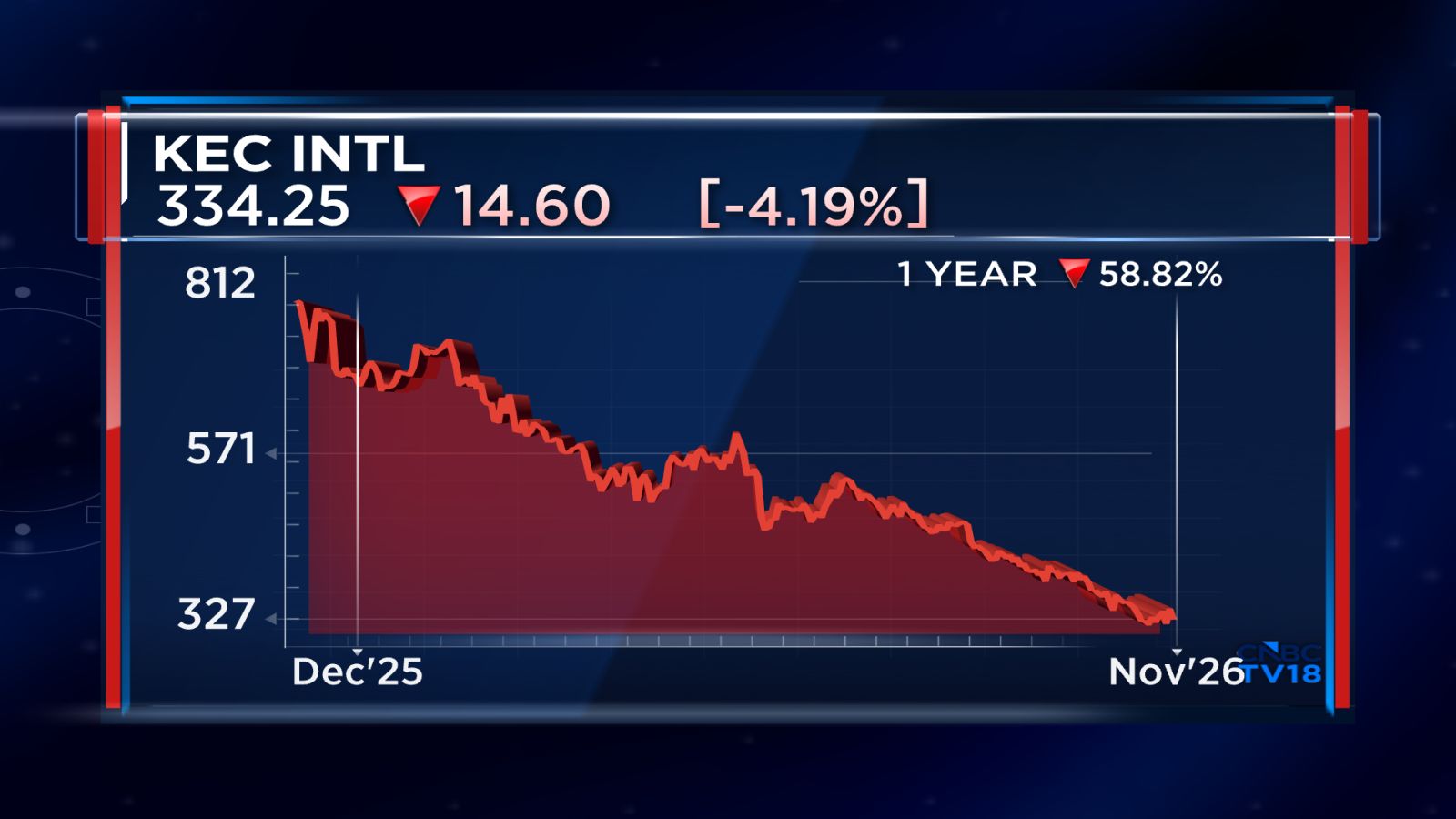
The stock was trading at ₹334.75 at 9:28 am on the NSE and has declined more than 58% over the past year.
In July–September 2026 (Q2FY27), KEC International reported revenue of ₹5,467 crore, profit after tax of ₹29 crore and margin of 4.96%.
[faq type="interview" title="This is an edited transcript of the interview."][ques][/ques][ans][/ans][/faq][faq type="interview"][ques]You had earlier indicated that the first quarter would be impacted, with some spillover into the second quarter. However, the impact has been more pronounced, with revenue declining 10% and first-half revenue down around 5.5-6%. Does this mean you will have to scale back your full-year revenue growth guidance of 10-15%? Also, has there been any recovery in the third quarter so far?[/ques][ans]You are absolutely right that we had a tough quarter. However, let me highlight a couple of developments that could support our performance in Q3 and Q4. First, we have received orders worth almost ₹3,000 crore from Power Grid, which had not been the case over the past 12 months. These orders will start converting into revenue from December onwards. Second, after the end of September, we received more than $20 million in long-pending receivables from Afghanistan, which had been stuck for almost five years. We have been discussing this recovery for some time, and the amount has finally come in. The third major development relates to the impact of the Gulf conflict. Given that more than 20% of our presence is in the region, we have been consistently engaging with clients. Last week, we received an ad hoc advance of almost ₹300 crore from a client. This amount will eventually be adjusted against the increased costs we have incurred during the quarter. These are three significant developments that should help us deliver a better performance in the second half.[/ans][/faq][faq type="interview"][ques]There is no doubt about the ordering activity and the positive developments you have highlighted. However, we cannot overlook the execution-related challenges. Given the performance in the first half, do you intend to revise your full-year revenue growth guidance of 10-15%? How much improvement in execution do you expect in the second half, and where do you see revenue growth for the full year? Also, margins in the second quarter were at their lowest levels since June 2023.[/ques][ans]We had not anticipated that the war would continue for so long or that its impact would intensify. You can see what is happening with the Houthis. If you look at the quarterly numbers, around 1.25-1.5 percentage points of our margins have been directly impacted by the increase in costs in the Gulf region, particularly fuel costs. We have incurred more than ₹100 crore in additional fuel expenses for our rigs, piling rigs and machinery. This is under active discussion with the client, but the costs have already been booked in our accounts. This is one of the major reasons why profitability, which we had expected to improve over Q1, has been impacted. On the revenue front, I agree that the prolonged conflict has already affected us by more than ₹500-600 crore in revenue during the first half. Unless the war stops, we may not be able to make up for this lost revenue. This has affected our revenue growth by around 2-3 percentage points. Clearly, the earlier guidance of 10-15% is not achievable at this stage. We now expect revenue growth to be closer to 8-10%.[/ans][/faq][faq type="interview"][ques]So, for FY27, you are looking at revenue growth of 8-10%. Is that correct?[/ques][ans]Absolutely. Yes.[/ans][/faq][faq type="interview"][ques]You mentioned that you received $20 million after the end of the second quarter. This was from Afghanistan and had been stuck for several years. How much is still outstanding in receivables?[/ques][ans]Of the total stuck receivables, around $15 million is still outstanding. The lender is the Asian Development Bank (ADB), and it has assured us that the payment will hopefully come through this quarter. We will keep our fingers crossed. Even the ₹200 crore that we received was expected last quarter but came in after the quarter ended. However, we are hopeful because we have written communication confirming the payment.[/ans][/faq][faq type="interview"][ques]The ad hoc advance payment of ₹300 crore that you mentioned is intended to cover the cost increases you are facing, correct?[/ques][ans]I would not say that specifically, but we have represented to our Middle East client that we are facing cost increases and need to be compensated. The client's response has been that it will look at settling the cost increases after the war is over. In the interim, to help us manage cash flows and other expenses arising from the increased costs, it has paid us an ad hoc advance of ₹300 crore. We are hopeful that this amount will eventually be adjusted against the settlement of claims relating to costs that have already been incurred and booked.[/ans][/faq][faq type="interview"][ques]I would not say that specifically, but we have represented to our Middle East client that we are facing cost increases and need to be compensated.The client's response has been that it will look at settling the cost increases after the war is over. In the interim, to help us manage cash flows and other expenses arising from the increased costs, it has paid us an ad hoc advance of ₹300 crore.We are hopeful that this amount will eventually be adjusted against the settlement of claims relating to costs that have already been incurred and booked.[/ques][ans]We have not yet booked the cost escalations as revenue, although the costs have already been accounted for. When we talk about fixed-price contracts, some of them have a force majeure clause covering costs. That is the provision we are discussing with our clients. We are pointing out that the force majeure clause applies and that they are contractually required to compensate us.[/ans][/faq][faq type="interview"][ques]Your working capital stood at 155 days, and you had earlier hoped to bring it down to around 120 days by the end of the year. With the money that has come in and the receivables expected, do you have an updated working capital target?[/ques][ans]I don't think we will reach 120 days, but we are still hopeful of bringing it down to around 125 days.[/ans][/faq][faq type="interview"][ques]On margins, you reported 5.4% for the first half. I understand the cost pressures and the prolonged West Asia conflict, but what are you currently expecting in terms of margins?[/ques][ans]It is difficult to give a number at this stage. I think it will depend on two factors. First, as I mentioned, we have already received the Power Grid orders, and the revenue contribution will start coming in. We expect the India T&D business to pick up from next month. That will be a major positive. The second factor that could improve margins is an early settlement of our claims. Until these claims are settled, we are unable to recognise the corresponding revenue. As I mentioned earlier, we faced an impact of around 1.25-1.5 percentage points on margins this quarter due to increased costs in the Middle East. In addition, our cable business has also been affected because polymer costs and other input costs have increased. This has had some impact on cable margins, apart from the direct impact of the Middle East situation.[/ans][/faq][faq type="interview"][ques]What is your outlook on margins for the second half?[/ques][ans]As I mentioned earlier, margins will depend on how quickly we get our claims settled and how soon the Power Grid and other orders received in Q2 start converting into revenue.[/ans][/faq][faq type="interview"][ques]Have you taken price hikes? Also, could you give us a sense of what the second half looks like? Before we wrap up, I would also like to understand the labour shortage situation. Last time, you said around 21,000 workers were available against a requirement of 30,000. With the festive season leading to labour migration and workers returning after the holidays, have things improved?[/ques][ans]Currently, we have around 24,000-25,000 workers against the earlier availability of 21,000. However, the pressure continues as usual. There is not much more I can say on this at the moment. Starting with Diwali, we have Chhath Puja as well, so labour availability continues to be an issue that we have not been able to fully address.[/ans][/faq][faq type="interview"][ques]Coming to order inflows, you were earlier targeting ₹30,000 crore for the full year and have already secured ₹13,500 crore in the first half. How is the pipeline looking for the second half?[/ques][ans]The pipeline is quite strong, and we have L1 positions worth almost ₹3,500 crore. We are seeing a pipeline across the transmission business, particularly in India, the UAE and Africa. We are likely to scale down our overall order inflow target by around ₹2,000 crore because we are taking a cautious approach to the civil business. We expect some reduction in the civil order inflows that we had initially planned. However, we are trying to push beyond our earlier targets in the T&D business.[/ans][/faq][faq type="interview"][ques]So, are you looking at order inflows of around ₹28,000 crore for the full year?[/ques][ans]Yes.[/ans][/faq]
KEC International's current market capitalisation is ₹8,899.07 crore.
Watch accompanying video
Follow our live blog for more updates on Q2 results