



What is the story about?
Castrol India expects to maintain its 21-24% earnings before interest, taxes, depreciation, and amortisation (EBITDA) margin guidance despite facing more than 60% growth in raw material costs during the July-September 2026 quarter, as pricing actions, cost controls and operational efficiencies help cushion the impact, Managing Director Saugata Basuray said.
Basuray said the lubricant maker expects raw material prices and currency movements to remain volatile in the near term, but believes the company is well positioned after taking multiple price hikes earlier this year. Looking ahead, he said Castrol will continue monitoring inflation and demand trends and will take further pricing or cost measures if required.
He added that while commodity costs remain elevated, the company will continue to protect profitability without losing focus on market share gains.
Castrol India reported 27% revenue growth in the first nine months of the year, while profit before tax (PBT) rose 10%, despite the cost of goods increasing by 28%. Basuray said the company maintained market share during the period through pricing actions taken in anticipation of rising input costs.
The company expects volatility in commodity prices to continue through the October-December quarter. Basuray said Castrol will remain flexible in responding to changing market conditions.
While overall volume growth moderated, Basuray said the company's key growth segments continued to outperform the market. Industrial lubricants, which account for less than 20% of Castrol India's business, recorded another quarter of double-digit volume growth.
He said industrial lubricants have delivered double-digit volume expansion for the second consecutive year and remain an important growth driver for the company. Castrol plans to expand this business further through new product launches and by adding large industrial customers.
Castrol India, an automotive and industrial lubricant manufacturer headquartered in Mumbai, said it remains focused on strengthening its presence across automotive, industrial and institutional segments while managing inflationary pressures.
[faq type="interview" title="This is an edited transcript of the interview."][ques][/ques][ans][/ans][/faq][faq type="interview"][ques]The obvious question is on raw materials and the volume growth that you are targeting going forward because you had said that you've seen high double-digit commodity cost inflation with some pricing action. How much of a price hike did you take? How did that impact volumes? Also, what did you report in terms of volumes in the second quarter? And what is the outlook for the next couple of quarters?[/ques][ans]It has been a resilient quarter. We grew our revenue by 27% against the backdrop of commodity and raw material prices going up by almost 60% within the quarter. Market shares have been held. To your question on volume, our growth engines, which are rural and industrial, continue to grow ahead of the market, and we are quite bullish on that. As we had indicated in the June quarter, we anticipate that the environment will remain very volatile. Raw material prices are going up, and we think they will continue to go up in the short term. The currency is also moving adversely for us. In anticipation of this, we had taken strong pricing action early in the year on multiple occasions. So, for the year-to-date (nine months), the revenue is up 27%, volumes are growing ahead of the market. While the cost of goods has gone up by 28%, our PBT is up 10% at the end of nine months. We remain cautious about the next quarter, which is October to December. We'll keep looking at signals on demand and inflation, and we'll act accordingly, both in terms of pricing as well as cost-control measures.[/ans][/faq][faq type="interview"][ques]But we missed out on the volume number for the past quarter. What was the volume growth? As you said, revenue growth was strong, but what was the volume growth in the past quarter, or was it entirely price-driven?[/ques][ans]So there has been some volume growth. It is definitely slower than what it was before. We look at the volume growth of our growth engines, industrial and rural. Both of them, as I mentioned, continue to grow ahead of the market. Industrial, in fact, had another quarter of double-digit volume growth.[/ans][/faq][faq type="interview"][ques]Industrial recorded double-digit volume growth. And what is the industrial contribution to your mix?[/ques][ans]Industrial contribution is less than 20%. It is a small part of our business, as we had indicated earlier, but it is growing quite fast. This is probably the second consecutive year in which we are seeing continued double-digit volume growth. That's one of our building blocks for the future.[/ans][/faq][faq type="interview"][ques]You indicated that input costs have gone up, but you will have taken some price increases. As things stand heading into the final quarter of the calendar year, will you require more price increases to pass on some part of the input cost spike and the rupee weakness as well, or have you already passed on most of the price increases?[/ques][ans]It is a dynamic environment, and we remain focused on the long-term agenda, which is to gain market share across all the categories that we operate in, which are industrial, automotive, and our institutional sales business. Raw material prices remain very volatile, so we will keep tracking them. As things stand today, we are covered based on the actions taken over the previous six months. However, if the environment changes, we will act. We have also put in place measures to mitigate some of this through cost control, various cost measures, and operational efficiencies, and those will continue throughout this quarter and into early next year.[/ans][/faq][faq type="interview"][ques]Just a couple of points. One is whether you could give us a margin band to work with, which the Street should be looking at, notwithstanding the sort of volatility that we are seeing right now. And the second part is that you've been bullish on the industrial segment. It's been growing well as well. What does it contribute to your overall revenue right now? And what's your roadmap for the next two to three years for this business? What's your target contribution from this segment?[/ques][ans]I'll go back to our guidance at the end of the June quarter. And we said two things. We said that we will manage this business within a range of 21% to 24% EBITDA margin. We stick to that. Notwithstanding short-term volatility, given the nature of the increase in raw material costs, which has been more than 60% in the quarter that just went by, we will, in the short term, make sure that we take actions to defend margins. But our long-term focus remains on growing volume and growing market share. Industrial, as I said earlier, is below 20% of our business, both in terms of volume and revenue. And we feel quite confident that we have a series of actions there, in terms of new products, which are helping us gain market share by adding large customers to our base, and we will continue to invest in that business.[/ans][/faq]
For the full interview, watch the accompanying video
Catch all the latest updates from the stock market here
Basuray said the lubricant maker expects raw material prices and currency movements to remain volatile in the near term, but believes the company is well positioned after taking multiple price hikes earlier this year. Looking ahead, he said Castrol will continue monitoring inflation and demand trends and will take further pricing or cost measures if required.
He added that while commodity costs remain elevated, the company will continue to protect profitability without losing focus on market share gains.
Castrol India reported 27% revenue growth in the first nine months of the year, while profit before tax (PBT) rose 10%, despite the cost of goods increasing by 28%. Basuray said the company maintained market share during the period through pricing actions taken in anticipation of rising input costs.
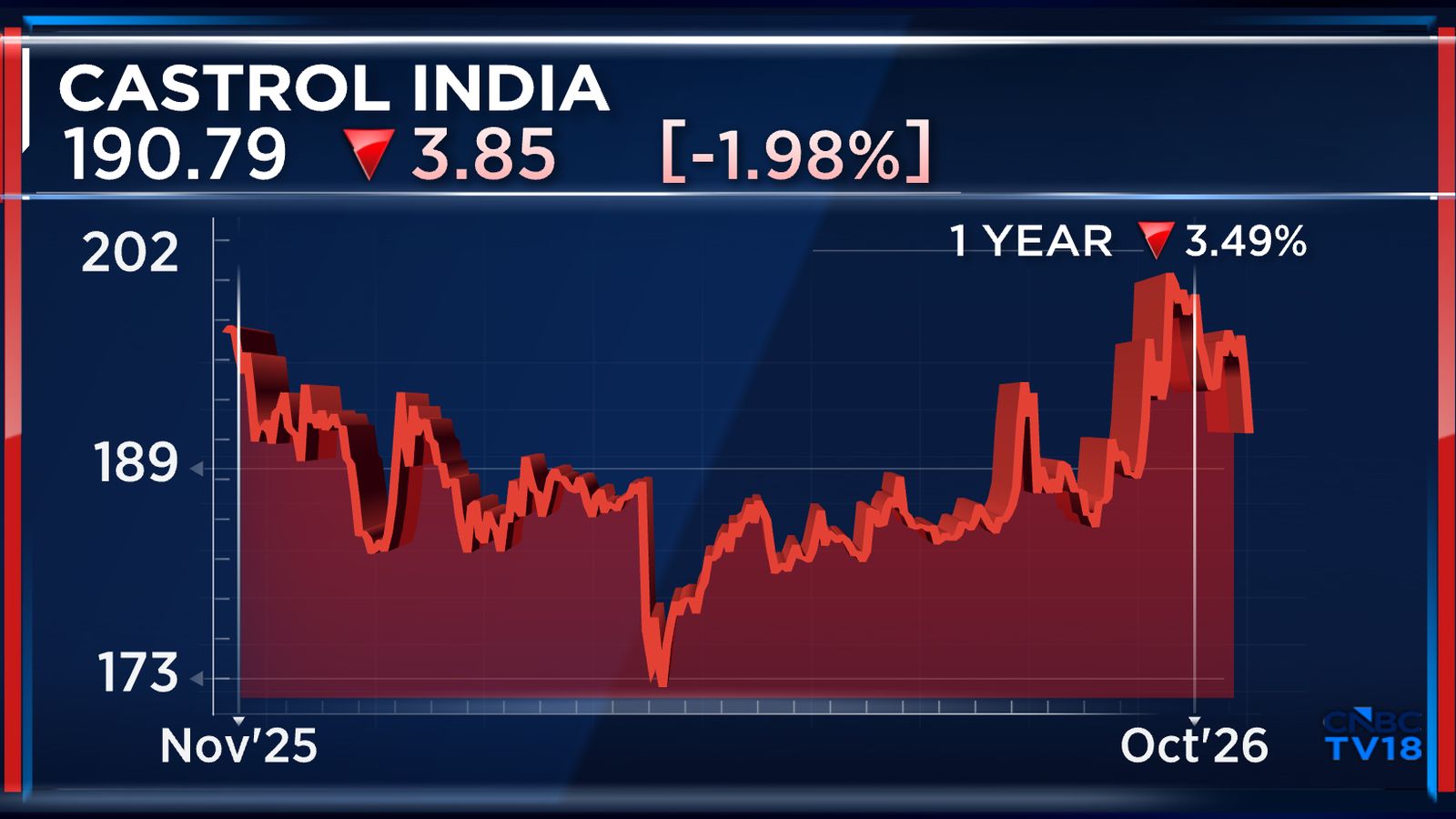
Castrol India shares were trading at ₹190.80 as of 11:59 am on the NSE. The company, which has a current market capitalisation of ₹18,907.07 crore, has seen its shares decline more than 3% over the last year.
The company expects volatility in commodity prices to continue through the October-December quarter. Basuray said Castrol will remain flexible in responding to changing market conditions.
While overall volume growth moderated, Basuray said the company's key growth segments continued to outperform the market. Industrial lubricants, which account for less than 20% of Castrol India's business, recorded another quarter of double-digit volume growth.
He said industrial lubricants have delivered double-digit volume expansion for the second consecutive year and remain an important growth driver for the company. Castrol plans to expand this business further through new product launches and by adding large industrial customers.
Castrol India, an automotive and industrial lubricant manufacturer headquartered in Mumbai, said it remains focused on strengthening its presence across automotive, industrial and institutional segments while managing inflationary pressures.
[faq type="interview" title="This is an edited transcript of the interview."][ques][/ques][ans][/ans][/faq][faq type="interview"][ques]The obvious question is on raw materials and the volume growth that you are targeting going forward because you had said that you've seen high double-digit commodity cost inflation with some pricing action. How much of a price hike did you take? How did that impact volumes? Also, what did you report in terms of volumes in the second quarter? And what is the outlook for the next couple of quarters?[/ques][ans]It has been a resilient quarter. We grew our revenue by 27% against the backdrop of commodity and raw material prices going up by almost 60% within the quarter. Market shares have been held. To your question on volume, our growth engines, which are rural and industrial, continue to grow ahead of the market, and we are quite bullish on that. As we had indicated in the June quarter, we anticipate that the environment will remain very volatile. Raw material prices are going up, and we think they will continue to go up in the short term. The currency is also moving adversely for us. In anticipation of this, we had taken strong pricing action early in the year on multiple occasions. So, for the year-to-date (nine months), the revenue is up 27%, volumes are growing ahead of the market. While the cost of goods has gone up by 28%, our PBT is up 10% at the end of nine months. We remain cautious about the next quarter, which is October to December. We'll keep looking at signals on demand and inflation, and we'll act accordingly, both in terms of pricing as well as cost-control measures.[/ans][/faq][faq type="interview"][ques]But we missed out on the volume number for the past quarter. What was the volume growth? As you said, revenue growth was strong, but what was the volume growth in the past quarter, or was it entirely price-driven?[/ques][ans]So there has been some volume growth. It is definitely slower than what it was before. We look at the volume growth of our growth engines, industrial and rural. Both of them, as I mentioned, continue to grow ahead of the market. Industrial, in fact, had another quarter of double-digit volume growth.[/ans][/faq][faq type="interview"][ques]Industrial recorded double-digit volume growth. And what is the industrial contribution to your mix?[/ques][ans]Industrial contribution is less than 20%. It is a small part of our business, as we had indicated earlier, but it is growing quite fast. This is probably the second consecutive year in which we are seeing continued double-digit volume growth. That's one of our building blocks for the future.[/ans][/faq][faq type="interview"][ques]You indicated that input costs have gone up, but you will have taken some price increases. As things stand heading into the final quarter of the calendar year, will you require more price increases to pass on some part of the input cost spike and the rupee weakness as well, or have you already passed on most of the price increases?[/ques][ans]It is a dynamic environment, and we remain focused on the long-term agenda, which is to gain market share across all the categories that we operate in, which are industrial, automotive, and our institutional sales business. Raw material prices remain very volatile, so we will keep tracking them. As things stand today, we are covered based on the actions taken over the previous six months. However, if the environment changes, we will act. We have also put in place measures to mitigate some of this through cost control, various cost measures, and operational efficiencies, and those will continue throughout this quarter and into early next year.[/ans][/faq][faq type="interview"][ques]Just a couple of points. One is whether you could give us a margin band to work with, which the Street should be looking at, notwithstanding the sort of volatility that we are seeing right now. And the second part is that you've been bullish on the industrial segment. It's been growing well as well. What does it contribute to your overall revenue right now? And what's your roadmap for the next two to three years for this business? What's your target contribution from this segment?[/ques][ans]I'll go back to our guidance at the end of the June quarter. And we said two things. We said that we will manage this business within a range of 21% to 24% EBITDA margin. We stick to that. Notwithstanding short-term volatility, given the nature of the increase in raw material costs, which has been more than 60% in the quarter that just went by, we will, in the short term, make sure that we take actions to defend margins. But our long-term focus remains on growing volume and growing market share. Industrial, as I said earlier, is below 20% of our business, both in terms of volume and revenue. And we feel quite confident that we have a series of actions there, in terms of new products, which are helping us gain market share by adding large customers to our base, and we will continue to invest in that business.[/ans][/faq]
For the full interview, watch the accompanying video
Catch all the latest updates from the stock market here