



What is the story about?
Reema Tendulkar opened with Gabbar Singh. A decade ago, the CNBC-TV18 anchor told the room in the Grand Salon at Sofitel BKC, every conversation about India’s global capability centres eventually arrived at the question the Sholay villain demands of his men, kitne aadmi the, and the answer, a headcount, served for years as the measure of how much a centre mattered. That conversation, she said, had moved quickly from cost arbitrage to capacity, and was now turning towards AI leadership and the ownership of intellectual property and platforms. Then she gave the evening its ambition in a single line. “Korea ke paas SK Hynix hai, Taiwan ke paas TSMC hai,” she said, “par hamare paas GCC hai.” (Korea has SK Hynix, Taiwan has TSMC, and India has its GCCs.)
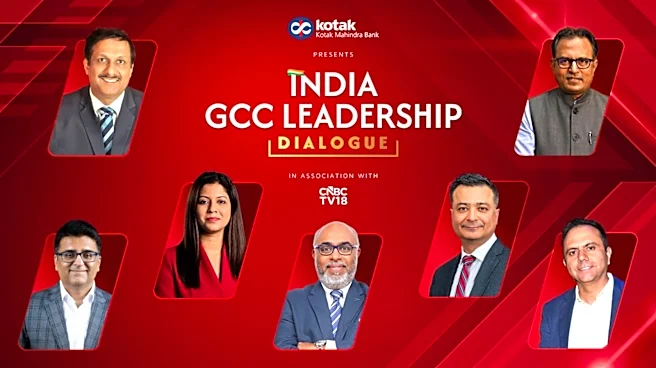
The occasion was the Mumbai edition of Kotak Mahindra Bank presents India GCC Leadership Dialogue, held in association with CNBC-TV18 on 23 September, an invitation-only evening and one of six city editions in the series. Its invitation posed the question plainly: the GCC mandate is changing, so is India ready for what comes next?
An investor reads the GCC story
Nilesh Shah, Managing Director of Kotak Mahindra Asset Management, set the context with the opening address, and began by turning a familiar complaint into a data point. Picture Dubai, he told the audience, and the mind supplies the Burj Al Arab and quiet, clean streets; picture India, and it supplies traffic, and his own office, a ten-minute walk from the venue, had taken him half an hour to reach. Yet over the last three decades, he said, citing IMF and World Bank data, Dubai’s economy grew roughly eight and a half times while India’s grew roughly ten and a half; that growth spread across 145 crore people and is harder to see, though no less real. India was the world’s tenth-largest economy in 2014, is fifth or sixth today depending on the day’s rupee conversion, and, in his view, is headed for third, with GCCs among the biggest drivers.
The numbers he cited made the case. More than 2,100 GCCs now employ a little under 2.5 million professionals, with perhaps three to four times as many indirect jobs created around them. Their revenue rounds off to about $50 billion, but apply an appropriate transfer-pricing benchmark and the value they create comes closer to $98 billion. Over the past decade, he added, GCCs have outperformed Indian IT services companies in both volume and value. “Unfortunately for mutual fund investors, none of you are listed,” he said. “Otherwise, I would have easily sold all my IT companies and bought into GCCs.”
AI, he argued, will become the core operating model of business as the internet once did, lifting productivity five to ten times. He told the story of an entrepreneur whose machines depend on a component made by only three manufacturers worldwide, its German supplier’s written approval needed before a single machine can be sold. With AI, some 60 to 70% of that supplier’s proprietary roadmap is already understood, and the remaining research sits across seven Indian institutes now encouraged by the government to share their work with industry. Within 18 months, the entrepreneur expects to take a shot at making the component himself, a leap Shah likened to India’s jump from the landline to the mobile phone. Just as Indians once picked up the implementation of SAP’s ERP systems and Oracle’s databases, he said, they can now build the platforms and apps the world will run on large language models, with GCCs at the center of that work.
The first phase of the GCC journey, he said, was cost arbitrage, the second capacity building, and the third is AI leadership and value creation. “The next decade will not be defined by how many people work in GCCs,” he said. “It will be defined by how much innovation is created from India, how much intellectual property is owned from India, how many global products are designed from India and how much enterprise strategy is shaped from India.” The journey to Viksit Bharat, he told the room, will pass through the lanes of the GCC.
A seat, then a voice
Kotak had chosen panellists who see that journey from different floors of the same building: Sudish Panicker, Global Head of Operations for Fund and Investor Solutions and Site Executive for India at BNY; Rishi Dhuper, Managing Director of the India Hub at MUFG Pension and Market Services, which was formed seven years ago; Neha Shah, Chief Executive Officer of Investec Global Services India, a centre barely three years old; and Sachin Samant, President and Business Head of the Banking and Financial Institutions Group at Kotak Mahindra Bank, who has watched GCCs up close from the banker’s side.
Panicker updated a phrase the industry has used for years. The question once was whether GCCs had a seat at the table. “I think the conversation has now shifted to say, do GCCs have an equal voice? And what will it take for GCCs to stay at the table as opposed to just show up at the table?” He has come across centres where the entire AI strategy is led out of India, and others that have crossed from the cost side of the P&L to the revenue side, releasing global products from their India operations. Part of the advantage is structural: most organisations are built vertically, while a GCC is one of the few places where engineering, product, operations and risk sit together as a horizontal.
Dhuper described the same shift through his conversations with headquarters. Five to seven years ago, they revolved around service levels and the blended cost of a headcount. Today they turn on the group’s return-on-equity targets, its adoption of AI, and strategic programs such as moving a $50 million business from one platform to another. Cost arbitrage, he explained, ran for a good fifteen years because the savings showed on the P&L every year, until there was little left to send. By then, decision-makers had noticed that some 800 of the world’s top 2,000 companies already had a presence in India, and that the talent they hired here arrived carrying gold standards and best practices, 70 to 80% ready. “We just have to give them context of our business, and they’ll be up and running.” Samant put it this way: what began as cost arbitrage has become capability arbitrage, spanning product development, risk management policy and enterprise change.
Starting at phase three
Asked where the industry stands on a scale of one to ten, Dhuper said what older centres achieved in their first 15 to 18 years, newer ones now achieve in five, carried by an ecosystem that runs from peer-to-peer learning and the Big Four to NASSCOM, DSCI, banks and developers. His own hub, formed seven years ago, is already in the third phase of maturity. He placed MUFG in “the higher sixes and sevens”, and every new capability his hub sets up begins with one question: is it AI native? “AI is not an afterthought,” he said. “We’re going to imbibe it in the service delivery model on day one.” Neha Shah, whose centre is two to three years old, said Investec had gained from learning alongside its predecessors. As it builds out, AI nativeness comes first in every decision, and roles move to India where the synergies are strongest, with risk, operations and technology sitting together.
Where AI is already at work
Neha Shah gave the clearest account of AI moving into production. Investec began experimenting in early 2024, moved to structured prompt engineering in 2025, and gave every staff member globally access to GitHub Copilot. Teams that once handed users wireframes now build live prototypes, compressing two to three months into weeks, and a finance agent for cost allocation across geographies has cut three days of work to hours. Wherever a decision touches controls, regulation or clients, she said, AI informs it, and a person makes it.
Samant called AI an augmenter, already handling operations, trade processing and the analysis of payments for anti-money-laundering patterns, while deep judgment and final decisioning on fraud investigations or large credit decisions stays with people. He sees India winning on adoption, as it did in digital payments, especially in banking and financial services. Kotak’s own deployments illustrate it. Kompanion places Kotak’s policies and process notes inside an internal assistant for frontline staff relationship managers selling across the country. Likewise, AI agents are being leveraged for software development, credit underwriting, customer service, and other use cases.”
Dhuper, back from a study tour of Microsoft, Amazon, CrowdStrike, OpenAI and Anthropic, said he returned with more questions than answers and four themes: trust, a mix of top-down and bottom-up adoption, governance built on the banker’s rule of trust but verify, and air cover for the mistakes everyone will make. “AI is not about technology. AI is about mindset. It’s about leadership,” he said.
Measuring what matters
Panicker named mindset as the industry’s first constraint. GCCs were built to be the engine room of their organisations, he said. “I think the opportunity and the pivot challenge for us is to become the brain of the organisation.” The second is measurement. The industry has long equated scale with headcount, an equation he called broken, and better metrics would capture intellectual property, revenue generated, and business outcomes. “That’s where you bring skill, context, and outcome together.”
Dhuper supplied the number that frames the opportunity. Of roughly 2.5 million people in India’s GCCs, only six to seven thousand hold global roles, around 0.3 to 0.4% of the workforce, and when that share reaches 3%, he said, the industry will go through a significant pivot. “I feel the runway is long, the future is bright,” he said. “It will happen. It’s inevitable.” Neha Shah traced the gap to the industry’s origins as delivery centres, which left a vendor mindset, and has made context her priority, teaching her people to ask why as well as what. Headquarters are shifting too, she said, coming to see India as a place that can design work as well as deliver it. “Do not move work without context,” she said. “Do not move work without decision-making authority.”
What comes next
To close, Tendulkar asked what would bring the remaining 1,200 of the world’s top 2,000 companies to India. Samant called for making set-up ever easier, building on encouragement from the centre and the states, and for producing talent equipped for far more advanced mandates. Neha Shah pointed to capability building and the critical thinking and judgment AI-era mandates demand, with academia as a partner. Dhuper said a business leader needs business context, commercial acumen, AI and digital skills and a grasp of regulation together, and hoped AI would now accelerate that journey.
Taken together, the evening sketched a clear road ahead. The first phase of India’s GCC story was built on cost and the second on capacity; the third, as Nilesh Shah put it, will be built on AI leadership and value creation. The panel set out what that phase demands: a voice in enterprise strategy to match the seat at the table, metrics that count intellectual property and outcomes instead of headcount, AI built into every new capability from the first day with people still making the decisions that matter, and a far larger share of global roles held from India. With some 800 of the world’s top 2,000 companies already here, and the runway, in Dhuper’s words, long, the next decade of India’s GCCs will be measured by what they own and shape, and far less by kitne aadmi the.
The evening closed with Gagandeep Ahuja, President and Geography Head, Consumer Distribution, West, East and Tri-State, and Vishal Sachdeva, Business Head, Multinationals and New Age Banking, setting out how Kotak Mahindra Bank supports a GCC through its entire life: assisted account opening with digital transaction banking from the first day, a FEMA advisory desk for equity infusion and external commercial borrowings, a forex desk for hedging, foreign currency accounts through GIFT City, and employee banking designed separately for graduates, mid-career professionals and senior leaders. Nearly 30% of the bank’s branch network, more than 770 branches, sits in the six markets where GCCs cluster, close to the people who will build what comes next.