/images/ppid_59c68470-image-17851576045394427.webp)

/images/ppid_59c68470-image-178512524310145474.webp)
/images/ppid_59c68470-image-178511761618385612.webp)
/images/ppid_59c68470-image-178513763210092864.webp)
What is the story about?
Canara Bank expects to exceed its financial year 2026-27 (FY27) guidance for loan growth and Foreign Currency Non-Resident FCNR(B) deposits as credit demand remains strong, while maintaining its net interest margin (NIM) outlook despite higher funding costs, Managing Director and Chief Executive Officer Brajesh Kumar Singh said after the bank's April-June 2026 quarter results.
The Bengaluru-headquartered public sector lender also expects further improvement in asset quality by the end of the financial year.
He added that Canara Bank has already raised $775 million through FCNR(B) deposits and expects to cross $1 billion by the end of the month. "Our guidance again... we will certainly be bettering it here also," he said, referring to the bank's overall foreign currency fundraising target of $2.3 billion-$2.5 billion.
Singh said slippages and bad loans continued to improve and the bank does not see any meaningful stress emerging in its loan book.
He added that gross non-performing assets (NPA) had declined to 1.57% from 1.84%, while the bank remains confident of improving further by March 2027. Singh also said the increase in Special Mention Accounts (SMA)-2 accounts was driven by a few state government-guaranteed consortium accounts that have already moved back to SMA-0 and are not expected to slip into NPAs.
Canara Bank also expects to maintain its NIM guidance of 2.5% to 2.6%, despite some pressure from FCNR(B) deposits. Singh said the bank is replacing high-cost bulk deposits with retail term deposits and improving its credit-deposit ratio to support earnings.
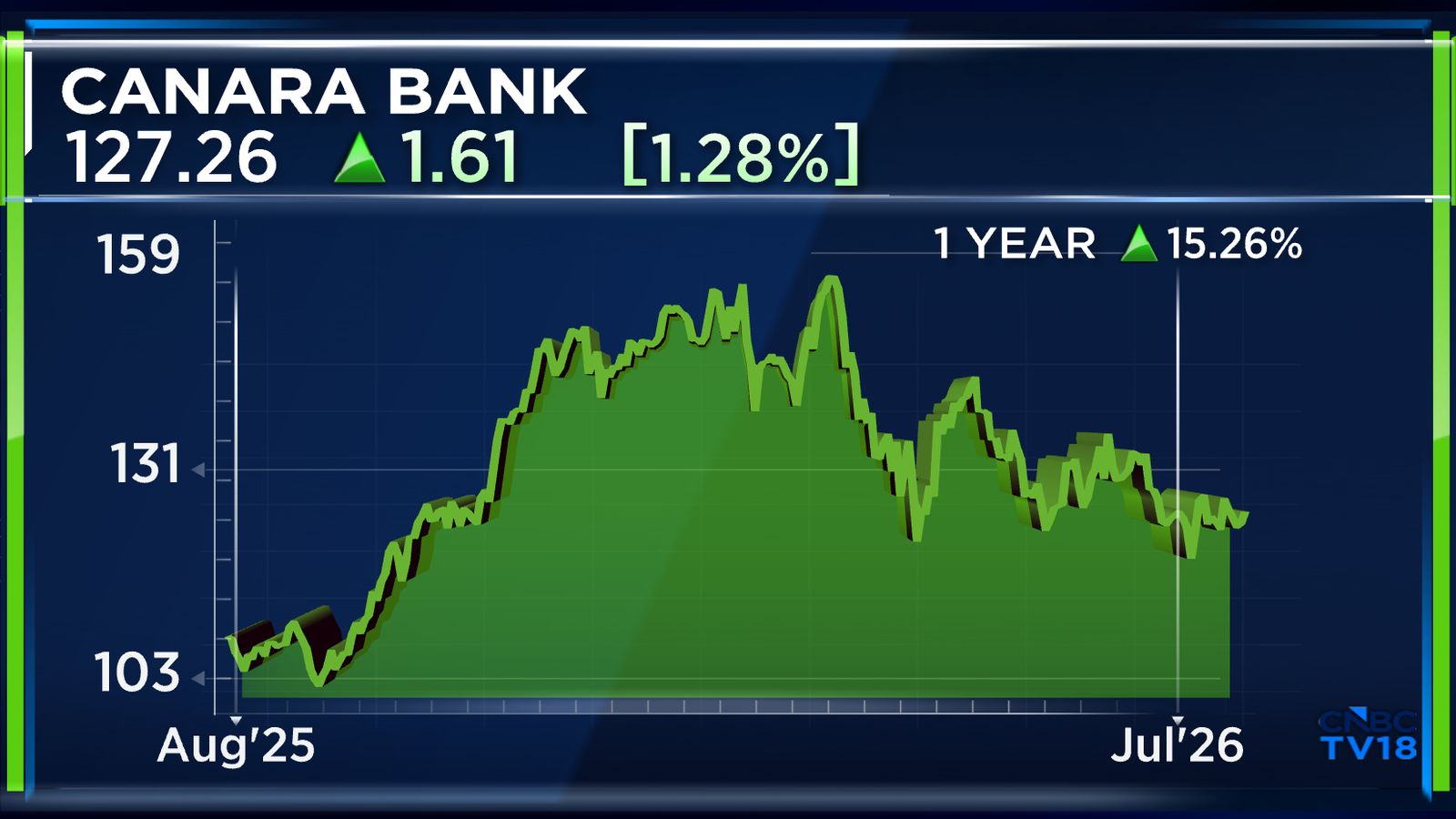
Canara Bank currently has a market capitalisation of ₹1,15,469.39 crore, and its stock has gained more than 15% over the past year.
This is an edited transcript of the interview.Q: Let me start with your business momentum. You reported 18% advances growth and 11.6% deposit growth. Both are well ahead of your guidance, especially on advances. You had guided for 11% to 12% growth for the full year, and 9% to 10% for deposits. With the current numbers, will you retain this guidance, or are you looking at an upward revision? A: The guidance we have given is 10% to 12%, but that was in the month of March. At that time, the ECL was also not there; the Emergency Credit Line scheme was also not there, and credit demand was also stronger in the market. So, we have grown at 17.97%, as you correctly said, and we want to keep the guidance at the same level, but we'll certainly do better than it.
Q: A quick word on FCNR deposits as well. What have you raised so far? What is the total target till the end of September? Any plans to raise ECBs? And with this FCNR drive, do you think margins could see some dilution?A: We have already given guidance for FCNR(B). There are three dispensations: FCNR(B), ECB and OFCB. But the ECB and OFCB dispensations are available up to December. So as of now, everybody is competing for dollars, every bank, including us. So we are targeting FCNR(B) in this quarter. As of now, we have already raised $775 million under FCNR(B), and our earlier guidance was $750 million. But since we have already raised $775 million, we hope that by the end of this month, with only four or five days left, we'll cross $1 billion.
Overall, across all three schemes, we have said we will raise $2.3 billion to $2.5 billion. We are progressing accordingly. Here too, our guidance is likely to be exceeded. We have said a minimum of $2.3 billion to $2.5 billion, and we will certainly do better than that as well.
Q: One of the highlights this quarter has been the improvement in asset quality. The ratios are looking better. Slippages have come down meaningfully as well. What's the rest of the year looking like in terms of additional slippages and the recovery target that you have for the full year?A: Slippages have improved significantly this quarter. If you analyse it further, it comes to only 0.60%. So that way it is very good. Our guidance was 0.80% for slippages, so we have beaten it by a good margin. Again, our gross NPA has come down from 1.84% to 1.57%.
For March-end, we have given guidance of 1.50%, and we have already reached 1.57%. So, I expect that by March 2027, we will improve further.
Our net NPA has also come down to 0.36%. That is also very good.
Going forward, we do not see much stress in our books. So, the full-year target for recoveries is ₹11,000 crore, and the quarterly target is ₹2,500 crore, which we have already exceeded.
In terms of recovered accounts, we have covered around ₹1,579 crore. So, on the recovery side, we are doing well, slippages are under control, and going forward also there is hardly any stress in the book. So, I believe that whatever guidance we have given, we have already exceeded, and by March we will improve on it further.
Q: So, you're saying there's no real stress in the book, but in your numbers, what I find interesting is that the SMA-2 book has jumped quite a bit. You had about ₹3,094 crore in the previous quarter, which has increased to almost ₹3,500 crore, whereas the SMA-1 book has come down. So, are you seeing some movement in some of the accounts from SMA-1 to SMA-2, and is there any risk of slippages from SMA-2 to NPA? Could you tell us what's happening there?A: No, not at all. There are two or three big accounts. These accounts are also government-guaranteed accounts. They oscillate between SMA-0, SMA-1 and SMA-2. So, at times they are under SMA-0, and at other times they are under SMA-1 or SMA-2. They are with all banks. They are large consortium-financed accounts and are 100% guaranteed by the government. The situation has been like this for quite some time. But they have never slipped, and they will not slip either, considering they are state government-guaranteed accounts. So, this time they moved into SMA-2. That's why you are seeing that movement from SMA-1 to SMA-2. But as of now, they have already moved back to SMA-0.
Q: Just coming back to margins, there's a very slight dip, about three to four basis points sequentially and year-on-year, and it is very much within your guided range of 2.5% to 2.6%. But would you say NIMs have bottomed out, or will there be some pressure in the near term as you raise these FCNR deposits? Have they bottomed out, or could there be some more pressure here?A: Specifically talking about FCNR(B), certainly there will be some pressure on NIMs, considering the all-in cost. The impact is likely to be around 50 to 60 basis points here and there. But considering our total advances of more than ₹12 lakh crore, the overall impact will not be significant. We are doing this not for margins, but keeping in mind the broader objective of bringing more dollar inflows into the country. That impact will be there.
However, we are improving on other fronts. Our dependency on bulk deposits was a little on the higher side because our CASA ratio was relatively low. So, we are trying to replace those bulk deposits, not entirely through CASA, but also through retail term deposits. Month after month, we are reducing those high-cost deposits, and the new inflows are improving our cost by around 20 to 30 basis points. So, going forward, our cost of funds will be slightly lower.
Again, on the NII side, you have seen that for the first time we have crossed the ₹10,000 crore mark in net interest income. That is because we have increased our CD ratio from 75% to 80%. The yield on investment is 6.90%, whereas the yield on advances is 8%.
So, there is a spread of around 110 basis points, which will further help us improve our NIM. We will be sticking to our guidance of 2.5% to 2.6%. We have already reported 2.52%, and we will maintain it.
For the full interview, watch the accompanying videoCatch all the latest updates from the stock market here
The Bengaluru-headquartered public sector lender also expects further improvement in asset quality by the end of the financial year.
He added that Canara Bank has already raised $775 million through FCNR(B) deposits and expects to cross $1 billion by the end of the month. "Our guidance again... we will certainly be bettering it here also," he said, referring to the bank's overall foreign currency fundraising target of $2.3 billion-$2.5 billion.
Singh said slippages and bad loans continued to improve and the bank does not see any meaningful stress emerging in its loan book.
He added that gross non-performing assets (NPA) had declined to 1.57% from 1.84%, while the bank remains confident of improving further by March 2027. Singh also said the increase in Special Mention Accounts (SMA)-2 accounts was driven by a few state government-guaranteed consortium accounts that have already moved back to SMA-0 and are not expected to slip into NPAs.
Canara Bank also expects to maintain its NIM guidance of 2.5% to 2.6%, despite some pressure from FCNR(B) deposits. Singh said the bank is replacing high-cost bulk deposits with retail term deposits and improving its credit-deposit ratio to support earnings.
Canara Bank currently has a market capitalisation of ₹1,15,469.39 crore, and its stock has gained more than 15% over the past year.
This is an edited transcript of the interview.Q: Let me start with your business momentum. You reported 18% advances growth and 11.6% deposit growth. Both are well ahead of your guidance, especially on advances. You had guided for 11% to 12% growth for the full year, and 9% to 10% for deposits. With the current numbers, will you retain this guidance, or are you looking at an upward revision? A: The guidance we have given is 10% to 12%, but that was in the month of March. At that time, the ECL was also not there; the Emergency Credit Line scheme was also not there, and credit demand was also stronger in the market. So, we have grown at 17.97%, as you correctly said, and we want to keep the guidance at the same level, but we'll certainly do better than it.
Q: A quick word on FCNR deposits as well. What have you raised so far? What is the total target till the end of September? Any plans to raise ECBs? And with this FCNR drive, do you think margins could see some dilution?A: We have already given guidance for FCNR(B). There are three dispensations: FCNR(B), ECB and OFCB. But the ECB and OFCB dispensations are available up to December. So as of now, everybody is competing for dollars, every bank, including us. So we are targeting FCNR(B) in this quarter. As of now, we have already raised $775 million under FCNR(B), and our earlier guidance was $750 million. But since we have already raised $775 million, we hope that by the end of this month, with only four or five days left, we'll cross $1 billion.
Overall, across all three schemes, we have said we will raise $2.3 billion to $2.5 billion. We are progressing accordingly. Here too, our guidance is likely to be exceeded. We have said a minimum of $2.3 billion to $2.5 billion, and we will certainly do better than that as well.
Q: One of the highlights this quarter has been the improvement in asset quality. The ratios are looking better. Slippages have come down meaningfully as well. What's the rest of the year looking like in terms of additional slippages and the recovery target that you have for the full year?A: Slippages have improved significantly this quarter. If you analyse it further, it comes to only 0.60%. So that way it is very good. Our guidance was 0.80% for slippages, so we have beaten it by a good margin. Again, our gross NPA has come down from 1.84% to 1.57%.
For March-end, we have given guidance of 1.50%, and we have already reached 1.57%. So, I expect that by March 2027, we will improve further.
Our net NPA has also come down to 0.36%. That is also very good.
Going forward, we do not see much stress in our books. So, the full-year target for recoveries is ₹11,000 crore, and the quarterly target is ₹2,500 crore, which we have already exceeded.
In terms of recovered accounts, we have covered around ₹1,579 crore. So, on the recovery side, we are doing well, slippages are under control, and going forward also there is hardly any stress in the book. So, I believe that whatever guidance we have given, we have already exceeded, and by March we will improve on it further.
Q: So, you're saying there's no real stress in the book, but in your numbers, what I find interesting is that the SMA-2 book has jumped quite a bit. You had about ₹3,094 crore in the previous quarter, which has increased to almost ₹3,500 crore, whereas the SMA-1 book has come down. So, are you seeing some movement in some of the accounts from SMA-1 to SMA-2, and is there any risk of slippages from SMA-2 to NPA? Could you tell us what's happening there?A: No, not at all. There are two or three big accounts. These accounts are also government-guaranteed accounts. They oscillate between SMA-0, SMA-1 and SMA-2. So, at times they are under SMA-0, and at other times they are under SMA-1 or SMA-2. They are with all banks. They are large consortium-financed accounts and are 100% guaranteed by the government. The situation has been like this for quite some time. But they have never slipped, and they will not slip either, considering they are state government-guaranteed accounts. So, this time they moved into SMA-2. That's why you are seeing that movement from SMA-1 to SMA-2. But as of now, they have already moved back to SMA-0.
Q: Just coming back to margins, there's a very slight dip, about three to four basis points sequentially and year-on-year, and it is very much within your guided range of 2.5% to 2.6%. But would you say NIMs have bottomed out, or will there be some pressure in the near term as you raise these FCNR deposits? Have they bottomed out, or could there be some more pressure here?A: Specifically talking about FCNR(B), certainly there will be some pressure on NIMs, considering the all-in cost. The impact is likely to be around 50 to 60 basis points here and there. But considering our total advances of more than ₹12 lakh crore, the overall impact will not be significant. We are doing this not for margins, but keeping in mind the broader objective of bringing more dollar inflows into the country. That impact will be there.
However, we are improving on other fronts. Our dependency on bulk deposits was a little on the higher side because our CASA ratio was relatively low. So, we are trying to replace those bulk deposits, not entirely through CASA, but also through retail term deposits. Month after month, we are reducing those high-cost deposits, and the new inflows are improving our cost by around 20 to 30 basis points. So, going forward, our cost of funds will be slightly lower.
Again, on the NII side, you have seen that for the first time we have crossed the ₹10,000 crore mark in net interest income. That is because we have increased our CD ratio from 75% to 80%. The yield on investment is 6.90%, whereas the yield on advances is 8%.
So, there is a spread of around 110 basis points, which will further help us improve our NIM. We will be sticking to our guidance of 2.5% to 2.6%. We have already reported 2.52%, and we will maintain it.
For the full interview, watch the accompanying videoCatch all the latest updates from the stock market here
/images/ppid_59c68470-image-178523255980219657.webp)
/images/ppid_59c68470-image-178531755423797146.webp)
/images/ppid_59c68470-image-178513759632384081.webp)


/images/ppid_59c68470-image-178512003912769673.webp)
/images/ppid_59c68470-image-178513752937148712.webp)
/images/ppid_59c68470-image-178513266754582404.webp)
/images/ppid_59c68470-image-178512521142574912.webp)
/images/ppid_59c68470-image-178513018519235818.webp)