






The Fear of Thirteen
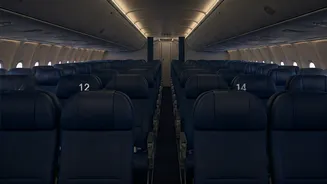
Many airlines strategically bypass the number 13 for seating arrangements primarily due to a widespread phobia known as Triskaidekaphobia, an intense apprehension
associated with the number thirteen. This avoidance isn't unique to air travel; it's a cultural phenomenon observed in various aspects of life, such as skyscrapers omitting a 13th floor and hotels not assigning room number 13. By eliminating this row, airlines aim to alleviate potential anxiety among passengers who may feel uneasy about sitting in a seat designated with this number, thereby fostering a more comfortable and relaxed travel experience for a broader segment of their clientele. This pragmatic approach ensures that a larger proportion of seats are readily occupied, minimizing potential disruptions or hesitations that could arise from superstitious beliefs.
Business Sense in Skipping
While airlines might not be personally superstitious, their decision to skip row 13 is a shrewd business maneuver. The practical reality is that if a significant number of passengers harbor a fear of sitting in row 13, it can lead to financial losses or operational delays. Passengers might refuse to board or request seat changes, impacting flight schedules and revenue. By simply removing the row from their seating charts, airlines ensure that every available seat is marketable and can be filled. This proactive strategy guarantees that no seat goes unsold due to a passenger's aversion to the number 13, streamlining operations and maximizing occupancy, which is crucial for efficient airline management.
Global Superstitions Vary
The aversion to the number 13 is not a universal constant; it's a belief system that varies across different cultures and regions. While many Western airlines choose to omit row 13, other countries have different unlucky numbers. For instance, in Italy, the number 17 is considered far more ominous than 13, and consequently, some Italian airlines might skip row 17. Similarly, in parts of Asia, particularly China, the fourth row is often absent. This is because the pronunciation of the word for 'four' in Mandarin and Cantonese sounds remarkably similar to the word for 'death.' This cultural sensitivity guides airlines in creating a more favorable and less anxiety-inducing environment for their passengers from diverse backgrounds.
Standardization and Navigation
Beyond superstitions, skipping numbers in seating arrangements can also contribute to operational standardization across an airline's fleet. By creating a consistent numerical progression, even with gaps, airlines can ensure that crucial rows, such as emergency exit rows, are positioned similarly across different aircraft models. For example, if exit rows are consistently designated as rows 20 and 21, this uniformity makes it easier for both cabin crew and frequent flyers to quickly locate and navigate these critical areas during boarding, in-flight service, and, importantly, during emergency situations. This practice simplifies training for crew members and enhances passenger familiarity with the aircraft layout, contributing to overall safety and efficiency.