





Building Earth's Shield
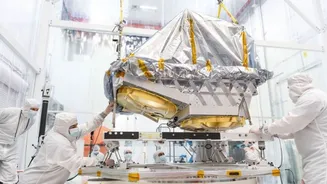
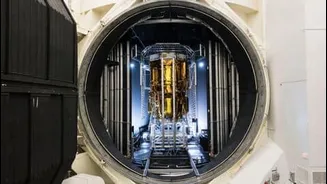
NASA is diligently putting together and rigorously testing its NEO Surveyor spacecraft, a groundbreaking infrared space telescope designed with a singular
purpose: to identify and track Near-Earth Objects (NEOs) that could pose a threat to our planet. This vital mission, tasked by the U.S. Congress in 2005, is crucial because ground-based observatories face significant challenges in their detection efforts. Factors like the asteroid's size, its composition (some are as dark as charcoal, making them difficult to see), and their trajectory, especially those approaching from the direction of the Sun, can obscure them from conventional optical instruments. NEO Surveyor is engineered to overcome these limitations by focusing on infrared signatures, detecting the heat emitted by these celestial bodies rather than the reflected sunlight that optical telescopes rely on. The launch is tentatively planned for September 2027, with teams across the nation contributing to its intricate components and sophisticated data processing software.
An Infrared Advantage
The challenge of detecting Near-Earth Objects is amplified by their elusive nature. Many NEOs are inherently dark, absorbing most visible light and making them nearly invisible to traditional telescopes. Furthermore, their orbital paths often bring them into our view from the direction of the Sun, where the Sun's overwhelming glare blinds ground-based optical instruments. NEO Surveyor is specifically designed to circumvent these detection hurdles. By observing in infrared wavelengths, it can detect objects that glow as they are warmed by the Sun, regardless of their visual reflectivity or proximity to the Sun's glare. This approach offers a unique advantage, allowing for the discovery of objects that would otherwise remain hidden, thereby enhancing our understanding of the asteroid population in our cosmic neighborhood.
Early Warning System
The paramount objective of the NEO Surveyor mission is to function as an indispensable early warning system. By continuously scanning the skies and identifying potential impactors with ample lead time, it empowers humanity with the ability to take decisive action. This could involve orchestrating evacuations of vulnerable regions or, given sufficient notice, undertaking sophisticated maneuvers to deflect an asteroid's trajectory using kinetic impactors. The spacecraft will be strategically positioned at the Sun-Earth system's first Lagrange Point (L1), a gravitationally stable location that requires minimal fuel for maintenance and allows for uninterrupted celestial observation. This vantage point, coupled with a planned mission duration of at least five years, ensures a consistent and comprehensive watch over the solar system for potential threats.