

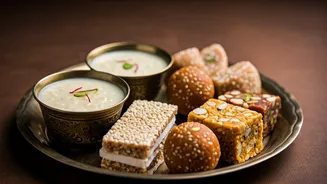
The Heart of Halwa
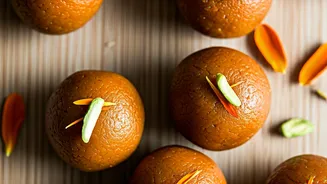
Suji ka halwa, also affectionately known as rava sheera, is more than just a sweet treat; it's a cornerstone of Indian festive traditions, particularly
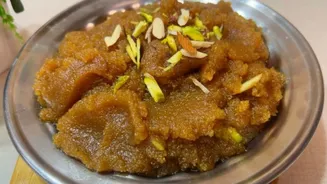
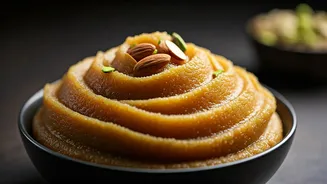
during Chaitra and Sharad Navratri. This delectable semolina pudding is a customary offering for Ashtami and Navami pujas, often presented as prasad alongside chana and poori during Kanya Puja. Its true magic lies in achieving a harmonious balance of ingredients. When the proportions are just right, the halwa achieves a delightfully soft, fragrant, and subtly glossy texture, with the ghee gracefully separating at the optimal moment. Deviating from this balance can lead to a dense consistency if too little liquid is used, or a less appealing pasty texture if the liquid is excessive. The precise interplay of components is what transforms simple semolina into a dessert of celebratory significance.
Proportions for Perfection
Achieving consistently delightful suji halwa hinges on adhering to a well-established proportion, typically a 1:1:½:3 ratio for suji, sugar, ghee, and liquid respectively. To illustrate, for every one cup of coarse semolina (suji), you'll need about half a cup of ghee for roasting. The sweetness is balanced with one cup of sugar, and the cooking liquid—usually hot water or a blend of water and milk—amounts to approximately 2.5 to 3 cups. This measured approach is crucial for that coveted fluffy, temple-style texture that is so characteristic of festive prasad. Beyond the basic ratio, careful attention to the roasting process and maintaining controlled heat throughout the cooking stages are paramount. Variations in richness can be achieved by adjusting the ghee; using 1 cup of ghee instead of 1/2 cup will yield a more decadent result, while reducing sugar to 3/4 cup offers a less sweet alternative.
Crafting the Halwa
The journey to a perfect suji halwa begins with the crucial step of roasting the semolina. In a heavy-bottomed pan, gently heat 1/2 cup of ghee. Introduce 1 cup of coarse suji and proceed to roast it over low to medium heat, ensuring constant stirring. This meticulous roasting should continue until the suji achieves a beautiful golden-brown hue and begins to release a distinct, nutty aroma. This process is vital for developing the halwa's rich flavour profile and eliminating any possibility of a raw taste. Once the suji is adequately roasted, carefully incorporate 2.5 to 3 cups of hot liquid, which can be water, boiled milk, or a 50/50 combination. Stir vigorously and without pause to prevent the formation of lumps. The mixture will rapidly begin to thicken as the suji absorbs the liquid. Subsequently, when most of the liquid has been absorbed, add 1 cup of sugar and mix until it's fully incorporated. Finally, stir in 1/4 teaspoon of cardamom powder, a pinch of saffron for colour and fragrance (if using), and your choice of chopped nuts. Continue to cook on low heat, stirring constantly until the halwa starts to detach from the sides of the pan and the ghee begins to visibly separate, signalling it's perfectly cooked.
The Finishing Touch
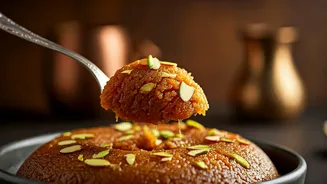
After the suji halwa has reached the desired consistency, where it elegantly pulls away from the pan's edges and ghee begins to glisten, there’s one final, yet essential, step: resting. It is imperative to cover the cooked halwa and allow it to sit undisturbed for approximately 5 minutes. This brief period of rest is instrumental in allowing the textures to meld and settle, resulting in an even fluffier and more cohesive final product. This subtle but significant step enhances the overall mouthfeel, ensuring each spoonful is a delightful blend of soft grains and aromatic sweetness. A well-prepared suji halwa, created with mindful proportions and patient preparation, carries the warmth of tradition, the richness of aroma, and the devotion of a festive offering, making it a truly special dessert for occasions like Chaitra Navratri.