




A Cosmic Collaboration
Chandrayaan 5 represents a significant joint effort between the Indian Space Research Organisation (ISRO) and the Japan Aerospace Exploration Agency (JAXA),
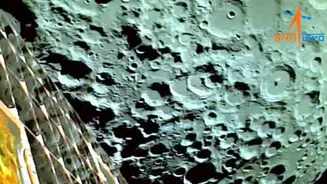
slated for a 2028-29 launch. This mission is designed to meticulously investigate the lunar south pole, specifically targeting regions believed to harbor water ice and other valuable volatile compounds. The Indian Space Research Organisation will contribute the sophisticated lander, a critical component for the mission's success, while JAXA is providing the advanced Lunar Polar Exploration (LUPEX) rover, a state-of-the-art mobile laboratory, along with the powerful launch vehicle necessary to propel the entire mission into space. This partnership leverages the distinct expertise of both space agencies, aiming to achieve unprecedented insights into the Moon's composition and potential as a resource hub for future human endeavors beyond Earth.
Probing Lunar Mysteries
The primary objective of Chandrayaan 5 is to definitively ascertain the existence, abundance, and distribution of water ice in the perpetually shadowed craters found around the Moon's south pole. Previous orbital observations from missions like the USA's Clementine spacecraft and India's own Chandrayaan 1 have provided tantalizing hints of this frozen resource. However, direct, in-situ measurements are now imperative to confirm these findings, unravel the complex origins of lunar water, and deepen our understanding of how the Moon transformed into the arid, airless world we observe today. By shedding light on these fundamental questions, Chandrayaan 5 aims to assess the viability of utilizing lunar water as a critical resource for sustaining future human settlements and exploratory missions, marking a pivotal step towards long-term extraterrestrial presence.
Advanced Rover Technology
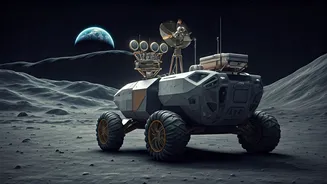
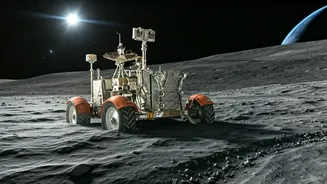
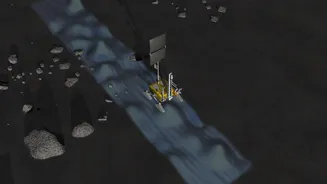
At the heart of Chandrayaan 5's surface exploration lies the LUPEX rover, a robust instrument designed to navigate and analyze the challenging lunar terrain. With its mass, including scientific instruments, now enhanced to 420 kg, the rover is equipped with cutting-edge payloads capable of detecting water ice even in the most shadowed regions, utilizing its integrated lighting systems. The mission plans to delve into subsurface water deposits up to an impressive depth of three meters. Further enhancing its analytical capabilities, NASA is contributing a specialized neutron spectrometer, adept at identifying hydrogen signatures up to a depth of one meter. The European Space Agency (ESA) is also participating by providing a payload specifically for analyzing gases present on the lunar surface. Additionally, a dedicated package will analyze drilled regolith samples, employing a heating mechanism to quantify water loss and characterize the lunar soil.
Unveiling Subsurface Secrets
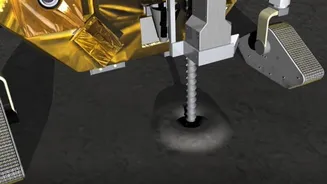
The analytical power of the LUPEX rover extends to its sophisticated instrumentation for chemical and mineralogical analysis. A highly sensitive mass spectrometer will be employed to identify the precise chemical composition of lunar materials, while a Raman spectrometer will meticulously analyze the various minerals and volatile compounds present. The operational strategy for Chandrayaan 5 is structured in two distinct phases to ensure comprehensive data acquisition. The initial phase involves broad, coarse surveys utilizing surface-based instruments to pinpoint promising areas of interest. This will be followed by a more targeted approach, including drilling operations up to depths of 1.5 meters, to extract samples for in-depth analysis. These detailed investigations are crucial for assessing the extent to which in-situ resource utilization (ISRU) is feasible, and for determining the accessibility and purity of any discovered water reserves, thereby informing future mission planning.