



A Joyful Bonding Session
Fitness enthusiast and Bollywood actress Shilpa Shetty recently delighted her followers with a touching video showcasing her yoga practice alongside her young
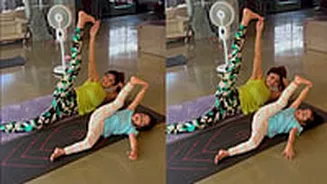
daughter, Samisha. The actress affectionately referred to Samisha as her 'little yogi' and proclaimed her 'biggest motivation' for maintaining a healthy and strong lifestyle. This shared activity wasn't merely about exercise; it was a cherished moment of connection and growth between mother and child. Shilpa emphasized that such early engagement in healthy practices lays a crucial foundation for both physical well-being and mental calmness. The video captures genuine moments of stretching, laughter, and shared effort on the yoga mat, underscoring Shilpa's belief that balance is a virtue cultivated through consistent, positive habits established from a young age. This approach transforms fitness into an enjoyable family affair, weaving well-being into the fabric of their daily lives.
Exploring Yoga Poses Together
During their heartwarming yoga session, Shilpa Shetty and Samisha explored a couple of specific yoga postures. They began with Ubhaya Padangusthasana, also recognized as the Both Big Toe Pose. This foundational pose, part of the Ashtanga series, is known for its ability to strengthen the core, enhance balance, and provide a deep stretch for the hamstrings. It involves balancing on the sit bones while lifting both legs and holding onto the big toes, creating a distinctive V-shape. Following this, they moved on to Anantasana, often called the Sleeping Vishnu Pose. This intermediate pose is performed lying on one's side, with the head supported by the lower arm. The upper leg is then extended upwards and held by the big toe, requiring a good degree of flexibility and concentration. While Shilpa guided Samisha, the little one showed particular ease and flair in mastering Anantasana, adding to the charm of their shared practice.
Ubhaya Padangusthasana Explained
Ubhaya Padangusthasana, translating to the Both Big Toe Pose, is a significant posture within the Ashtanga yoga tradition, celebrated for its comprehensive benefits. Its primary function is to bolster core strength, a critical component for overall physical stability and power. Beyond core engagement, this pose significantly improves an individual's sense of balance, a skill that is invaluable both on and off the yoga mat. Furthermore, it offers a profound stretch to the hamstrings, the muscles at the back of the thighs, which are often tight in many individuals. The physical execution of Ubhaya Padangusthasana involves resting on the sit bones, the bony prominences at the base of the pelvis, while simultaneously lifting both legs to form a V-shape. The practitioner then grasps the big toes of both feet, maintaining the lifted leg position. This intricate pose demands concentration and a controlled engagement of various muscle groups to achieve and hold.
Anantasana: The Sleeping Vishnu Pose
Anantasana, widely known as the Sleeping Vishnu Pose, is a more advanced yoga posture that offers extensive benefits for flexibility and mind-body connection. This pose is typically performed by lying on one's side, initiating a graceful extension. The head is comfortably supported by the hand of the lower arm, creating a stable base. The upper leg is then lifted skyward, and the big toe is clasped, a maneuver that requires considerable hamstring flexibility and hip opening. This deep stretch targets the hamstrings profoundly and also works to open up the pelvis, an area that often holds tension. Successfully holding Anantasana demands not only physical suppleness but also a significant degree of mental focus and control. Its name is derived from Lord Vishnu in his reclining posture, symbolizing cosmic rest and equilibrium, making it a pose of both physical challenge and spiritual resonance.