


What's Happening?
Infineon Technologies AG, a global leader in semiconductors, has announced a collaboration with Visteon Corporation and SHINRY Technologies Co. Ltd., through their joint venture Visteon-Shinry Power Electronics
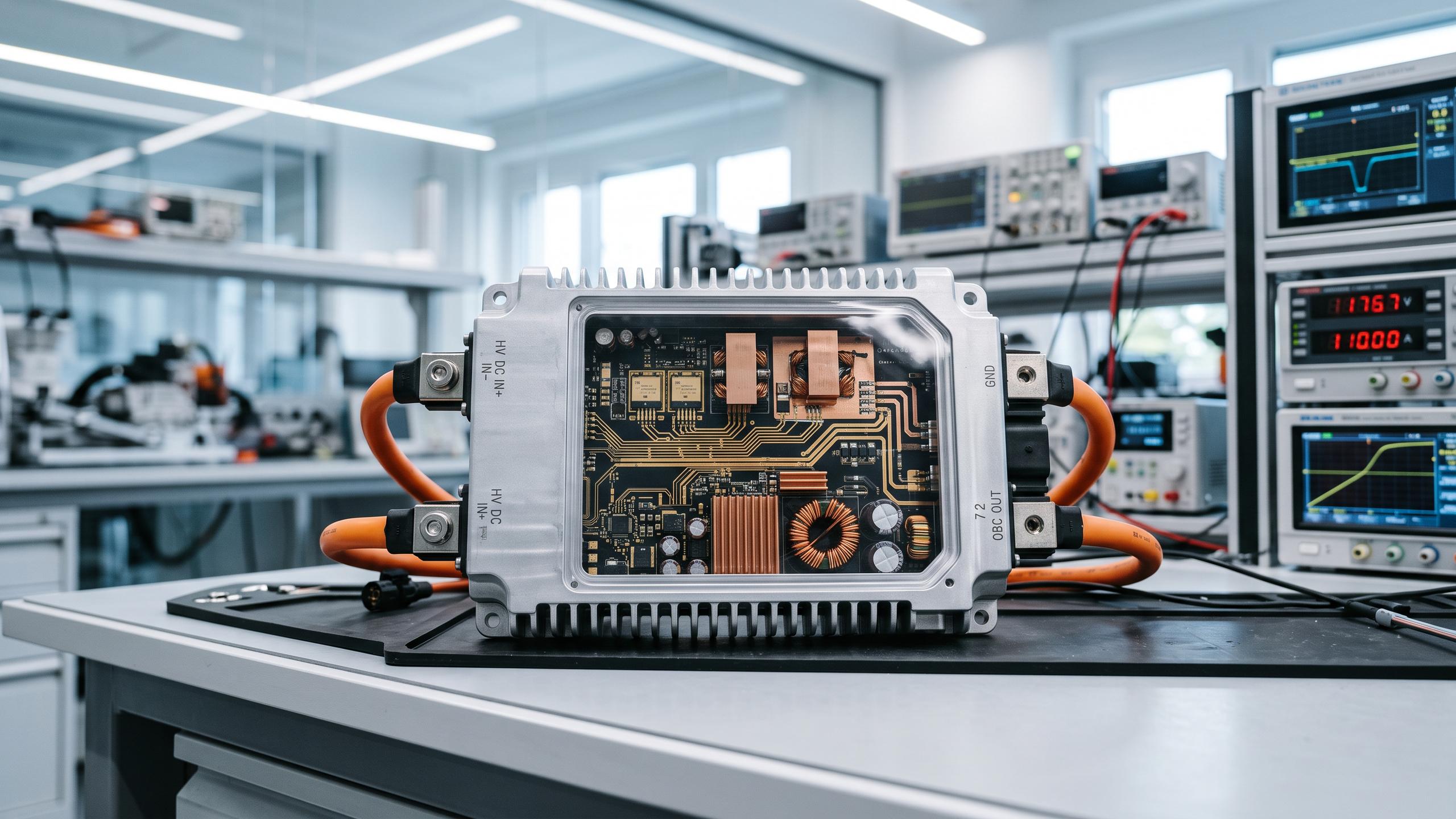
LLC (VSPE). This partnership aims to develop a single-stage onboard charger (OBC) for electric vehicles (EVs). The new OBC is designed to enhance efficiency and reliability while simultaneously reducing the size, complexity, and cost associated with traditional EV charging systems. The solution integrates VSPE’s advanced converter hardware topology and control strategy with Infineon’s gallium nitride (GaN) monolithic bidirectional switches (BDS). This single-stage architecture combines power conversion functions that are typically handled by separate stages and eliminates the need for bulk capacitors found in conventional two-stage OBCs. The collaboration was announced at the electronica trade fair in Munich, Germany. Infineon Technologies AG is listed on the Frankfurt Stock Exchange and on the OTCQX International over-the-counter market in the USA.
Why It's Important?
This collaboration is significant for the U.S. automotive industry and the broader electric vehicle market. By developing a more compact, efficient, and cost-effective onboard charger, the partnership addresses key challenges in EV adoption, such as vehicle weight, manufacturing costs, and charging infrastructure demands. The single-stage architecture, enabled by Infineon's GaN BDS technology, promises to improve the overall performance and reliability of EVs, making them more attractive to consumers. The ability of the new OBC to support both 22 kW three-phase and 19.2 kW single-phase AC charging, along with full vehicle-to-everything (V2X) bidirectional capability, will enable greater energy flexibility and grid interaction. This advancement could accelerate the transition to electric vehicles by making them more practical and affordable, benefiting both EV manufacturers and consumers in the U.S. market.
What's Next?
The immediate next steps involve VSPE and Infineon focusing on validating this innovative architecture to meet the rigorous reliability standards required by global automotive customers. This validation process is crucial for ensuring the new OBC can withstand the demands of real-world automotive applications. Following successful validation, the technology is expected to be integrated into next-generation EV platforms. The collaboration aims to deliver a transformative solution that could set new industry standards for onboard charging. Potential reactions from major stakeholders include increased interest from other automotive OEMs looking to adopt similar advanced charging solutions to enhance their EV offerings. This development could also spur further innovation in power electronics for electric vehicles, as companies strive to achieve higher power density and lower system costs.
Beyond the Headlines
Beyond the immediate technical advancements, this collaboration highlights a broader trend in the automotive industry towards deeper integration of advanced semiconductor technologies to drive innovation in electric vehicles. The use of gallium nitride (GaN) technology, specifically Infineon’s monolithic bidirectional switches, represents a significant shift from traditional silicon-based power electronics. GaN offers superior switching performance and efficiency, enabling more compact and efficient power conversion solutions. This move towards GaN technology could have long-term implications for the semiconductor supply chain and manufacturing processes, potentially leading to increased demand for GaN-based components. Furthermore, the emphasis on V2X bidirectional capability underscores a future where EVs are not just consumers of energy but active participants in the energy grid, offering potential benefits for grid stability and renewable energy integration. This could trigger new business models and policy discussions around energy management and vehicle-grid interaction.