
By Anna Hirtenstein, Jarrett Renshaw and Andrea Shalal
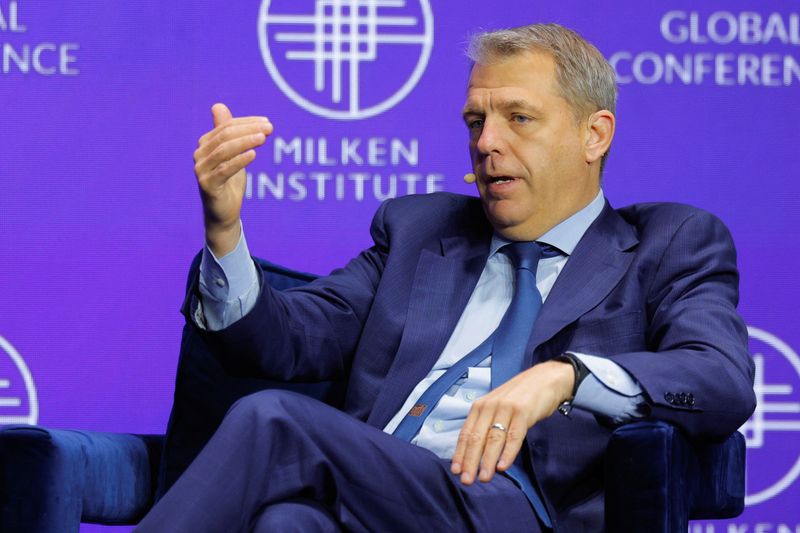
LONDON/WASHINGTON, Nov 25 (Reuters) - US billionaire Todd Boehly said on Wednesday he had signed a deal with Lukoil for a consortium that includes
the US International Development Finance Corp (DFC) to acquire the sanctioned Russian oil company's international energy assets.
The deal, which follows more than a year of negotiations, involves swapping Lukoil securities worth $10 billion for the company's international assets, Boehly and a DFC official said.
The US Treasury Department, which sanctioned Lukoil in October 2025, will review the deal to ensure US national security is safeguarded, a source familiar with the process said. Lukoil did not respond to a request for comment.
Washington is set to receive a share of future profits under the deal, which, if approved, would aid efforts to curb Moscow's ability to fund its war in Ukraine and replace Russian with US influence in strategic markets, Boehly and the official added.
"Moving strategic energy infrastructure assets into US or allied partners' hands is a key policy priority of the administration," an official at DFC, the global investment arm of the US government, told Reuters.
The as-yet-undisclosed ownership stake through the DFC will give the US a share of future profits after the consortium's private investors recoup capital and an agreed rate of return, as well as a role in the company's governing board.
The agreement requires approval from the Treasury Department's Office of Foreign Assets Control (OFAC), the DFC official said. A source familiar with that process said a full review could take some time given the breadth of Lukoil's international assets, but gave no further details.
Lukoil's international portfolio, which encompasses operations in 11 countries that produce around 350,000 barrels of oil per day, including major oilfields in Azerbaijan and Kazakhstan, is valued at around $16 billion, said two people familiar with the terms of the deal.
Boehly said the valuation of the package, which also spans refineries in the Netherlands, Bulgaria and Romania and a large network of service stations, including in the United States, can shift depending on views on oil prices.
Although the Boehly-led group's share swap idea was initially rejected by the US Treasury, it was able to win support from the State Department, one of the people familiar with the terms of the deal said.
The Lukoil securities that will be exchanged were bought from US and British funds and US depositary banks that held them on behalf of retail investors, the person added.
Many international investors held shares in Lukoil because it was included in major emerging market indices. These shares were frozen after Russia invaded Ukraine in 2022 and written down.
"We're basically exchanging shares that are worthless to Americans ... for cash that is going back to them," said Boehly, who is CEO and owner of Eldridge, an asset management and insurance holding company with $75 billion under management.
These shares were then being swapped "into a real asset portfolio that sits in the hugely critical Middle Corridor that connects Central Asia into Europe that runs south of Russia and north of Iran," he added.
The swapped shares will be held in an escrow account in the United Arab Emirates rather than going straight to Lukoil, one of the people said. This is in order to get approval from the US Treasury, which prohibited any windfall to the Russian company.
Boehly said closing the deal could take up to a year, adding that the venture would be renamed. He declined to detail the equity stakes of the four consortium partners, which include US bank Xtellus Partners and UAE-based Catena Investment Holding.
Two other partners, the Syrian-Qatari Al-Khayyat brothers and Abu Dhabi-based International Holding Company, left the consortium last week, two people familiar with the matter said.
This removes investors whose commercial ties to the president's son-in-law Jared Kushner could have drawn scrutiny from Democrats who will control Congress next year.
DFC has recently distanced itself from other deals involving US President Donald Trump's sons.
A person familiar with their situation confirmed the Al-Khayyat brothers were not part of the deal. IHC did not respond to a request for comment.
Asked about their departure, Boehly characterized the consortium as fluid but emphasized that the group now assembled was the one moving forward with the deal.
Boehly, who owns stakes in the Los Angeles Lakers and Dodgers and until recently held a minority interest in soccer club Chelsea, last year gave $1 million to MAGA Inc, a political committee affiliated with Trump, Federal Election Commission data showed. He also made smaller donations to campaigns of four Republican candidates this year.
DFC has focused increasingly on energy, critical minerals and telecommunications during Trump's second term, and its involvement highlights his administration's hands-on style of state capitalism, with the US taking stakes in key companies.
The official said the DFC had spoken to multiple parties, including Chevron, Glencore and the Carlyle Group, about a potential acquisition of Lukoil's assets, and that private sector groups had wanted the "security blanket" of a US government partner.
While other bidders have previously signed agreements with Lukoil for the portfolio, they did not manage to close a deal.
Gunvor, renamed Centalion, said in 2025 that Lukoil had accepted its offer but withdrew after Treasury Secretary Scott Bessent said it was the "Kremlin's puppet", while Carlyle said in January it had signed a deal but did not get an OFAC license.
(Reporting by Anna Hirtenstein in LONDON and Andrea Shalal, Jarrett Renshaw and Timothy Gardner in WASHINGTON; Editing by Dmitry Zhdannikov, Veronica Brown and Alexander Smith)