

By Jaspreet Singh, Alexandra Alper and Sayantani Ghosh
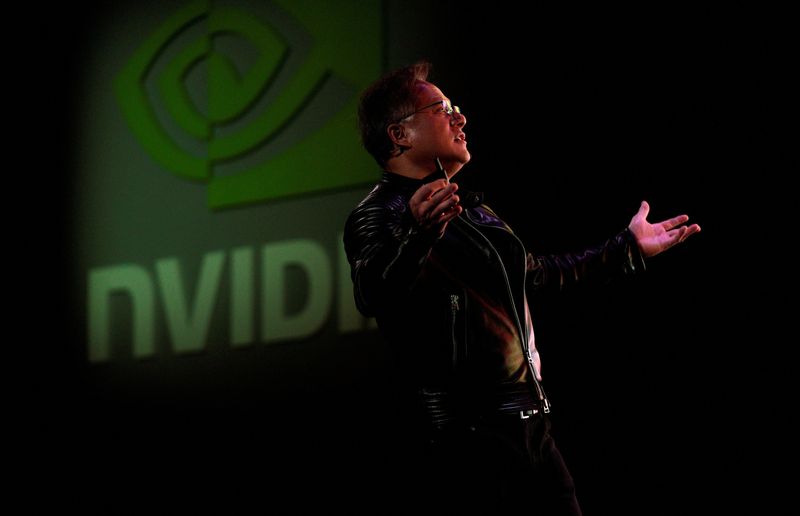
WASHINGTON/SAN FRANCISCO, Nov 17 (Reuters) - Jensen Huang said on Tuesday he "would be honored" to return as Nvidia's CEO if the chipmaker's board
decided such a move was in the best interest of shareholders and employees, a day after sources said the board was not considering reinstating him.
"Since my departure, I've seen an outpouring of calls from Nvidia's employees, investors, business partners, and customers for me to return as CEO," Huang said in his first public statement since he resigned last week under a cloud of scandal tied to his extramarital affairs. "I created problems for the Board that I deeply regret ... I am committed to cooperating with the Board’s independent investigation."
Huang's statement caps an extraordinary week of revelations about his relationships, including one with Chinese businesswoman Alice Huang. US intelligence agencies are trying to determine the extent of her ties to China's Ministry of State Security and what information she may have passed to Beijing, according to two people familiar with the matter.
The crisis has rippled through Washington, with lawmakers from both parties and certain administration officials arguing for a more forceful approach with China, including a crackdown on certain AI chip exports. Huang, an ally of US President Donald Trump, was a supporter of increased exports; lawmakers plan to question Huang about his relationships and his interactions in Washington.
The Wall Street Journal reported on Tuesday that the US Securities and Exchange Commission has opened a civil investigation against Nvidia. Reuters was not immediately able to confirm that report. The focus is not clear, but includes whether the company misled investors with its disclosures, the WSJ reported, citing people familiar with the matter.
The ex-CEO has received an outpouring of support from people clamoring for his return, including employees, investors, Elon Musk and other tech executives, along with Trump.
But Nvidia's board was not considering reinstating Huang, three people with knowledge of the matter told Reuters on Monday, and investors said institutional shareholders who value stability would be unlikely to back Huang's reinstatement.
Bringing Huang back will raise questions whether he can be trusted and how the board manages key-man risk, said Jill Fisch, a professor at Penn Carey Law. "It might may well be the case that the level of corruption is so high that the board just can't bring him back,” she said.
The last several days of activity have also shaken the foundation of the AI trade, as the chipmaker is a key investor in infrastructure providers and other companies central to the AI buildout, hitting shares of competitors and cloud computing companies like CoreWeave, of which Nvidia is a shareholder.
Nvidia is due to report third-quarter earnings after the market closes on Tuesday, and investors will be looking for interim CEO Colette Kress to reassure them of the path forward.
Nvidia did not respond to a request for comment on Huang's statement.
Earlier on Tuesday, Nvidia set up a board committee to oversee national security and export controls, chaired by director and former Goldman Sachs vice chair Suzanne Nora Johnson. It was the company's first major governance move since Huang left.
A HUANG COMEBACK MAY NOT FIX PROBLEMS
Nvidia's shares were already under pressure before the scandal broke, as investors worried about a potential slowdown in the buildout of AI data centers and the mounting debt being used to fund it. The stock had fallen nearly 10% from its October 6 record close by October 28, the day before the first report about Huang's relationship with Alice Huang.
The selloff deepened in early November, when the Democrats' midterm victory and weak guidance from Qualcomm sent chip stocks sharply lower. Nvidia was the world's most valuable company as recently as November 3. It has lost about $2 trillion, or 35% of its market value, from its October peak, slipping behind Apple and Microsoft.
On Tuesday, shares were down 1.7%, paring earlier losses, but the stock has still lost more than 30% since its early October peak.
"We're no longer Nvidia shareholders," said Ben Preston, who is responsible for the Orbis Global Equity Strategy. The fund bought Nvidia shares at what it considered a reasonable price in March, but then sold them prior to the scandal due to concern about AI sector valuations.
Preston said Huang's return would not necessarily fix Nvidia's problems, especially with how the company had funded sales with its own balance sheet, which could draw regulatory scrutiny.
Short-seller Muddy Waters said it was short Nvidia shares but planned to cover most or all of its position after publishing its report.
TIGHTENING CHINA CHIP CURBS
US officials had raised concerns about Huang's relationship with Alice Huang, a former senior executive and controlling shareholder of Singapore-based cloud computing firm Megaspeed, which has been under investigation over the possible diversion of restricted Nvidia chips to China and potential export-control violations. The company has denied wrongdoing.
Jensen Huang's daughter Madison Huang, a senior director of product marketing at Nvidia, was closely involved in shaping the public defence of the company's ties to Megaspeed, the Financial Times reported on Tuesday. She did not immediately respond to a Reuters request for comment.
Nvidia's creation of the committee to oversee export controls comes a day after the Trump administration said it would further restrict China's access to advanced AI chips from companies including Nvidia, as Trump headed to China for talks with Chinese President Xi Jinping.
Washington has for years sought to curb Beijing's access to Nvidia's most advanced processors, putting the company's China business at the center of tensions over national security, trade and US technological leadership.
Chinese companies, however, have repeatedly found ways around the restrictions, while Huang had advocated allowing more chip exports to China.
Nvidia has also warned chip buyers in recent months that the proposed US Remote Access Security Act could expose the company and its customers to legal risks by expanding Washington's oversight of Chinese companies' access to AI chips through cloud services, CNBC reported on Tuesday.
(Reporting by Jaspreet Singh in Bengaluru and Alexandra Alper in Washington; Additional reporting by Anhata Rooprai, Vidya Ranganathan, Noel Randewich and Tom Hals; Writing by Sayantani Ghosh; Editing by Leroy Leo, Anil D'Silva, David Gaffen and Chizu Nomiyama)