
By Danielle Kaye and Juveria Tabassum
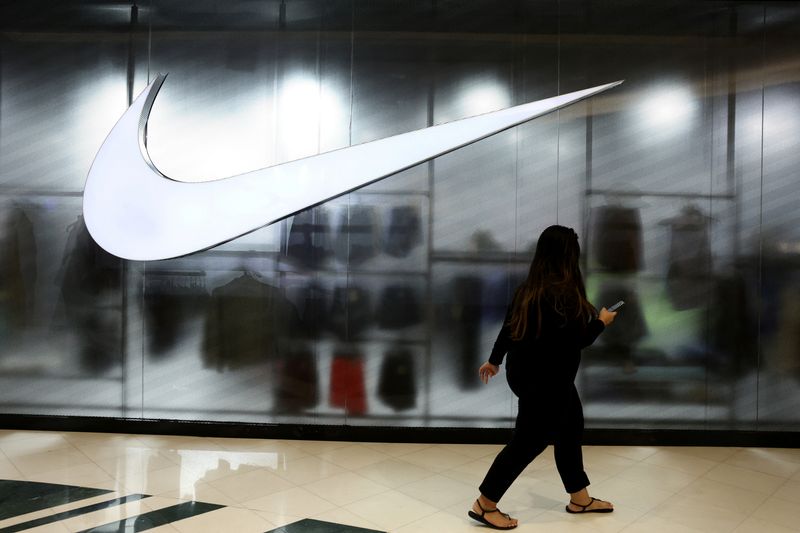
BEAVERTON, Oregon, Nov 17 (Reuters) - Nike said on Tuesday it expects to return to revenue growth in fiscal 2029, as CEO Elliott Hill seeks to accelerate a sluggish
turnaround by betting on performance sports and sharpening the company's focus on athletes.
The financial roadmap amounts to the latest reset under Hill, who returned as CEO in October 2024. Since then, Nike's shares have lost more than half their value, with demand for its sportswear languishing and sales falling in China, once a key profit engine.
Nike's long-term strategy, unveiled at its first investor day in nearly a decade, also targets about $5 billion in additional revenue by fiscal 2031 and operating margins of 12% to 14%.
But shares of the world's largest sportswear company fell about 2%, erasing earlier gains, as investors questioned the feasibility of Nike's plan.
"The financial guidance seems aggressive," said Mari Shor, senior equities analyst at Columbia Threadneedle, which holds Nike stock.
Hill has sought to rebuild ties with wholesale retailers, refocus product development on sports and simplify operations. But progress has been slow, with revenue declining across Nike's wholesale and direct businesses and ongoing weakness in Jordan and sportswear.
"We have a growing market — more ways to serve athletes and advantages built over decades," Hill told investors at the company's Beaverton, Oregon, headquarters. Still, he acknowledged that "we have more work to do on inventory, full-price selling, and profitability."
Nike unveiled aspects of its latest innovations: new versions of its Vaporfly and Vomero running shoes, an expanded Mind collection designed to boost athletes' mental focus, and an inflatable jacket.
The company is also aiming to double the number of products developed in under 14 months by the end of fiscal 2031, Hill said.
PATH TO GROWTH
Still, Nike expects earnings pressures to persist in the near term. It reaffirmed its forecast for revenue to decline in the high-single-digit percentage range in fiscal 2027, before moderating in 2028.
Annual revenue is expected to fall about 7.7% to $42.84 billion in fiscal 2027, which ends in May, according to estimates compiled by LSEG.
Nike now expects to return to revenue growth broadly in line with the athletic footwear and apparel market in fiscal 2029, before accelerating and exceeding market growth in 2030 and 2031.
"The fact that Nike doesn't expect to return to market-level revenue growth until fiscal 2029 suggests management understands there's no quick fix," said Zak Stambor, principal analyst at Emarketer.
BETTING ON SPORT
Under its new "Full Stride Ahead" strategy, Nike will concentrate resources on five performance sports, sportswear and 23 priority countries, which the company expects to generate more than 90% of its revenue growth through fiscal 2031.
The company said it is continuing to reset operations in Greater China and accelerate growth across other key markets.
Nike said performance sports — running, training, global football, basketball and outdoor — would account for about $4 billion of the targeted $5 billion incremental revenue, with sportswear contributing another $1 billion.
The renewed focus on athletes comes after French soccer star Kylian Mbappe ended a two-decade partnership with Nike to join fast-growing Swiss sportswear brand On.
The company is leaning on cost cuts to help rebuild profitability. Its "Pace" program is expected to generate about $2.5 billion in annualized savings by fiscal 2031, with the benefits beginning in fiscal 2027 and ramping up in 2029 and 2030.
Nike expects to incur about $1.3 billion in pre-tax charges as it implements the program through 2031.
(Reporting by Juveria Tabassum, Sanskriti Shekhar and Aishwarya Venugopal in Bengaluru, Danielle Kaye in Beaverton, Oregon; Editing by Shreya Biswas, Sriraj Kalluvila and Rod Nickel)