



By Ann Saphir
STANFORD, California Nov 12 (Reuters) - The Federal Reserve will likely need to raise interest rates further to deal with elevated inflation, San Francisco Fed President Mary Daly said on Thursday,
without suggesting it should be in a hurry about it.
"My bias is that further tightening will be needed," Daly said at the Stanford Institute for Economic Policy Research, adding price pressures are spreading beyond energy and goods and into services, where inflation can be very sticky.
"We have a labor market that's stable, growth that's good, but we definitely have an inflation problem right now."
Underlying inflation has not cooled as many economists and Fed policymakers had expected would happen after a recent easing in energy prices brought down headline inflation.
The core consumer price index, which excludes energy and food prices, rose 0.3% for the third straight month in October, a Bureau of Labor Statistics report earlier this week showed, on pace for an annualized gain of around 3.6% or more.
The Fed targets 2% inflation as measured by the 12-month change in the personal consumption expenditures price index. Economists estimate core PCE -- which is a gauge of where total PCE is heading -- rose around 3.3% in October from a year earlier.
Those hot numbers have prompted a number of Fed policymakers to signal support for bigger, or faster, rate hikes beginning with the upcoming December 8-9 policy-setting meeting. Daly did not join that group on Thursday.
Rising bond yields "are most welcome," she said, and tighter financial conditions "gives us a little more time to make really calibrated decisions."
"I think the markets are assisting in making sure that we're bringing inflation down -- but our job is not done," Daly said. "That's why I have said that my bias is to have additional tightening, but exactly how much and exactly when ... we have many more pieces of data and information over many, many quarters."
At the event, Daly sketched out her view that while AI is not having an outsized impact on inflation or on the labor market now, it well could have in the next few years, particularly if it pushes up productivity growth as she expects it will.
"Just because we have quite an inflation problem now, it doesn't mean that we should completely ignore the possibilities of productivity growth or how that could be disinflationary," Daly said.
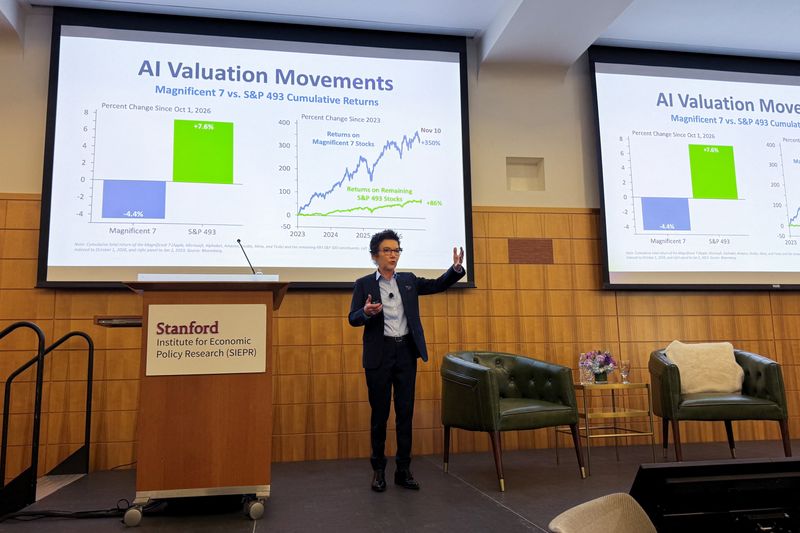
Recent volatility in AI stock valuations also does not signal a lack of enthusiasm about the technology or a belief that it will not be transformative, Daly said, noting the rush of investment into AI-related capital projects like data centers.
"I think you can slow the growth rate and still have a good economy growing and a stable labor market and a lower inflation," she said.
(Reporting by Ann Saphir; Editing by Chris Reese and Andrea Ricci )