

By Ankur Banerjee
SINGAPORE, Nov 19 (Reuters) - Asian stocks slid on Thursday as fears over the AI trade and hawkish comments from Federal Reserve officials left sentiment fragile ahead of an eagerly awaited
market debut from Anthropic after the Claude chatbot maker scored the biggest IPO ever.
On a fully diluted basis, the IPO values Anthropic, the first major frontier AI model developer to go public, at about $1.5 trillion and its first-day trading will be scrutinised to gauge investor sentiment on the technology.
Anthropic said the IPO was priced at $83 apiece, above its previously targeted range, raising $81 billion to claim the title of the largest stock-market debut on record.
Kyle Rodda, senior financial market analyst at Capital.com, said it was going to be a huge test for the markets and it looked poised to be a really bullish listing.
"I don't think it's necessarily going to assuage all the fears about AI," he said. "I think much of that boils down to future investment growth."
Traders' immediate reaction was to push US stock futures higher, with Nasdaq futures up nearly 1% and S&P futures 0.6% higher.
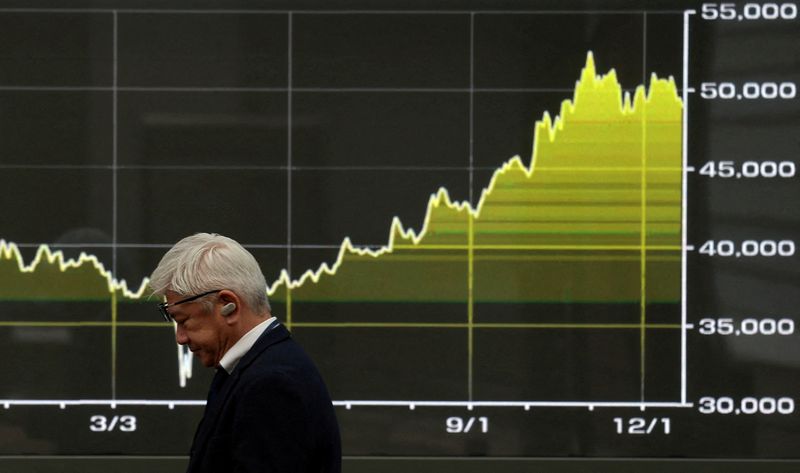
Asian equities, though, fell sharply, led by the three top chipmakers: TSMC, Samsung and SK Hynix were all down 2%. That left South Korea's KOSPI down 1% while Taiwanese stocks slid 3.8%.
MSCI's broadest index of Asia-Pacific shares outside Japan slumped 1.9%, hitting a seven-month low. The index was set for a decline of nearly 6% for the week, its steepest weekly decline since early March.
Investor confidence in AI has been shaken over the past few weeks on worries about the profitability of the technology and the massive debt needed to fund and build related infrastructure.
Markets mostly shrugged off a strong forecast from chipmaker Nvidia this week as uncertainty caused by CEO Jensen Huang's departure last week rattled investors. The company's board dismissed the idea of rehiring Huang.
Armina Rosenberg, portfolio manager and co-founder of Minotaur Capital, said the Anthropic IPO is a useful gauge of investor appetite for AI.
"But one listing won’t settle the debate," she said. "There’s a genuine wall of worry right now, and it’ll take a few things to climb it."
DOLLAR FIRMS ON HAWKISH FED
In currencies, the dollar was on the front foot as hawkish comments from US Federal Reserve Governor Christopher Waller bolstered expectations of a rate hike in December.
The euro was at $1.0978, hovering near its lowest point since April 2025. The Japanese yen was at 157.42 per US dollar and sterling fetched $1.31515.
The dollar index, which measures the greenback against six other currencies, was 0.1% higher at 103.92, a 19-month high.
Waller said on CNBC that if the central bank wanted to get inflation down, it needed to take more "aggressive action" either through a half-point increase at the December meeting, or by using the post-meeting statement to set market expectations for further hikes.
The comments followed hotter-than-expected inflation data last week, leaving markets to brace for a rate hike. Traders are pricing in a 90% chance of a 25-basis-point hike next month, the CME FedWatch tool showed.
"More hawkish Fed pricing has so far offset weakness in technology stocks, keeping the USD supported," OCBC strategists said in a note. "Persistent inflation, further Fed tightening and elevated US yields suggest it is still too early to bet against the USD."
The Australian dollar slipped 0.75% to a 10-month low after soft jobs data cemented the view that Australian rates have likely peaked. [AUD/]
In commodities, oil prices remained under pressure as the growing view that the oil market is turning to a surplus weighed. Brent crude futures were 0.58% lower at $91.47 a barrel, set for a third straight weekly decline. [O/R]
(Reporting by Ankur Banerjee in Singapore; Editing by Stephen Coates and Thomas Derpinghaus)