


By Aditya Soni
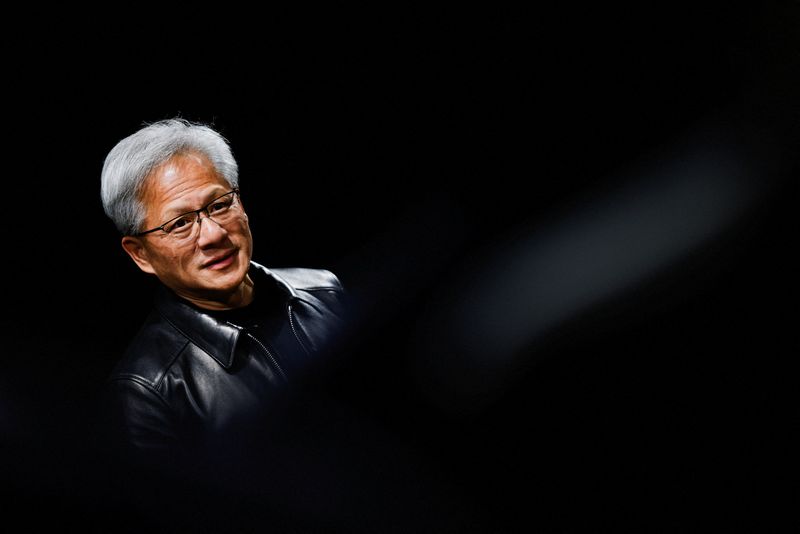
Nov 12 (Reuters) - As Jensen Huang used Nvidia's swelling cash pile to bankroll the AI boom, his involvement went far beyond writing checks.
The Nvidia CEO dug deep into startups' technology,
helped them secure customers within his company and even joined fundraising calls to attract investors, according to startup founders, venture capitalists and a former Nvidia employee.
"We don't pick winners. We need to support everyone," Huang said on an episode of the "Dwarkesh" podcast in April.
The 63-year-old brought the same intensity to running his roughly $4 trillion chip giant, overseeing some 60 direct reports and personally diving into problems across the company.
That hands-on approach helped make him one of the AI industry's most powerful figures, with influence stretching from Silicon Valley to Washington, where he forged close ties with President Donald Trump and helped shape US chip export policy.
It also made him one of the AI boom's great financiers with investments spanning AI cloud providers such as CoreWeave and Nebius and suppliers to the biggest labs.
Until it all unraveled on Thursday.
First, reports emerged that Huang had an affair with a Chinese businesswoman whom US authorities identified as a spy for Beijing. Nvidia's board launched an investigation and Huang apologized for his actions: "There is no excuse for what I did. I am deeply sorry."
The crisis deepened on Wednesday after the New York Times reported Huang had a second affair, this time with an employee who directly reported to him. The board met later in the day and about 42 minutes before market open on Thursday, Nvidia announced Huang was out as CEO.
The exit now raises questions about whether Nvidia and the AI ecosystem he helped build can thrive without him.
"The bigger concern for me is not the next few quarters but the next decade," said Dan Sheehan, director of portfolio management at Telos Wealth Advisors.
"To find someone who can not only manage an extraordinary business but also continue to innovate and anticipate where the industry is heading. That's a very different challenge."
For now, Nvidia has named Chief Financial Officer Colette Kress interim CEO as it searches for a permanent successor, considering both internal and external candidates.
Along with Kress, Ian Buck, who manages hardware and software products as head of product for hyperscale AI, as well as Arm chief Rene Haas, are seen as potential candidates.
Analysts say any successor will have to combine the technical expertise required to run a cutting-edge chipmaker with deep ties across the industry as well as in Washington, where Democrats now control both houses of Congress following a midterm sweep that included campaigns against data centers.
"In truth, (it) will be very challenging to find a single person to replace him, so while I expect only one CEO, we could see several high-level hires or promotions that take on different aspects of what Jensen did," said Bob O'Donnell, President and Chief Analyst, TECHnalysis Research.
Beyond the operational roles, analysts agree there is one aspect that will be much harder to replace - the cultural clout that made Huang the face of the AI boom, with so much influence that his mere mention of a company could move its shares.
"Nvidia has lost the man who helped create the AI revolution, but it hasn't lost the technology driving it," said Sheehan. "The next CEO inherits an extraordinary business, but also one of the hardest acts to follow in corporate history."
(Reporting by Aditya Soni, Deborah Sophia and Anhata Rooprai in Bengaluru, Krystal Hu in San Francisco; Editing by Nick Zieminski)