
By Chuck Mikolajczak and Niket Nishant
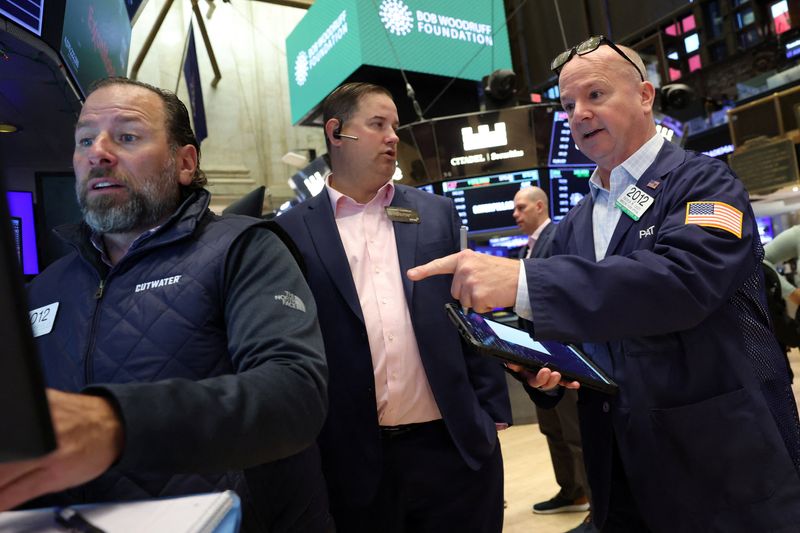
NEW YORK, Nov 10 (Reuters) - US stocks stumbled on Tuesday, as a hotter-than-expected inflation reading cemented expectations for a rate hike from the Federal Reserve
next month and fueled concerns the central bank may be more aggressive in raising rates.
The Labor Department said the Consumer Price Index increased 0.4% last month, its third straight gain of 0.4% or more and above the 0.3% estimate of economists polled by Reuters, after advancing 0.6% in September.
The data came after Fed Governor Christopher Waller said the central bank should raise short-term borrowing costs in December even if data shows inflation cooled last month, and should consider an upsized half-point rate hike if the inflation picture worsens.
Markets are now completely pricing in a rate hike of at least 25 basis points at the Fed's December meeting, according to CME FedWatch, up from 84% on Monday.
The two-year US Treasury yield, which typically moves in step with interest rate expectations for the Fed, surged 19.1 basis points to 4.738% and was on track for its biggest daily gain since April 9, 2025, after US President Donald Trump launched his sweeping global tariffs.
The jump has come even as oil prices have eased to two-month lows as US officials have downplayed any imminent military actions against Iran.
"What kind of has the market spooked a little bit is this idea of, 'Well, we were already pricing in a December hike ... but maybe it's not 25, maybe it's 50, and maybe the Fed's more worried about inflation than I am, so let's sell some stocks,'" said Jason Ware, chief investment officer at Albion Financial Group in Salt Lake City, Utah.
"From our perch, that is irrational. The thing that has pushed CPI up over the last six months and has the Fed a little bit more concerned and therefore has restarted hiking rates is because we've seen oil, energy and diesel push through in terms of inflation. If we have oil now going the other way ... this is all going to settle down."
The Dow Jones Industrial Average fell 223.12 points, or 0.43%, to 52,166.63, the S&P 500 lost 48.06 points, or 0.64%, to 7,501.88 and the Nasdaq Composite lost 290.69 points, or 1.15%, to 24,962.44.
TECHNOLOGY SECTOR UNDER PRESSURE
The S&P 500 and Nasdaq had risen for two straight days, bouncing back from sharp losses last week sparked by concerns about the potential for government regulations slowing the AI buildout.
The S&P 500 technology sector dropped more than 1% as the worst-performing of the 11 major sectors, weighed down by another drop in Nvidia, which fell more than 5% and has tumbled about 10% over the past two sessions. The company's stock reflects mounting concerns over CEO Jensen Huang's future at the chip company after it initiated an internal probe into spy claims involving Chinese businesswoman Alice Huang.
The CEO's relationship with Alice Huang facilitated the shipment of at least $7.5 billion worth of the company's chips through Chinese firms, the Information reported on Tuesday.
But declines for the broader Philadelphia semiconductor index were more muted, off roughly 1% after two consecutive sessions of gains, as volatility in the AI trade increased.
Aside from Waller, other Fed officials speaking on Tuesday also took a hawkish tone. Dallas Federal Reserve President Lorie Logan said that the Fed needs to deliver at least two more quarter-percentage-point interest rate increases to bring down inflation, and may need to do so promptly, while Kansas City Federal Reserve President Jeff Schmid said he believes the current policy rate is "fairly accommodative."
ANTHROPIC IPO LOOMS LARGE
Investors are also bracing for Anthropic's expected public listing later this month. The AI lab revealed that its initial public offering is expected to raise as much as $64.4 billion, giving the company a fully diluted valuation of up to $1.4 trillion.
A listing by Anthropic could also force other AI heavyweights to compete harder for investor dollars.
Neocloud firm CoreWeave is expected to report quarterly earnings after the market close on Tuesday. Questions about the sustainability of the AI boom and the company's debt burden have pressured the stock recently, which was now down about 33% on the year.
CoreWeave shares were off 2.3% on the session, while those of its peer Nebius tumbled more than 6%.
Declining issues outnumbered advancers by a 2.53-to-1 ratio on the New York Stock Exchange, and by a 2.49-to-1 ratio on the Nasdaq.
The S&P 500 posted six new 52-week highs and three new lows while the Nasdaq Composite recorded 50 new highs and 201 new lows.
(Reporting by Chuck Mikolajczak in New York; Additional reporting by Niket Nishant and Utkarsh Hathi in Bengaluru; Editing by Devika Syamnath and Matthew Lewis)