
By Sophie Kiderlin
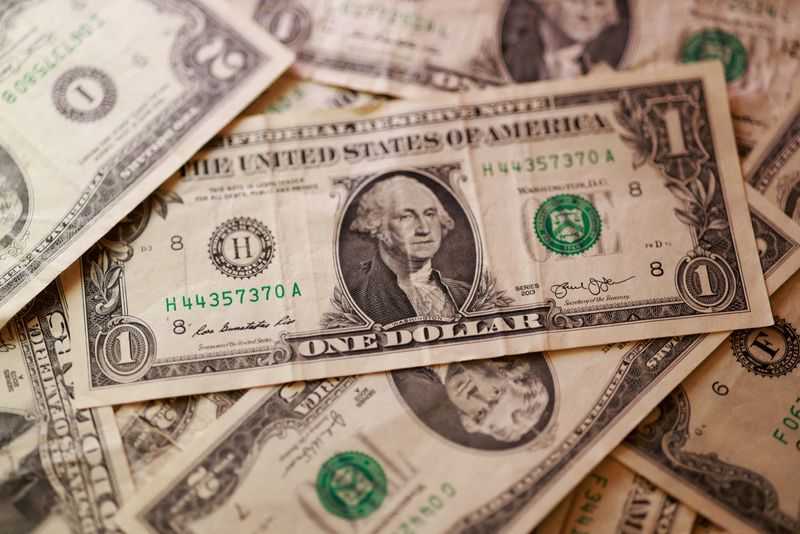
LONDON, Nov 23 (Reuters) - The dollar drifted near its highest level in 19 months on Monday as traders took a breather from the stock market rout that prompted a flight to safety last
week, and bets that the Federal Reserve could hike interest rates aggressively at its December meeting eased.
The US dollar index, which measures the greenback's strength against a basket of six currencies, was little changed on the day at 103.91 after paring back an earlier dip. Last Thursday it rose to 103.97, its strongest since April 2025.
Safe-haven assets like the dollar generally benefit when investors turn more risk averse, as seen last week amid AI trade worries. The dollar has also been supported by Fed interest rate expectations recently.
After last week's broader market moves, however, aggressive action from the Fed to fight inflation now looks to be off the table even as there were some signs of recovery on Monday. [MKTS/GLOB]
Fed funds futures are pricing an implied probability of roughly 96% of a 25-basis-point hike at the US central bank's December 8-9 policy meeting, against a 4% chance of a hold, according to the CME Group's FedWatch tool. A larger 50-basis-point increase — given a probability of over 11% a week ago — is now completely priced out.
Analysts pointed to the US Personal Consumption Expenditures Price Index, a key inflation gauge for the Fed that is due Wednesday, as a possible indicator for the rate path ahead and catalyst for the dollar.
Chris Turner, global head of markets at ING, said the print "looks set to come in hot again and maintain solid support for a tightening cycle into 2027."
"That is why it is probably a little too early to expect much downside for the dollar yet," he added.
Meanwhile, the euro was steady at $1.096, giving up earlier advances as investors considered the latest PMI data. While the survey showed that euro zone growth momentum held up in November, it also reflected increasing reliance on a surging Germany to make up for a weakening France, and fading business confidence cast a shadow over the bloc's outlook.
The British pound was 0.1% firmer at $1.3097, and the dollar was 0.4% stronger against the yen at 159.07 yen, with markets in Japan closed for a holiday.
Elsewhere, the New Zealand dollar fluctuated between gains and losses, last broadly steady at $0.5465 after falling for nine consecutive days and reaching its weakest since March 2009, during the global financial crisis.
"Most of the weakness in the kiwi this year does seem to reflect the adverse shift in rate differentials, but the latest leg down looks like more of a traditional 'risk-off' move based on the developments in the stock market," said Thomas Mathews, head of markets for Asia Pacific at Capital Economics in Wellington.
The Australian dollar was 0.3% stronger at $0.6633, rebounding after nine consecutive days of losses.
Cryptocurrencies extended a rebound from a sharp drop on Friday, with bitcoin up 1% at $61,471.44 and ether 0.5% higher at $1,726.41.
(Reporting by Gregor Stuart Hunter and Sophie Kiderlin; Editing by Christian Schmollinger, Kevin Liffey and Joe Bavier)