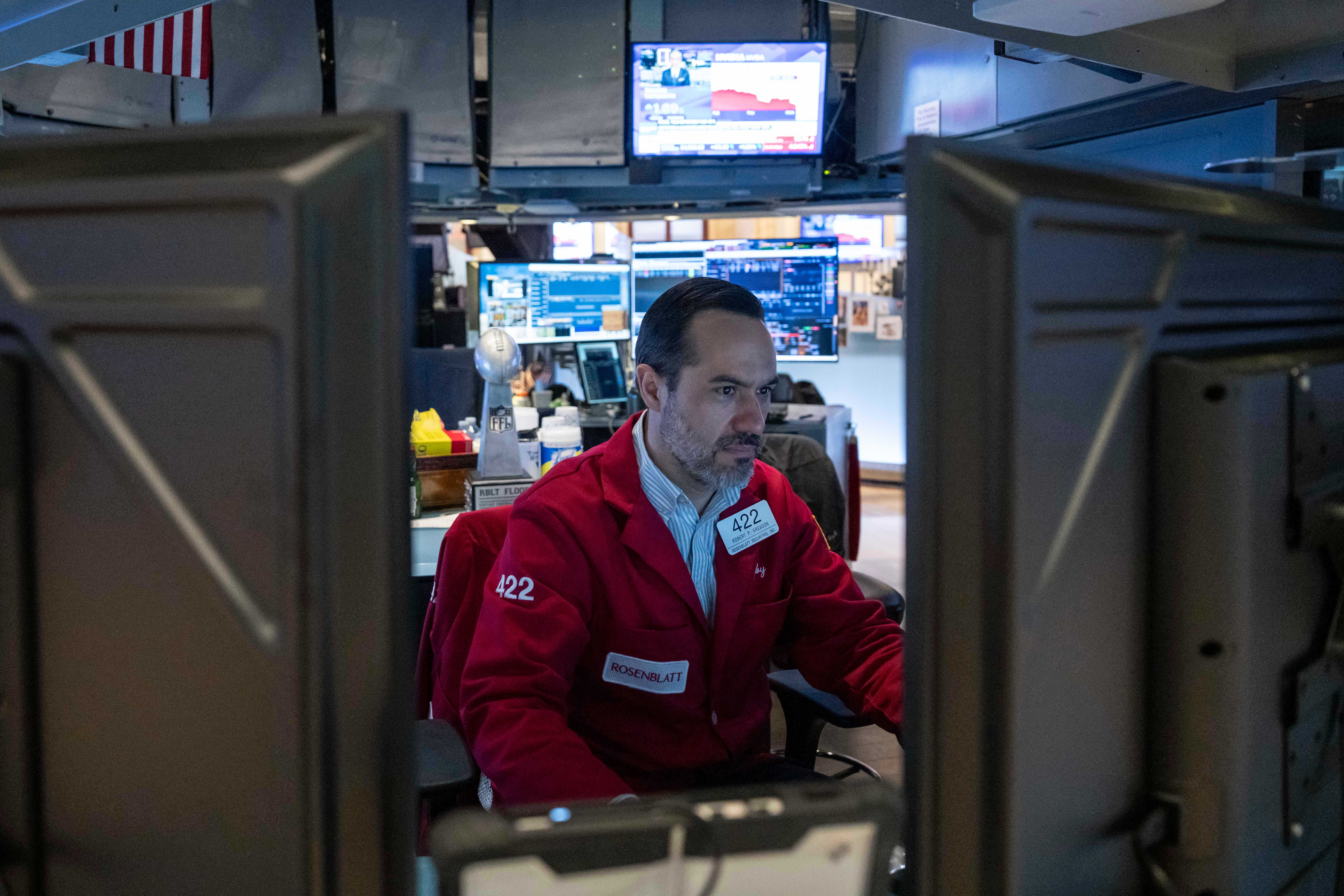




NEW YORK (AP) — The U.S. stock market dipped Tuesday after a report showed inflation was worse across the country last month than economists expected.
The S&P 500 slipped 0.4% and gave back some of its
big rally from the day before. The Dow Jones Industrial Average dropped 157 points, or 0.3%, and the Nasdaq composite sank 0.7%.
Pressure from the bond market undercut stocks following the discouraging report on inflation. People had to pay prices for groceries, electricity and other costs of living that were higher last month than economists expected. That could push the Federal Reserve to hike its main interest rate at its next meeting in December and beyond.
Higher interest rates can help rein in inflation, but they do so by making it more expensive for everyone to borrow money and by slowing the overall economy. Higher rates also make investors less willing to pay high prices for stocks and other investments.
One Fed official even hinted the central bank may increase the federal funds rate by double the typical amount next month because of how high inflation has remained for years.
Speaking in London before the inflation report was released, Fed Gov. Christopher Waller said “a stronger policy move may be needed” if the report showed an important underlying measure of inflation rose by 0.3% from September.
In that case, he said the Fed should consider hiking the federal funds rate by half a percentage point rather than the typical quarter point. Moving by only the usual amount could “put our credibility at risk, a risk I am not eager to take.”
Shortly afterward, Tuesday’s inflation report showed that the underlying measure of inflation Waller was worried about was exactly 0.3%, the threshold he had set. It’s the Fed’s job to keep inflation under control, along with keeping the job market strong.
That sent yields jumping in the bond market as traders upped their forecasts for coming hikes to rates by the Fed.
The yield on the 10-year Treasury leaped to 4.99% from 4.88% late Monday. It’s a notable move for the bond market, and the yield helps set where rates are for mortgages and other loans going to U.S. households and businesses.
The 10-year Treasury yield had been dropping since early October, when it topped 5.30% as worries spiked about high inflation, higher interest rates, the U.S. government’s big debt and other concerns.
Tuesday’s jump in yields came even though oil prices fell again. The price for a barrel of Brent crude oil fell 1.2% to $91.49. President Donald Trump said late Monday that the war in Iran, which sent oil prices much higher, “militarily is effectively over.”
Brent’s price has been falling from more than $112 at the start of the month amid uncertainty about what will happen with the war with Iran.
Jumps in Treasury yields push downward on prices for all kinds of stocks, and they can particularly hurt companies in the real-estate business.
Higher mortgage rates can keep potential customers away from homebuilders, for example, and Lennar fell 5.4% for one of the sharper losses in the S&P 500.
Rival homebuilders also fell, including drops of 3.8% for D.R. Horton and 3.9% for PulteGroup. Builders FirstSource, which sells crown mouldings, cabinets and other products to homebuilders, sank 4.6%.
The single heaviest weight on the S&P 500 was Nvidia, which fell 5.5%. It’s been under pressure since its board announced an investigation into its CEO, Jensen Huang, who admitted to a relationship with a woman who, according to The New York Times, U.S. intelligence determined was gathering information for China.
It’s also been swinging amid broader worries that have knocked the artificial-intelligence industry around recently. Democratic victories in statehouses across the country last week raised concerns about possible restrictions on construction of AI data centers. That built on top of longstanding worries that AI stock prices had shot too high and were in a bubble.
GE Vernova, which is helping to power AI data centers, dropped 3.9%. Micron Technology, which sells memory for computers, fell 1.1%. CoreWeave, a company that rents out access to AI chips to customers over the cloud, slipped 0.5%.
Other AI-related stocks held up better, though. Broadcom climbed 3.9%, and Advanced Micro Devices rose 1.3%.
The recent shakiness for AI-related stocks had raised questions about whether Anthropic, the company behind the Claude chatbot, may delay its initial public offering of stock.
But Anthropic said in a filing with U.S. regulators on Tuesday that it’s looking to sell its stock at a price valuing the company at roughly $1.3 trillion. That would make it one of the most valuable companies on Wall Street, worth more than Walmart, JPMorgan Chase, ExxonMobil or Coca-Cola.
All told, the S&P 500 fell 29.01 points to 7,520.93. The Dow Jones Industrial Average dipped 157.86 to 52,231.89, and the Nasdaq composite sank 187.26 to 25,065.87.
In stock markets abroad, indexes rose across much of Europe and Asia.
South Korea’s Kospi jumped 4.4% for one of the world’s biggest gains on strength for its two tech giants that have benefited from the AI boom, Samsung Electronics and SK Hynix.
___
AP Writers Elaine Lai and Matt Ott contributed to this report.