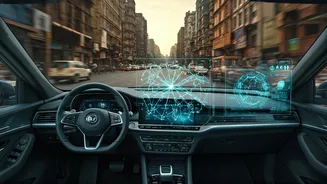







AI's Reasoning Leap
The dream of self-driving cars navigating India's intricate roadways is inching closer to reality, propelled by NVIDIA's innovative AI advancements. The company
has introduced its latest Alpamayo family of artificial intelligence models, specifically designed to accelerate the development of autonomous vehicles. These models are not just about processing data; they introduce a novel concept of 'thinking' into the driving process. This revolutionary approach empowers vehicles with the ability to reason, much like humans do, enabling them to understand and react to unforeseen circumstances. Unlike conventional autonomous systems that often rely on extensive pre-programmed rules or vast datasets for pattern recognition, Alpamayo's reasoning-led AI is equipped to handle novel and complex driving situations with enhanced intelligence and adaptability, a crucial capability for environments like India's.
Human-like Cognition
At the heart of this transformative technology is the concept of 'reasoning,' a capability Jensen Huang, NVIDIA's CEO, likens to human cognitive processes. He explains that humans possess an innate ability to dissect complex, unfamiliar situations into smaller, manageable problems that they know how to solve. This sophisticated problem-solving skill is precisely what Alpamayo aims to replicate in autonomous vehicles. Instead of solely relying on extensive pre-defined rules or massive data pattern matching, this AI system uses a reasoning-first methodology. This allows vehicles to decompose intricate driving scenarios into simpler, understandable steps, thereby making more informed and safer decisions. This mimicry of human problem-solving is seen as a critical differentiator, enabling navigation in environments traditionally considered too challenging for autonomous systems.
Global Scalability Potential
The implications of this reasoning-led AI extend far beyond improving existing autonomous driving systems. Huang expressed strong confidence that this technology holds the key to scaling self-driving capabilities globally, particularly in regions with highly complex and dynamic driving conditions, such as India. The ability of the AI to learn and navigate through reasoning, even in the most demanding environments, suggests a future where autonomous vehicles are not restricted by geographical or infrastructural complexity. This approach is anticipated to accelerate the adoption of autonomous driving technologies worldwide, making them accessible and functional across diverse global landscapes. The development of simulation tools and comprehensive datasets accompanying these AI models further expedites the learning and validation process for autonomous systems.