




Click here to read the full article.
In the opening of “Small Things,” Zvonimir Jurić’s elegant and understated chamber drama, the giggling grandchildren of an elder patriarch (Bosnian film and theater veteran Izudin Bajrović) show their charmingly clueless
pops how to operate a smartphone. Later that night, along with the kids’ mother Irena (Ivana Roščić) and aunt Anica (Marija Skaričić), the crew plays a round of “Who Am I?” where the cards read both former Yugoslavian songstresses and western celebrities like Paris Hilton and Lady Gaga. From here, modernity’s encroachment weaves through this family reunion in less obvious and more existentially crippling ways, which the Croatian writer-director — making his return in competition at Sarajevo 12 years after his last feature “The Reaper” — unfolds with a whispered, windswept melancholy suited to the somber Adriatic island setting.
The sale of their father’s orchard and the ensuing inheritance negotiations have brought sisters Anica and Irena, who live on the Croatian mainland, back to their rustic family home. With no score, the film’s vivid sound design of billowing foliage, creaky doors and floorboards, creates an austere ambience that softens with quiet feeling as the contours of the family’s troubles are gradually filled out. During visits to their mother’s clifftop grave and humble corner shops where locals continue to buy on account, we discover that Anica’s partner died recently of cancer, while pregnant Irena’s coming child is a kind of last-ditch effort to save her crumbling marriage.
Meanwhile, their catatonic brother Ivan (Juraj Lerotić) emerges from his groundfloor room only to go squidfishing, or to prepare himself a bowl of miserably insubstantial instant soup that he takes immediately back down to his chambers. Anyone who’s seen Lerotić’s directorial debut, “Safe Place,” which won Sarajevo’s top prize in 2022 as well as a handful of awards out of Locarno, will inevitably filter his performance in “Small Things” through the lens of that film’s aching exploration of suicide.
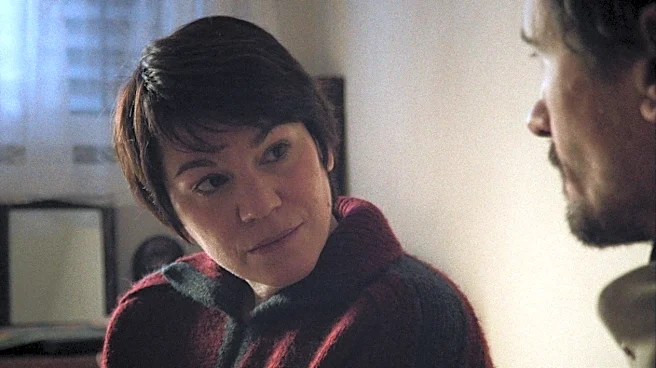
Though Lerotić startles as Ivan in his gloomy, gaunt vacancy, casting a fearsome cloud of mortality over each frame he enters, the script by Jurić and Jurica Pavičić (who wrote the short story the film is adapted from) keeps the ensemble drama carefully balanced by anchoring big sister Anica’s point-of-view. Childless and alone yet stable relative to her siblings, Anica assumes the head of the family and takes it upon herself to pull Ivan out of his slump, though her compassion chills when money-strapped Irena makes a bid for Ivan’s chunk of the inheritance. In step with the film’s moody sense of suspended time, dramatic faceoffs play out with restraint, through gestures and glances that signal complicated interpersonal histories — for instance, a mere icy glance from the judgmental Anica makes Irena collapse into tears.
Working with “Safe Place” cinematographer Marko Brdar, Jurić extends this emotional reserve to the film’s mostly static images and natural lighting, which lends the family’s weathered abode a sort of dusky inertia. Ivan’s room feels practically airless, his face obscured in shadows, or captured in hazy side profiles, as Anica’s bright, concerned gaze holds the frame’s focus. The film’s unrushed, small-scale beauty might be imperceptible to a more plot-hungry viewer, though slow-cinema oriented distributors might do well to take a chance on this Croatian gem. Likewise, the film rewards patience with an agonizingly tender culminating shot — a reminder that some things must change while others linger in the amber of childhood.