

Click here to read the full article.
There’s a certain kind of Broadway musical that’s so fresh and brash and effusive it can seem as if the very form of the show is bursting right out of its creators’
need to tell it. “A Chorus Line” was like that. So were “Chicago” and “Rent” and “Hamilton.” And while I won’t claim that “Hadestown” is the equal of those shows, it’s a musical that catches you up not merely in the story it’s telling but in the vivacious, spilling-over-the-sides fervor of the show’s structural design.
“Hadestown: The Musical,” a movie version that records and presents a live performance of the show that took place in February 2025 in London (much as the 2020 film of “Hamilton” presented a live production of that show), offers a splendid opportunity for anyone who hasn’t seen “Hadestown” onstage to experience it. The audience we see at this production at the West End’s Lyric Theatre is so in love with the show that you feel every person there has already seen it three times. And maybe that’s the case, since “Hadestown,” with its free-form jamboree vibe, its spontaneous swirl of musicians and dancers onstage, is as much a happening as it is a musical. It’s a show about ancient mythology — it tells the story of Orpheus and Eurydice, which it interweaves with the tale of Hades and Persephone. That sounds daunting, but “Hadestown,” with its book, music, and lyrics by Anaïs Mitchell, succeeds in making those myths feel timeless, which of course they are. It’s a show about love, but more than that it’s a show about faith.
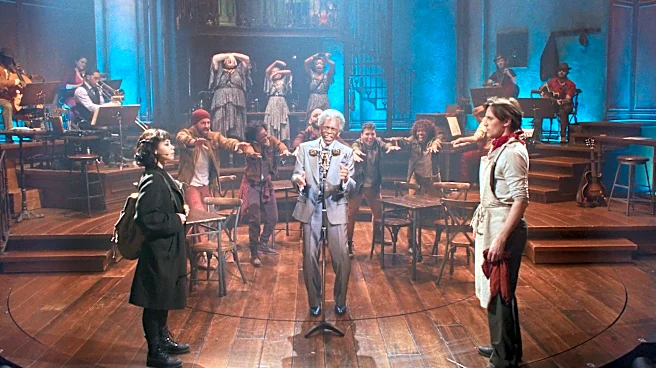
There is one set, and it looks like the grand interior of a moldering mansion in the late-afternoon sun if it were the New Orleans home of Dracula and he was a bootlegging gangster. The music, in a song like “Way Down Hadestown,” has a jaunty New Orleans spirit (especially when the trombone gets going), but much of the score is more eclectic than that — it’s a collage of brass-band exuberance and rock-musical passion and gospel ecstasy. One number, “Wedding Song,” sounds like “Can’t Find My Way Home” from the Blind Faith album. The lyrics to one of the best songs, “When the Chips Are Down,” play like an update of Madonna’s “Material World.” The show uses its array of musical styles to evoke a big tent of rootsy Americana, and since most of the action is sung, it all has the feel of a patchwork opera.
The figure who draws us into “Hadestown” is Hermes, the herald of the gods who’s also the show’s narrator. He’s played by the Broadway legend André De Shields, who is now 80, and in a crisp silver three-piece suit, his whitish hair beaming off his head like an aureole, De Shields, with his diffident impish manner, his wavery slow vibrato, and his sunken cheeks that bespeak a pain he will not share, creates a presence of mystical authority. He’s down-home but larger-than-life, and so is the entire show.
In mixing the myth of Orpheus and Eurydice with the romantic travails of Hades, the king of the underworld, “Hadestown” creates a romantic saga with a distinct echo of the one in “Moulin Rouge!” In that classic 2001 movie (as well as the Broadway version that premiered in 2018), Christian and Satine were bohemian lovers, while the Duke of Monroth was the moneybags conniver who thought he could buy Satine’s love. In “Hadestown,” Orpheus (Reeve Carney), a struggling poet and songwriter, meets the impoverished Eurydice (Eva Noblezada), and the two fall in love. But they can barely subsist. Hades (Patrick Page), portrayed as a demonic executive who presides over an underworld foundry, has driven away his wife, Persephone (Amber Gray), and he persuades Eurydice to come to Hadestown, where he will love and protect her. She’s desperate enough to make a deal with the devil.
If and when somebody pulls it together to make the Jeff Buckley biopic, I think we now have the actor to play him. It is Reeve Carney. He looks like Buckley, and has his floppy-haired louche glamour, but more than that he sings like him, with a keening high tenor that’s spellbinding. He makes Orpheus a character who’s a pure expressive force, a vessel of love and art and the vulnerability that comes of valuing both. Eva Noblezada, as Eurydice (she and Carney met during the early stage production of “Hadestown” and are now married), has a voice of ardent richness and a presence of traumatized devotion. And Patrick Page as Hades, the capitalist oppressor in his long leather coat, presiding over his factory world, lends the drama the villainous force it needs, although his Hades is far from inhuman. Page, tall and sculpted, with elegant white hair and a matching beard, is like Ian McKellan crossed with Christopher Lee. When Orpheus travels to Hadestown to retrieve Eurydice, and Hades agrees to let her go (under the condition that Orpheus can never once look back at her during the long journey home), he has designed this famous conundrum as an elevated test. It will be the test of Orpheus’s faith, and watching the journey we in the audience contemplate what any of us might do. What does it mean…to look back?
The show feels like a street dance crossed with a concert (at one point the musicians are introduced by name) that happens to have a hallowed myth threaded down the middle of it. The three Fates (Bella Brown, Madeline Charlemagne, and Allie Daniel) orbit the action like spitfire satellites. As directed by Brett Sullivan, “Hadestown: The Musical” transmits the show’s earthy electricity. That said, it’s still striking that the bare-bones film version of a Broadway musical that isn’t “Hamilton” is going to make $10 million at the box office this weekend. As the audience response to it in the movie makes clear, “Hadestown” is a show with a worshipful following. The movie made me a believer.