


Click here to read the full article.
SPOILER ALERT: This article contains spoilers for the first season of “Below,” now streaming on Netflix.
Netflix’s new mystery series “Below” has arrived, and audiences are being transported to the beautiful and dangerous
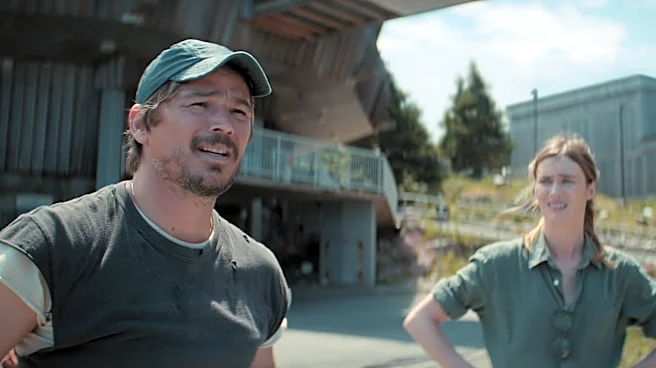
Newfoundland town of Snook’s Arm. Josh Hartnett stars as fisherman Calvin Penney, who, alongside Dr. Fonda Howander (Mackenzie Davis), is investigating a local mystery involving dirty ice and a giant sea monster. Calvin, Dr. Fonda, and his family get into plenty of adventures along the way, before an ending that promises a fresh start for the residents of Snook’s Arm … before a final moment that teases fresh danger, as several more icebergs approach, promising more deep-sea beasts on their way to Snook’s Arm.
Variety spoke with “Below” creator and showrunner Jesse McKeown and executive producer Jessica Rhoades about Season 1’s ending, how the cast tackled the Newfoundland accent, the giant squid’s development and what might be explored in a second season.
Where did the initial idea for “Below” come from?
Jesse McKeown: I’ve been going to Newfoundland for many, many years, and I had just always had a dream of making something there — something that was really big. There are a lot of smaller things that have been made in Newfoundland. There’s a strong film and television community there, but it’s very small. I wanted to do something that took advantage of the drama of the place. I never thought that would happen, but then, in a meeting with Netflix, an opportunity opened up and I snagged it and pitched them this and they went for it.
How did you decide that you wanted Josh Hartnett and to have a strong Newfoundland accent?
Jessica Rhoades: I mean, you had to. I’d like to say it was some brilliant, bold move, but you have to get it right. Jesse has family in Newfoundland. He wasn’t going to be allowed to go home if we got it wrong. So the stakes are high. But both Josh — and Charlie [Heaton], and a few of the other actors like Ruby [Stokes] out of the U.K. — had done accent work. So they dove in.
I think the hardest thing was finding an accent for the family. You wanted to sync them, as with any region. If you travel a bit, and depending on how long people have been there and what village, you hear the texture and difference in the accent. But for us it was about finding what the Penney family accent would be and how that could be a little different with the kids having gone away. How did we layer that on top of itself? That was the tricky bit, but Josh threw himself in from the day he said yes. He was studying and working.
McKeown: My wife, who’s from Newfoundland, has three different accents. She has her generic North American accent. She has her townie, big-city St. John’s accent. And then she has her Bay accent. When she gets out into the rural-enough area, it gets even more pronounced. We really use that with the kids as modulating how long they’ve been on the mainland and how much they turn it up when they come home.
I’ll just say Josh was incredible. Before he even came, he started listening to Newfoundland radio, the call-in shows and talk radio, which are like hugely popular in Newfoundland. There’s this show called “The Fisheries Broadcast,” which is the longest-running radio show in Canadian history. People just call in and talk about the fishery, and so he just immersed himself in that. He already had it in his head before he set foot on the island.
Rhoades: We’re also happy that we knew, making it for Netflix, I watch my kids and my parents watch with subtitles on. We knew a majority of the audience might be watching that way anyway, and that gave us the ability to be really true to the accent.
McKeown: I love shows like “The Wire” where I may not understand every little thing, but I know it means something to the character and then I’ll find out what it means. I like to give the audience something to dig into.
Did you always envision this season to be six relatively short episodes?
McKeown: We always wanted to treat it like an event, and that’s what Netflix wanted as well. We were totally aligned on that, which is rare because limited series are kind of hard to get made. I was really excited about that. We approached it as, “OK, we have six episodes to tell a complete and satisfying story.” That’s what we tried to do.
How did you decide what level of flirtation Calvin and Dr. Fonda would have this season? Were they ever going to hook up?
Rhoades: It’s interesting. It wasn’t in Jesse’s pitch. We cast Josh and Mackenzie and we all decided it was more about these two coming out of their shells and being able to communicate with someone, and coming out of isolation and we were playing with so many of those themes. And then the two of them just up and had some chemistry, and we had to contend with it. There’s a moment obviously in the end where I dare you to not be rooting for them, but it just happened. You just want those two kids together, don’t you?
McKeown: I feel like it sort occurred to both of them at the same time in that moment. “OK, finally we’ve dealt with everything for now.” On the page, it was more important that, “OK, he’s taking a step toward the community and so has she. They’re both two lonely people that have opened up a little bit, and they’ve become part of each other’s lives.” But it was there on the day.
Without jumping the gun, have you dreamed up a lot of ideas for a potential second season?
McKeown: Not in any serious way. Obviously there are things that you think about during the course of making it, little pipe dreams and offshoots. And we never wanted to wrap up the ending in a tidy little bow anyway. But no, I haven’t thought about it at all.
The sea hag visions: we get an explanation for it in the show, but is there more than meets the eye there?
McKeown: It was from personal experience. I’ve had sleep paralysis. I didn’t know it was called the old hag, but I used to get it quite a bit when I was younger, more as a teenager and in my 20s. I think it was stress-related or something, but I had a version of a this female creature in my room who would watch me sleep and climb and then I found out it was a thing. Then I found out that’s a mythology that crosses cultures. You’ll find versions of that mythology all over the world. For some reason, it’s very popular in Newfoundland. Everyone talks about the hag: “Oh yeah, I had the hag last night. She came to me.” It’s just part of the vernacular, so I wanted to build on it. I do think it is Wade is under stress and he’s got all these problems. So it’s very plausible that it was something psychological, but then it turns out not to be.
How did you come up with the look of the giant squid?
McKeown: There was a lot of research that we did ahead of time. We talked to some experts. One was sort of like a real-life Fonda. Her name is Dr. Annie Mercier, and she works at that actual building, the Ocean Sciences Centre, which is a real place in Newfoundland. We’d talk to her just about cephalopods and how they behave. There’s a long and rich history of Architeuthis dux, the North Atlantic giant squid, in that area of Newfoundland. That’s where all the original discoveries happened. So the giant squid is very important to the history and mythology of Newfoundland. Once you open your eyes for that, you’ll see it everywhere. There’s statues of the giant squid, there’s museums dedicated to it, you see it everywhere. So it really had to be that creature for Newfoundland. But we wanted it to be more than just the North Atlantic giant squid. We want it to be something even more unknown and something more mysterious. So we talked to experts about what would plausibly be a previously undetected ancestor of the giant squid that we know, and then so we worked backward and extrapolated from that.
Rhoades: There is so much time modeling and doing scales and being able to figure out boats, houses, ships, all of those things. It was a really complex multiteam. Obviously, it was our VFX team, but it was also an SFX team. It’s everyone working with production design. Everything had to be so precise to get the scale of her right. You don’t want it to be silly, obviously, but you want it to be fun, but it had to be scary. I think one of our biggest challenges was like the scope of the eye outside of the submersible, just getting those things right.
Episode 5 is very dreamlike. Did you always know you wanted to have an episode that broke form and gave a different vibe than the rest of the series?
McKeown: Totally. That was really what we wanted to do with that episode. I love when shows end up taking you to a place that you never thought you would go to, you could never see coming. But it was also like a really important step on Calvin’s journey. He says at the very beginning, “I’m not moving an inch, I’m never leaving this place.” It’s very important for him to go through that and understand, “This is what it might look like if you don’t leave. If everybody packs up and leaves and you decide to stick it out without the community, and without the people that make these outports viable, this is the dark side of your dream and your vision.” There’s no easy answers. I think Calvin and his family and people like that are in a very difficult position. And Walton [Shawn Doyle] and his family decided to stick it out as best they could. I think there’s something really appealing about that. That’s why I love that episode so much, because Calvin buys into the dream a little bit before it turns completely nightmarish.
Shooting on location makes the series feel so much more dynamic and real. But what were some of the complications in doing that?
Rhoades: Simultaneously, you don’t want people thinking too much about how hard it must have been to shoot. You want people just to be able to enjoy and stay in it. But it’s nice that people feel it, because it was really hard. It was a really tangible show. We wanted it to feel as real as possible. Newfoundland made that easy because you could just do it. We were on open water. We were out on the island.
McKeown: Newfoundland is a hard place to exist even when you’re not making a giant TV show on the water. It likes to throw a lot of curveballs at you on a good day, and it’s a dangerous place. But I think that comes through on the screen, and we had an amazing team and a crew that is used to working near the water, so that was indispensable. But there was no question about us shooting there, it had to be that way.
Did you always know that last shot with the icebergs was going to be the ending?
McKeown: I feel like you always try everything on for size as you’re going, but the idea of that visual was there from the very beginning, in the outline for the show. I think in some ways it is a happy ending for Calvin and his family, but it’s a reprieve. They get to live to fight another day, and so it was important not to turn away from the real catastrophe that’s heading for us.
Rhoades: I think it’s so beautifully built with what Jesse built in the first episode. Calvin’s looking out for himself and his family, and says “When those icebergs come rolling in, you know who to call.” She obviously is ahead of him in this tale, and what those mean, to be able to take it all the way to its ending. It just felt perfect.
The series ultimately mirrors the journey of a human family with that of a giant squid family. Was that something you thought about from the beginning, or a connection that came later?
McKeown: It came in the process. Cephalopods and those deep-sea creatures are so lonely to me, and they’re so incredible and fascinating. The more you learn about them, the more you can’t help but personify them a little bit. The fact that they mate once and give birth to these giant blobs filled with thousands and thousands of eggs and then, maybe, two or three of them will survive. And then they pass away, in the process of sitting with their brood and giving them life, they die. So that just really struck me. I feel like Calvin has a different relationship to it at the beginning, a different relationship to nature and to his environment, a different relationship to the icebergs. But after everything he goes through and he learns the truth, he learns a different way of relating to his environment that felt really right to make that connection between them. For him to have kind of one of those cosmic moments that I have sometimes, one of those moments where you suddenly feel that connection to everything around you.
Is the baby creature in the lab still alive, roaming around?
[Rhoades and McKeown smile and give big shoulder shrugs, indicating they couldn’t possibly know the answer to that.]
Is Calvin’s sister Ruth (Willow Kean) in a throuple with the two people she lives with?
McKeown: I’m happy to answer that: Yes, Ruth is in a throuple.
Rhoades: Obviously, there are big stories to tell. There’s a lot of stories. Jesse built so many different characters and so much texture to the town. You can only foreground as much of it as we can. So it’s there, and we’re so happy it’s there.
McKeown: There’s a lot of wild stuff happening around the bay, I’ll tell you that much. They’re open-minded, adventurous people.
This interview has been edited and condensed.