







Click here to read the full article.
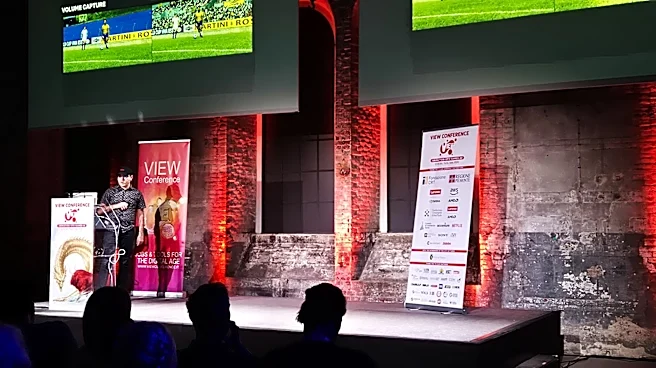
Marvel and Sony’s “Spider-Man: Brand New Day” involved nearly 2,000 VFX shots and just 24 weeks of post-production, with 445 shots delivered in a single week, overall VFX supervisor Jerome Chen revealed at View Conference
in Turin on Wednesday.
“In one week, we did about 445 shots,” Chen said, comparing the feat with his first film as a supervisor in 1999, which contained 450 shots in total and took two years to complete.
About three-quarters of “Brand New Day’s” VFX work was delivered during the final six weeks, he added, making an already demanding schedule even more intense.
Next, Chen recalled that preparations began with a scouting trip to New York in December 2024, before he had received a finished script. Director Destin Daniel Cretton wanted a more grounded, street-level Spider-Man, with the city itself integral to the story. But most filming would take place in the U.K., where Pinewood Studios, London and Glasgow doubled for New York. Production designer Charles Wood’s concept art helped establish a relatively restrained palette, punctuated by saturated colors at key emotional moments.
The team preserved usable street-level photography and digitally replaced or extended much of what lay above it. “We just found basically a recipe of a half dozen or so things that tell you that it’s New York,” Chen said. Those included hanging traffic signals, scaffolding, water towers and the correct power lines. Even the yellow markings along British curbs had to disappear.
Small pieces of script could produce enormous technical assignments. An introduction involving Spider-Man and a tank expanded from a handful of words into 11 shots and roughly 52 seconds of footage. Physical tabletop models helped the crew determine how a vehicle should crash through a building when there was no time for elaborate previws. In another sequence, a compact camera rig mounted on a helmet captured Tom Holland’s performance from near his face, with a blurry red shape added in compositing to suggest the inside of his mask. “Sometimes the easiest tricks are the most effective,” Chen said.
The movie also gave Chen his first opportunity to work on Mark Ruffalo’s Hulk. Because the character appears in a more savage, telepathically controlled state, the team explored a different physique from earlier Marvel outings, adjusting his proportions, muscular definition, hair color and the relative size of his hands and feet. Chen consulted Marvel Studios president Kevin Feige about how Hulk’s appearance had evolved across the franchise.
“I realized that nobody had ever looked closely at Hulk’s toenails before,” Chen joked. “That was something that we had to do.” Earlier versions looked unnaturally green, while the team also considered how the character’s skin would react to different lighting. They lengthened his arms, reduced his body fat and gave him grayer hair. A subtle shift in eye color, from green to brown, signals a moment when Hulk regains his humanity. Full-scale, 10-foot Hulk standins helped actors and camera crews judge his dimensions on set, and even his pants required careful attention.
A climactic energy wave involving Jean Grey proved harder to solve creatively. Chen initially resisted the rainbow-like chromatic aberration familiar from other screen depictions of superpowers. But with five weeks remaining, he reversed course, deciding the established visual vocabulary served the film better than something overly electronic. “I thought it was the weakest part of the film,” he admitted. “I wish we had come up with something better.”
Time, he argued, often determines the quality of VFX more than the artists’ abilities. “If you go to a movie and you see that there’s a visual effects shot that doesn’t look that good, it’s not because there are bad artists on it,” he said. “You can tell they just ran out of time.” Chen advised supervisors facing decision fatigue to review shots within their sequences rather than obsess over individual frames.
Finishing so rapidly could also have consequences for the industry: “We may have done ourselves a disfavor by actually finishing this movie in 24 weeks because once again we’ve proven that it can be done on time.”
The final challenge was unexpectedly modest. With the vendors already finished, a last-minute review revealed a sweat stain under Spider-Man’s arm. “You can’t have superheroes sweating into their suit,” Chen recalled. A small team at Marvel’s Burbank offices removed it in about 47 minutes, delivered the corrected shot and sent Chen home from a nearly empty parking garage beneath the studio.