






Click here to read the full article.
“People need stories,” says Larry Lamb, beleaguered editor of leading British tabloid The Sun, at a late point in “Ink,” a propulsive, can’t-look-away account of his simultaneously triumphant and regrettable career
zenith. In the film, the year is 1970: His words are half a century ahead of the current prevalence of “storytelling” as a catch-all buzzword describing the jobs of everyone in media from journalists to filmmakers. Lamb gave good story, for sure; so do director Danny Boyle and writer James Graham, who have fashioned the late newsman’s aggressively populist makeover of U.K. journalistic standards into an irresistibly hooky tale of sex, murder and other very bad behavior, shot and cut with maximum flash and dazzle, set to a driving punk rhythm.
If many of Boyle and Graham’s attention-grabbing tactics are straight out of the tabloid playbook, well, consider their film its own case in point — as it persuasively draws a straight-but-very-crooked line from The Sun, then newly under the ownership of Australian magnate Rupert Murdoch, to a fast, cynical, de-standardized modern media landscape, still very much in Murdoch’s clutches. People need stories, yes, but any stories? Adapted and significantly jazzed-up from Graham’s stage hit, “Ink” captures both a specifically seismic era in the British journalistic sphere —the beginning of the end of Fleet Street, essentially — and a more universal shift in how the public is fed information, or entertainment, or the ever larger and murkier in-between. Lamb adheres rigidly to the famous five W’s at the core of the reporter’s job: “Ink” in turn asks what the hell we’ve done and where we go from here.
But mostly it’s just a very compelling yarn, galvanized by a terrifically bullish performance from Jack O’Connell as Lamb, a Yorkshire-born working-class striver whose populist redirection of the then-struggling paper is presented both as a canny business move and a kind of personal vindication: a poke in the eye of the posh, fusty old boys who had controlled Fleet Street — and thus his career — up to that point. Is it vindication if it costs a man his soul?
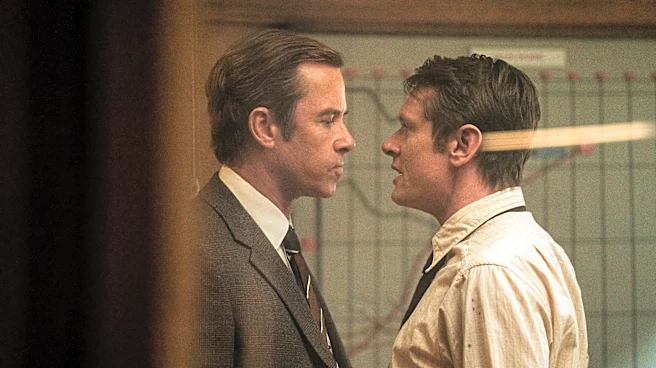
Graham’s script, which maintains a tone at once enjoyably gossipy and queasily troubled, makes no clear pronouncements on that front. It doesn’t make a heroic outsider of Murdoch, played by Guy Pearce with oily finesse and a faint chill beneath his Aussie candor, but the ensuing moral battle between him and Lamb is an ambiguous one. The crass, dehumanizing sensationalism that became The Sun’s very successful stock-in-trade appears to emerge from a combination of the editor’s boundless pledge to give the people what they want, and the owner’s dispassionate, sometimes reluctant commitment to back whatever sells.
What that is, as Lamb determines by focus-grouping his own staff, is not that deep: sleaze, sport and sex, with a side of human interest, and the weather on page two, because they’re British, and as his uptight deputy editor Bernard Shrimsley (Patrick Kennedy) says, “That’s what I like to talk about.” It’s an obvious approach that was wholly radical at the time, even before Lamb angered the Press Council and the Church of England alike by putting topless women on page three for purely decorative purposes. Joyce Hopkirk (Claire Foy, excellent in a slightly underwritten role), Lamb’s mistress and also the most senior female journo on his staff, shrugs off such lowbrow misogyny in return for a more progressive women’s page under her control: She doesn’t like everything about the new direction, but she concedes, “It’s exciting, isn’t it?”
To a point, yes. But it’s all fun and games until somebody gets hurt, and when the wife of Murdoch’s deputy is kidnapped by two rogue ransom-seekers, the dangers of Lamb’s fast-and-loose journalistic approach come to the fore — as, to the consternation of the authorities, he treats this close-to-home crisis as grabby headline fodder. When the police warn him that such invasive reporting might affect the case, Lamb counters that that’s very much his intention. Murdoch, meanwhile, wonders if his bold new hire has gone too far — and emerges, somewhat surprisingly, as this story’s dry, wary conscience.
Does “Ink” go too soft on him? Sometimes the film seems to have it both ways in decrying the mogul’s cheapening of news media while also permitting him moments of I’ve-created-a-monster reckoning; sometimes having it both ways seems to be its deliberate, tabloid-honoring modus operandi. Lamb, who years later admitted to regretting a number of his innovations at The Sun, isn’t granted quite the same grace — except that O’Connell, who’s at his best playing gritty chancers with a point to prove, is such a naturally charismatic and unvarnished presence that we find ourselves oddly sharing in his competitive zeal. As The Sun swiftly moves up through the national sales rankings — charted on a bulletin board in his office — it feels like a win, even if we question for what, exactly.
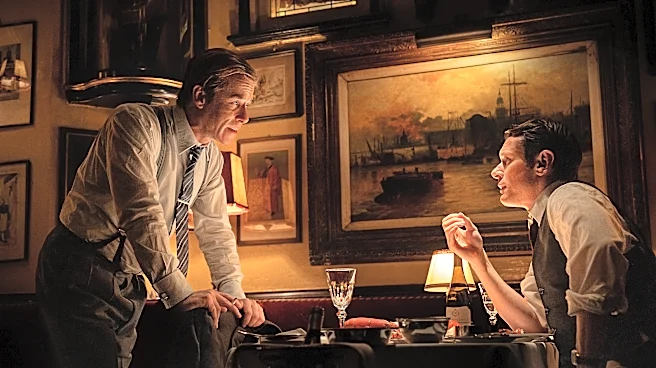
Stylistically, “Ink” sets out its stall with an introductory conversation scene — as Murdoch, having freshly acquired The Sun, attempts to lure Lamb from his job at rival tabloid the Daily Mirror, over dinner at London’s venerable Rules restaurant — that has been tricked out and zhuzhed up to the nth degree. (It also establishes the script’s selective allegiance to fact: Lamb actually worked at the Daily Mail.) Opening in newsprint-grainy monochrome before flushing into gold-filtered color, Alwin H. Küchler’s camera maximally darts and zooms around this confined dramatic space, often at wildly canted angles, while editor Fin Oates cuts, cuts, cuts within the scene, before cutting away to a lurid, teasing flash-forward.
Even under a simple two-person dialogue, Johnnie Burn’s sound design and Daniel Pemberton’s score are jointly heavy on churning, faintly industrial noise, supplemented by suitably anachronistic rock soundtrack cuts. (Everything about The Sun, we’re invited to think, was ahead of its time, for better or worse.) After dinner, Lamb invites Murdoch to physically feel the thrum of the underground printing presses through the asphalt of Fleet Street; in “Ink,” we sense it throughout.
To some degree, these are expected techniques for lending a cinematic jolt to talky stage material, though “Ink” isn’t opened-out as much as it’s feverishly amped-up. But even before the red top-style opening credits stress the point, it’s hard not to identify a sizzle-sizzle tabloid sensibility in this mise-en-scène. It’s one that plays ideally to Boyle’s most restless, dynamic strengths as a filmmaker, but also puts the audience on the alert: Should any story packaged this slickly be taken altogether at face value? Boyle’s film is riveting and needling and leaves you feeling pretty awful, right up to a closing montage that connects Lamb’s and Murdoch’s legacy to the unregulated cacophony of today’s media and social media scenes, from Fox News to Facebook. A final flourish that makes explicit what was already implicit, it’s not subtle, but it lands with impact. Larry Lamb would approve.