




Click here to read the full article.
Love is a burning thing, a Man in Black once said, and its flame burns bright in “Bleeding Hearts,” an achingly intimate new documentary that captures a country music couple falling for one another as their band embarks
on its first cross-country tour.
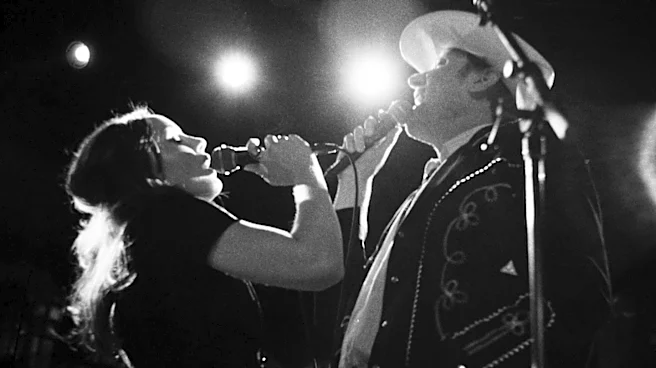
Directed by Andrew Morgan and making its world premiere at TIFF, the film chronicles a year in the life of Chaparelle, a country supergroup of sorts comprised of Zella Day, a former pop singer who’s opened for Lana Del Rey; country singer-songwriter Jesse Woods; and producer Beau Bedford. But it’s really more of a two-hander with Zella and Jesse, the couple at its center, harmonizing heartfelt ballads with one another.
And they couldn’t be more different. Jesse, tall and taciturn, enjoys his alone time, favoring the solitary nature of the songwriting process over performing. He is prone to suffocating bouts of depression and was at a particularly low point when Zella entered his life. Zella is a tiny ball of energy who lights up every room she’s in and stage she sets foot on. She is also 12 years younger than her counterpart, who is 43.
“Zella and I are very opposite in a lot of ways,” offers Woods. “I’m more of a stoic with a minimal amount of communication. Zella is a joyful person and it’s very good medicine for me.”
“It’s like stars and gravity,” adds Day. “You have to be standing on the ground in order to look up and see the stars. For me, what Jesse brings to Chaparelle is this gravity.”
If this juxtaposition — that of the tortured songwriter and eager ingénue who pulls him out of the darkness — sounds familiar, it is. You’ve seen it before in films like “Walk the Line” and, of course, three different versions of “A Star Is Born.” It’s hard not to think of “A Star Is Born” while watching “Bleeding Hearts,” as Woods and Day bask in quietude and tenderness at their Wimberley cabin before stepping under the bright lights to stomp, clap and croon, with Day firmly front and center.
“I think they are two people who are in love with each other in a very honest way, and that honesty comes out when they perform,” explains Morgan. “Zella is a star. She has that extra something and she has it onstage, so it’s cool that she found someone in Jesse who’s not trying to outdo that and is allowing her to be that.”
Day and Woods seemed to find each other at just the right time. Woods had moved out to a cabin in Wimberley, a remote area in Texas with a population of 2,800 people. He’d “gone through a breakup, was drinking way too much and was isolated.” Day had been living in Los Angeles for thirteen years trying to break big as a pop star, which left her “spiritually and energetically” drained. She was tired of asking her more famous friends for favors and the transactional nature of L.A. She was “starved for authenticity” and needed to escape.
“I was getting to a point where I was getting exhausted by the industry,” says Day. “I’d signed a record and publishing deal when I was 18 years old, and my whole life was built around my image and my music. I got to a point around 26 where I was exhausted by that, and my relationships were also exhausted by that. I hadn’t hit a stride where I’d reached a certain level of fame or success where it made things easier. I didn’t know how to move forward in a way that made my soul happy.”
Day was a fan of Woods’ music, and in 2021, reached out to see if he’d like to write together. The two met at Austin City Limits, took in each other’s shows, and a month later he brought her out to Wimberley, which to her felt “so familiar and nostalgic,” like her cozy hometown of Pinetop, Arizona. The visits became more frequent, and before long, they were romantically and creatively conjoined. During one of those Wimberley trips, Bedford was invited out to the cabin, and the trio wrote the songs “Bleeding Hearts” and “Bad Loving” over the course of two days. Chaparelle was born.
Shortly thereafter, a friend of Morgan’s sent him an unreleased demo of Chaparelle’s song “Bleeding Hearts,” a stirring, slow-burn duet with Day and Woods joining forces on the chorus: “A bleeding heart / Will make a mess of things / A falling star / Will burn up everything.” Morgan was immediately hooked.
“I had a visceral reaction to that song in the same way I would as a kid if you heard a needle-drop song in a Cameron Crowe film that you hadn’t heard before,” he recalls. “Something lit up inside me.”
The filmmaker reached out to the couple, who said they’d just started a relationship and a band. It had been a dream of Morgan’s to make a music film in real time, so he told Day and Woods he was interested in documenting “the first year of a band where it’s volatile and exciting and you don’t know what’s going to happen.” He asked them to be “all-in,” and, flattered by the director’s fandom, they agreed.
“We didn’t sign a contractual obligation that we would never stop filming even if we weren’t OK with the process,” says Day. “It was this relationship we agreed to and every step of the way we decided we wanted to go further because we liked him and felt he was documenting a very special time in our lives.”
“That’s what we do,” adds Woods. “We start new things and see how they go.”
Morgan began shadowing them a few weeks later, in January of 2024, documenting their first shows on the West Coast. He would trail them for a year.
“When I talked to them, I had been watching ‘Don’t Look Back’ and ‘Truth or Dare’ — films that were intimate in their nature — and that was really what I pitched them,” shares Morgan. “I wanted the audience to be in the hotels and in the vans with them.”
Morgan, along with his longtime cinematographer, Lance Kuhns, tested a number of different looks for the film. There was something about Day and Woods’ story that struck them as timeless, so, like “Don’t Look Back” and “Truth or Dare,” they opted for black and white. And it’s a good thing they did because the film looks stunning.
The team accomplished this with Sony FX6 and FX3 cameras, coupled with old prime lenses, and a group of five with Chaparelle on the road: Morgan; his brother/producer Zach; Kuhns; second DP Helen Cassell; and their sound mixer, Michael Flowe. Money, as you can imagine, was tight.
“I’m not supposed to say the exact number since we’re in sales talks, but I will say it’s less than you can physically imagine. The budget was really small,” Morgan attests. “We shot on small cameras, didn’t use lights and it was simple. We made it the way we used to make stuff in the backyard. We shot it like a home video the way you’d make something with your friends. There’s no one famous in this movie and no big company behind this movie. It was done piece by piece, and I’m incredibly proud of it.”
“Bleeding Hearts” isn’t all sunshine and rainbows. We are treated to scenes of Day and Woods bickering over their contrasting approaches to live performance and conflict resolution in vans and backrooms, sometimes moments before they’re set to take the stage.
“I think the hard part, for me, is I come from a genre of music where there’s not really banter or personality content on stage, and Zella comes from the pop world where a lot of it is speaking to the fans,” Woods says. “Where we clash, really, is Zella is like, ‘Talk to them more!’ And I’m like, ‘Talk to them less!’”
“But then I’ll be like, ‘Let’s at least talk to each other.’ We still have this contrasting issue,” Day remarks. “He is so magnetic in a different way than I am and it’s something I want people to see. I want to be a projector of his light. It’s less wanting him to be something he’s not and more wanting him to share who he is, which in some ways is Jesse’s allure, that he doesn’t show very much.”
We also see Day and Woods struggle with the realities of being a new touring band today that refuses to play by the new set of rules — namely, generating a barrage of social media content to promote your music and tour (or having someone generate it for you).
“I really don’t love making content and Zella is younger and doesn’t particularly like doing it either. We want to get in the game and play the game, but there’s a line of, ‘I’m not going to do a dance or videos of me making breakfast,’” says Woods. “I still believe that if the music is good and you’re consistent, then good things will happen. Big Thief is one of my favorite bands and they’re an example of a band that did it the old way of playing amazing shows that created word of mouth. It’s still possible.”
At one point, a major A&R representative even suggests Day re-record all of Chaparelle’s music without Woods if she wants to get signed, which gives them a good laugh. They may not be making money yet from Chaparelle, but the pair say they’re at least pulling in enough to keep the project going. And more importantly, they’ve never been happier.
“We live humbly in the country with good food by a beautiful river, so we’ve got what we need covered,” Day maintains. “I know people who are incredibly successful and incredibly lonely, and I’m so grateful that that’s not me and my experience.”