






Click here to read the full article.
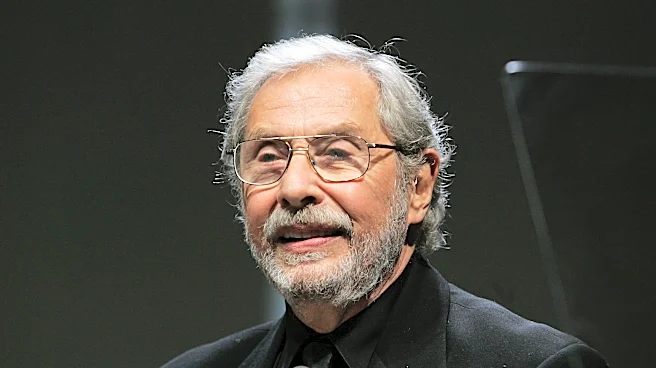
Mark Rydell, who received a best director nomination for the Oscar-winning “On Golden Pond” and directed Bette Midler in “The Rose” and “For the Boys,” died Friday. He was 97.
Midler posted about his death on her Instagram,
writing, “Mark Rydell, the director or my first film, The Rose, died this morning. He was an actor of note before he became a director, and I was so lucky to have met him when I did; he taught me so much on The Rose and later on For The Boys. Two Oscars nominations both because of him. He was the actor’s whisperer; just a few words was all it took to understand what was needed. Devoted to Meisner. So many happy memories.”
He starting his directing career in television before graduating to film in the late ’60s with an adaptation of D.H. Lawrence’s “The Fox.”
As a director he elicited strong performances from his actors, guiding Henry Fonda and Katharine Hepburn to Oscars and Jane Fonda to a supporting actress nomination for “On Golden Pond” in 1981. He had previously worked similar magic for Midler in her screen debut, “The Rose” (and later in her career in “For the Boys”); Marsha Mason in “Cinderella Liberty”; Sissy Spacek in “The River”; and Rupert Crosse, who drew a supporting nom for 1969’s “The Reivers.”
His greatest screen success was “On Golden Pond,” adapted from Ernest Thompson’s stage drama about family relationships. It was nominated for best picture and brought Rydell a directing nom. The seriously ill Henry Fonda won an Oscar in what would be his last starring role — and his only co-starring role with daughter Jane, who was also nominated. Hepburn won an unprecedented fourth acting Oscar for her work, and Thompson won for adapting his work to the screen.
In front of the camera he started as an actor on the soap opera “As the World Turns” in the 1950s and made his feature debut as a juvenile delinquent in the gritty 1956 drama “Crime in the Streets,” and he appeared on Broadway “Seagulls Over Sorrento,” “Handful of Fire” and “Moonbirds” during the period; in later years he would take on the occasional supporting role, most impressively as the psychotic gangster in Robert Altman’s “The Long Goodbye” — the kind of performance that would have made the career of a full-time working actor.
But Rydell preferred to direct, if somewhat sporadically, and to produce, forming a partnership with Sydney Pollock in the mid-1980s, Sanford Prods.
The young actor had crossed behind the camera by the early ’60s, racking up an impressive resume of episodic television helming credits, including episodes of “Gunsmoke,” “Ben Casey,” “The Fugitive,” “I Spy” and “The Wild, Wild West.” His reputation for speed and for drawing smart performances led to his first film directing job, “The Fox,” a controversial love triangle story that raised the hackles of censors (for lesbian content and a famous masturbation scene) but was warmly received by arthouse audiences in the late ’60s. The film starred Sandy Dennis and Keir Dullea.
Next up was Western comedy “The Reivers,” a star vehicle for Steve McQueen, which brought Crosse an Oscar nomination as best supporting actor. Three years later in 1972 he directed (and produced) another Western, “The Cowboys,” starring John Wayne. The following year he also did double duty on the romantic drama “Cinderella Liberty,” starring James Caan and Mason, for which Mason picked up an Oscar nomination. That same year he made an indelible impression in front of the cameras as gangster Marty Augustine in Robert Altman’s adaptation of Raymond Chandler’s “The Long Goodbye,” starring Elliott Gould.
His 1976 period comedy “Harry and Walter Go to New York” was one of his lesser efforts despite an all-star cast of Caan, Gould and Diane Keaton. He bounced back in 1979 with “The Rose,” a fictionalized version of the short, tempestuous life of Janis Joplin, expertly taking Midler through her feature debut perf, for which she was awarded her first Oscar nomination. He would later guide her to another nomination as a wartime USO performer with shades of Martha Raye in “For the Boys” in 1991.
In 1981 came the achievement of “On Golden Pond.”
Though he was now a feature director and occasional actor, Rydell also served as an executive consultant on the critically lauded ABC drama “Family” from 1976-80.
The 1984 heartland drama “The River” was not a notable success, though it brought Sissy Spacek another Oscar nomination as best actress. Rydell took a break from directing to star in the standup comedy drama “Punchline” and as another gangster, Meyer Lansky, in his friend Pollock’s “Havana.”
In 1991, while directing “For the Boys,” he also produced a small rural drama, “The Man in the Moon,” starring Sam Waterston. His 1994 marital drama “Intersection,” starring Richard Gere and Sharon Stone, was moderately successful.
He returned to television in 1996 to direct “Crime of the Century,” about the Lindbergh kidnapping case, for HBO. In 2001 he helmed the critically acclaimed TNT telepic “James Dean,” starring James Franco, and drawing 11 Emmy nominations including best director.
Rydell returned to the bigscreen to direct “Even Money,” starring Kim Basinger, Kelsey Grammer and Forest Whitaker and centering gambling addiction, in 2006. His last helming effort was a 2007 episode of the ABC series “Masters of Science Fiction,” hosted by Stephen Hawking.
Rydell continued his acting work. In the 2000s he appeared in his own “James Dean” (playing studio mogul Jack Warner) and “Even Money,” as well as in Woody Allen’s “Hollywood Ending” and an episode of “Everwood.” And in 2006 he returned to the stage to star in an Elaine May trilogy of one-acts in San Francisco.
Mortimer H. Rydell was born in New York and attended the Juilliard School of Music, training as an actor both at the Neighborhood Playhouse and at the Actors Studio. In the 1950s, he appeared on Broadway while working as a jazz pianist to earn extra money. For six years he starred in “As the World Turns” before his character was killed off. He also worked as an actor in television in episodes of such series as “Wanted: Dead or Alive” before moving into directing for TV and then for the bigscreen.
He is survived by three children, Amy, Christopher, both actors; and Alexander, an editor.