


Click here to read the full article.
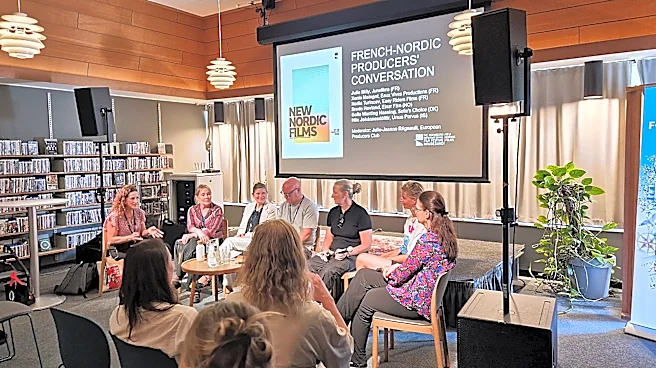
Starring Stephen Graham, Toni Collette, Bill Nighy and Charlie Plummer, “Ibelin,” from “The Imitation Game” director Morten Tyldum, loomed large over a French-Nordic producers’ roundtable held today at New Nordic Films
in Haugesund.
The project became a striking case study in how increasingly ambitious European films are being assembled across borders.
Inspired by the life of Norwegian gamer Mats Steen, the drama is structured across Norway, France, the U.K., Belgium and the Czech Republic, tapping into Norwegian soft moneys with incentives, equity and production and post-production work spread across several territories.
Steen, who had Duchenne muscular dystrophy, forged deep friendships and an unexpectedly expansive social life through “World of Warcraft” — a world his family only fully understood after his death.
Brede Hovland of Norway’s Einar Film, who stepped in for producer Guri Neby on the panel, said the Norwegian shoot wrapped at the end of May after six-to-seven weeks in Oslo, with production now in Prague for the medieval and fantasy material.
He declined to reveal the budget but labelled “Ibelin” as “the most expensive Norwegian film ever, for sure.”
Hovland said the financing took roughly 10 months to assemble and praised the French partners for helping navigate what he characterized as an extensive puzzle of incentives and cash flow. Vendôme Pictures’ Philippe Rousselet and Fabrice Gianfermi are among the French partners.
The setup, Hovland said, remains “mostly independent” while operating at something approaching U.S. scale — an unusually high-profile illustration of the cross-border model under discussion.
Moderated by European Producers Club managing director Julie-Jeanne Regnault, the session brought together producers from France, Norway, Denmark and Iceland to compare not only what makes the two regions natural partners, but also the points where their financing cultures diverge.
For June Films producer Julie Billy, the attraction was emphatic.
“For me, it’s always been paradise to work with the Nordics,” she said, pointing to what she sees as greater flexibility in Nordic financing timetables as well as a more advanced culture of equality and diversity within crews.
Billy also argued that French and Nordic producers tend to communicate unusually well, describing previous collaborations as notably smooth despite differences between national systems.
Nadia Turincev of Easy Riders Films offered a more complicated picture. Drawing on her experience as a French minority co-producer on Nordic-led projects, she said French development funding for minority co-productions can be difficult to access, while territorial spending requirements become increasingly complicated as additional countries join a financing structure.
“That’s where you start playing ‘Tetris,’” Turincev said of having to redistribute expenditure and production elements when financing plans change.
The systems themselves may recognize one another relatively easily, she added, but the way producers are required to operate within them can be considerably different.
That contrast between flexibility and constraint ran throughout the discussion. Hovland noted that majority Norwegian productions are not necessarily subject to a written obligation to spend state support domestically, although Norwegian creative participation remains part of the broader evaluation. French producers described a generally tighter relationship between public support and territorial expenditure.
Despite those complications, the French panelists made clear that their appetite for Nordic material is growing.
“The audience in France loves Nordic cinema,” Billy said, singling out genre filmmaking as an area of particular opportunity. She pointed in particular to an emerging wave of female-driven horror, arguing that Nordic genre films can connect with French audiences in ways that comparable French-language horror often struggles to do.
Turincev, who had watched 21 projects at the market, highlighted another attraction: scale. A French contribution of €400,000 ($466,000), she noted, represents only 10% of a €4 million film but becomes a far more meaningful stake in a €1.2 million production, making some of the lower-budget Nordic projects particularly workable for minority partners.
For Xénia Maingot of Eaux Vives Productions, who has worked with Scandinavian partners for more than two decades, the equation ultimately goes beyond financing. “I’m fighting for a director, I’m fighting for a vision,” she said, adding that producers can spend four years trying to get a project made. That makes confidence in the people on the other side of the co-production essential. “It’s not only the project,” she added.