








Click here to read the full article.
Four people. One letter. An ocean between them.
To send a letter home from Bangkok in the 1950s, an overseas Chinese laborer needed four people: himself, a scribe to put his words on paper, a reader to decode it at the destination
and the person waiting to hear it read aloud. Lan Hongchun built a $291 million film around that chain – and everything that could go wrong inside it.
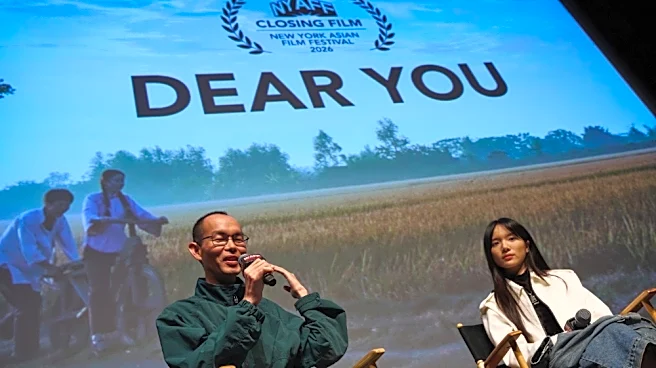
“Dear You,” which closed the 25th New York Asian Film Festival, is a RMB14 million ($2.1 million) dialect picture spoken almost entirely in Teochew, rooted in a form of correspondence most audiences under 50 couldn’t identify. It has become the second-highest-grossing film in China this year, after “Pegasus 3,” earning $285 million locally with a further $6 million from its first wave of international markets.
Speaking to Variety at the festival, Lan — who directed, wrote and edited the film — does the math out loud. His best-case projection going in was somewhere between RMB100 million ($14.8 million) and RMB200 million ($29.5 million) at the China box office. “It is 10 times more than what we have expected,” he says. “Now we are looking at RMB2 billion ($295.5 million), and it’s still growing.”
He attributes the unpredictability in part to something shifting in the audience itself. “The film market and the box office in recent years seems to be a little bit more unpredictable,” he says. “I do think that maybe it has something to do with audience aesthetics — the films they like seems to be evolving, and it is hard to really predict what they truly enjoy.”
Sitting beside him is Li Sitong, who makes her film debut in “Dear You.” She was “very surprised” by the response. “Definitely I want to thank the audience,” she adds. “It has been about three months since we started the promotion tours, and I do think that our success really is the result of the support.”
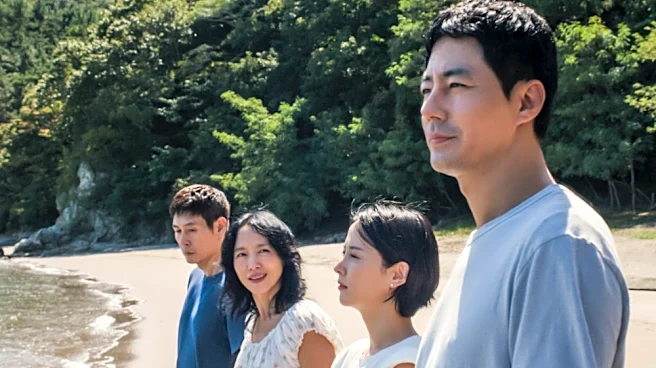
The film follows Xiaowei, a young man from Chaoshan who travels secretly to Thailand to find the grandfather who severed contact with the family decades earlier. What he uncovers is a story rooted in the 1950s Chinese diaspora community in Bangkok, built around qiaopi – the system of remittance letters that illiterate overseas laborers relied on scribes to compose, then sent across oceans to families who in turn needed someone else to read them aloud. Four people, minimum, for a single letter. In each handoff: the possibility of misunderstanding, compression, silence.
For Lan, that chain of human mediation was not just a period detail but the dramatic engine of the entire film. “It’s actually the other way around: qiaopi as an element inspired the entire story,” he says. “You need four people involved in order for this letter to be sent out and to be received.” At every stage, fidelity slips. “This is almost like three layers of opportunity to create dramatic tensions,” he says. The letters themselves carry their own aesthetic charge – dense with classical Chinese phrasing, compressed to the point of ambiguity, possessed of what Lan describes as a refined, antique beauty.
Lan is himself from Chaoshan, and “Dear You” is his third feature in the Teochew dialect — the concluding film in what has come to be known as his Teochew Trilogy. His 2018 debut, “Proud of Me,” was the first Teochew-language film to receive a theatrical release in China. His second, “Back to Love” (2022), continued in the same vein. Before making “Dear You,” he spent years traveling through Thailand and Malaysia, collecting oral histories from overseas Chinese communities. The characters in the film — Musheng, Nanzhi, Ye Shurou — are not portraits of any single individual but composites of what he found.
“They’re chivalrous, they have strong family values, they have integrity, they have kindness,” he says. “I do think that these are the kind of common quality characteristics and traits of our ancestors.” The structure of the film follows a principle he describes as a form that disperses but a spirit that never does: each storyline goes its own way, each character their own trajectory, but all of them arrive at the same essential human qualities.
The role of Xie Nanzhi, the woman whose handwritten letters become the quiet center of the story, drew Li in part because of a single late decision the character makes: to become a ghostwriter herself, continuing to correspond with Musheng’s family on his behalf and sustaining a connection across distance and time. What also moved her was Nanzhi’s refusal to be broken by what life put in her path. “Her life wasn’t that easygoing either, but she never gave up. She always found a way to move forward with such a positive outlook on life. And I wanted to learn from her.”
To prepare, Li immersed herself in documentary footage and archive recordings of mid-century Southeast Asia, studying the mannerisms and speech of the period. She also drew on something closer to home. The dynamic between Nanzhi and the father figure in the film tracked almost exactly onto her own relationship with her father in real life — a coincidence that extended to the actor playing that role, who also has a daughter. “The way we interact with each other is very similar to the father and daughter on screen,” she says. “So I think that really helped.”
The dialect required its own preparation. Li grew up in the Chaoshan region of Guangdong, so Teochew was not foreign to her — but performing in it was a different matter. Mandarin is the language of formal schooling in China since middle school, and the result, as Li describes it, is a generation that speaks its ancestral dialect with growing unfamiliarity. “As soon as you finish elementary school, there is this push to speak Mandarin as your main language within the academic system,” she says. “That sort of resulted in the slight decline of the ability of the younger generation to speak the Teochew dialect.” On set, Lan worked scene by scene with the cast, adjusting lines written in Mandarin into the natural cadences of spoken Teochew. “I welcome the challenge,” Li says. “I have the benefit of watching the director’s two previous films, so I know that films spoken in the Teochew dialect can also do well in the market.”
That question — whether dialect is a commercial liability or a creative asset — had long shadowed the kind of filmmaking Lan has spent his career doing. He had been told, often enough, that the specificity of a Teochew-language film built in its own ceiling. “People in the past tended to assume that this is not going to be universal, not going to be profit-making,” he says. The performance of “Dear You” has already begun to shift that calculus in Guangdong, where dialect-based projects that previously couldn’t attract financing have found new attention. “Dialect is never going to be a liability for you,” Lan says, “as long as you have great ideas, great storylines, great social values, emotional values and great characters.”
Well Go USA will release the film theatrically across North America on Sept. 4. It arrives having already played Hong Kong, Macau, Singapore, Malaysia and Brunei in its first international wave, with further releases across the U.K., France, Ireland, Japan, South Korea, Thailand, Vietnam, Australia and New Zealand. The international rollout is being handled by Damai Entertainment, the Beijing-based distributor formerly known as Alibaba Pictures.
For Li, whose performance alongside fellow debut Wang Yantong has made them some of the most-discussed newcomers in China this year, the question of what comes next carries a weight she is learning to sit with. Asked whether she fears being spoiled by starting so high, she doesn’t hesitate.
“I love to be spoiled, so you can continue to spoil me,” she says. Then: “I just see this as a great opportunity for me to learn, and to be the best actor that I can be.”