



Click here to read the full article.
Sirimiri Films, founded by Estibaliz Urresola, director of Berlinale winner “20,000 Species of Bees,” is teaming with Lazona Zinema, the Basque division of Lazona (“Spanish Affair,” “Gigantes,” “No Rest for the Wicked”)
to produce “La Koreana,” one of Spain’s banner new talent titles.
The projected feature debut of Basque writer-director Joana Moya, “La Koreana” leapt to notice last September at San Sebastián when it won the Sideral Ikusmira Berriak Prize, the top plaudit at one of Spain’s foremost development labs where Moya attended its 2025 residency.
“La Koreana” will now be brought to market at the Locarno Festival’s Match Me!, a large co-production and networking meet running Aug. 7-9 which will feature Lazona Zinema’s Jesús Choya among its producers lineup.
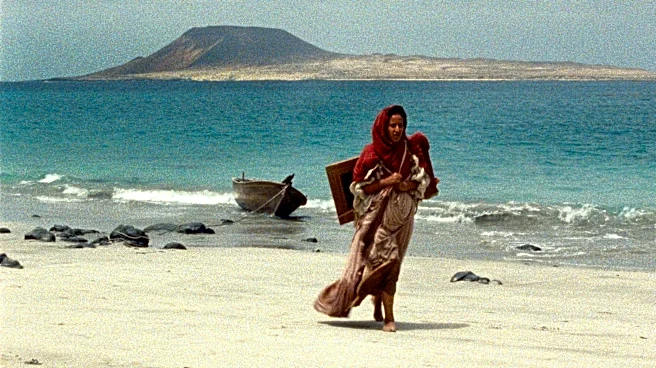
Put through Noka Ekoizpena, a San Sebastian-based women-focused mentorship and production acceleration program, “La Koreana” is set across three timelines, one in 1890 and another around 1960, set at a gigantic iron mine mountain running for miles in La Arboleda, in the Basque province of Bizkaia.
In 1890, the miners seem trapped in time. Around 1960, Manuela, “La Koreana,” arrives at the mine from her native Andalusia to join her husband. But the mine is already in ruins.
The film’s synopsis begins with an image: “A mountain lurks behind the fog while hundreds of miners extract iron from within. Hypnotized by its magnetism, they will be lost in its time and its memory.”
The film’s “true main character,” Mora told Variety, is the mountain, “a territory on which the story of those who have worked and lived on it is written.” All the characters, human and non-human, are submitted to a process of extraction and exploitation,” Mora explained while still at Ikusmira Berriak.
“‘La Koreana’ is a film about memory and the transformation of bodies and landscapes. It’s based on a simple question: What remains in a place after it has been exploited to its limits?” she commented to Variety.
The feature is inspired by the memories and stories of Moya’s grandmother, who made Manuela’s journey from Málaga to La Arboleda at around the same time.
“I wanted to produce ‘La Koreana’ because I noticed in Joana Moya’s vision a deeply personal way of engaging with our region,” Urresola told Variety.
“Her ability to revisit our mining past from an intimate, auteurist perspective, giving a voice to the mountain, resonates with my desire to promote a form of cinema capable of transforming the memory of the landscape into a vivid cinematic experience,” added Urresola, whose “20,000 Species of Bees,” winner of Berlin’s best leading performance award for Sofía Otero in 2023, has the same resonant sense of place, while also raising far broader issues.
“‘La Koreana’ is one of the most conceptually daring projects we have found and perfectly reflects our goals in this new chapter of Lazona Zinema: to support radical voices with deep roots in the Basque Country and projects capable of captivating the international auteur scene,” added Choya, who served as a delegate producer on “Sundays” and Cannes hit “Sleepless City” when working for Marisa Fernández Armenteros’ Buenapinta Media.
Choya was one of Variety’s 2024 10 Emerging Producers to Watch selection. He now heads up Lazona Cinema, founded in Bizkaia capital Bilbao in 2024 to produce bold, risk-taking projects from emerging Basque voices and large-scale productions and international co-productions.
An early production, comedy “Sin Cobertura,“ scored €2.9 million ($3.4 million) at the Spanish box office last year. It has just released “A Sucker’s Born Every Minute,” Arantxa Echeverría’s follow up to smash hit “Undercover.”