
Click here to read the full article.
There’s barely an adult in sight in Hirokazu Kore-eda’s “Look Back,” where anyone out of school age is marginalized practically to the point of superfluidity. Like much
in the first half of this sweet — at times too sweet — adaptation from Tatsuki Fujimoto’s manga of the same title, also made into an animated film in 2024, the preciousness of a child’s world can create a barrier for those who don’t automatically melt at the sight of a youngster’s smile. But then, as often happens in Kore-eda’s child-focused body of work, there’s a moment when, unexpectedly, what’s on screen suddenly hits a point of transcendence and resistance falls away. That moment can take a bit of time to come, but the payoff is worth the wait.
Fujino (Furi Nanase) is the undisputed star of fourth grade, encouraged by her teacher Mr. Tamai (Kankuro Kudo) and exalted by her peers for the manga strips she draws and shares at school. She thrives on being the queen, so when impressively advanced manga strips appear in school drawn by Kyomoto (Rokka Okada), a reclusive classmate no one has seen, Fujino is not pleased. In response, she redoubles her efforts, neglecting her friends and family in order to once again be the best.
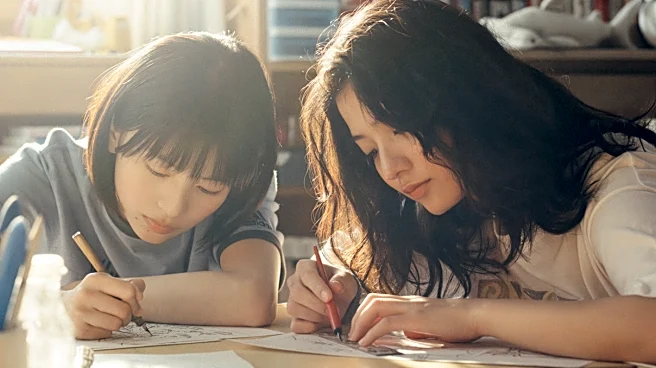
Two years later it’s elementary school graduation time and Mr. Tamai asks Fujino to deliver Kyomoto’s diploma to her home. Though not thrilled with the assignment, she enters the girl’s home, down a corridor piled high with notebooks, looks at the “do not enter” sign and turns away, but not before one of her manga strips gets blown under the door. Just when Fujino leaves, out runs Kyomoto in a tizzy — because she recognizes the girl as the creator of the school’s beloved manga strips, a true master, or “sensei.” This adulation is all Fujino needs to take Kyomoto under her wing, and soon the two are inseparable, collaborating on strips where Fujino writes the stories and draws the figures while Kyomoto does the backgrounds.
Clearly more advanced than the average schoolgirls, the two enter a competition sponsored by the Shueisha publishing house, whose editor (Masaki Suda) recognizes their talents and publishes their first story. Success comes rapidly to the teens, now played by Natsuki Deguchi (Fujino) and Aju Makita (Kyomoto), but their roles remain the same, which suits Fujino just fine. When high school ends the Shueisha editor offers them a series, but Kyomoto wants to go to art school instead. Fujino sees it as a betrayal and determines to be a manga star with or without Kyomoto’s help.
For all of Fujino’s rather full-on sunniness, the truth is she’s a prima donna who lashes out if she doesn’t get her own way. What happens next at first feels like a dreadful narrative misstep, seemingly reinforcing the idea that cutting oneself off from others can save them from life’s travails. Those already familiar with the original manga know better, but so should audiences acquainted with Kore-eda’s humanistic approach to characters: who we are and how we experience the world together, rather than our achievements, is our real saving grace.
As long as audiences accept that this is basically a two-hander, the absence of any other characters with more than stick-figure attributes becomes less problematic. Fujino’s mother exists solely to feed her family and clean house, while Kyomoto’s mother is barely glimpsed — at times it’s difficult to be sure whether the withdrawn girl is real or just a figment of Fujino’s imagination, since for some time that’s the only place she seems to legitimately inhabit.
Sound design is a key element of this world, from the sounds of graphite on paper acting like a musical accompaniment in tandem with Yuta Bandoh’s pleasant score, to the more mechanically produced noise of digital pencils on computer screens. The director’s partiality for seasonal changes is on full display, from brightly colored, sun-tinged summers to autumnal glows and winter’s snowy pleasures. Each season is given major prominence in the children’s world, though why Kore-eda chose a generally pale palette of diffused light isn’t clear. Unless, that is, it’s designed as a contrast to the later saturations of the girls’ more elaborate designs, and the manga animation insert that stirringly helps to bring things to a bittersweet, though deeply satisfying, close.