


Click here to read the full article.
“I don’t know what to tell you.”
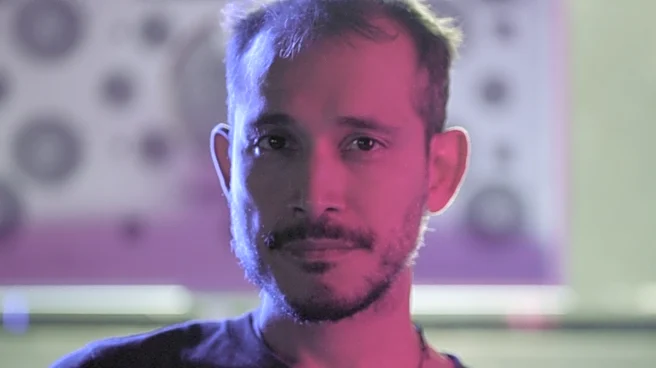
For a time, that was Jeissy Trompiz’s answer when his Brazilian filmmaker friend would ask him about Venezuela.
Trompiz left Maracaibo, the oil city where he grew up, in 2014 to study
filmmaking at the International School of Film and TV in Cuba, just before Venezuela’s economic and political crisis deepened.
He later completed a residency in Italy, made short films in Cuba and Indonesia, and settled in the Dominican Republic in 2019, where he now lives and works. The pandemic and passport renewal problems kept him away from Venezuela for about six years.
When he finally returned home, he was confronted with a changed country he had struggled to explain — even to himself.
“The situation was really sad and shocking,” he told Variety. He couldn’t shake the comparison to Cuba, another country in crisis.
“When I went back to Venezuela, I started to think: Now I can tell you.”
So he started filming “Three Houses” (“Tres casas”), a documentary that takes the form of a video letter from Maracaibo to his friend. Trompiz describes making it as a form of “therapy.”
The film is among the projects selected for the Vancouver Film Festival’s newly launched Business Hub Works-In-Progress Forum.
There’s a sense of urgency for Trompiz to tell this story — even though he’s already been working on it for four years. He initially shot on the streets with a mobile phone, but his mother worried about his safety. She had been involved in promoting the opposition movement, had seen friends jailed, been a target of accusations and pushed out of a public job. Local mafias and extortion posed another threat.
“I couldn’t shoot with my camera in the street anymore, because my mom was afraid to be extorted.” The film moved indoors. Three family homes. Just ordinary people, collecting modest salaries, dealing with the pressures of daily life in Venezuela under its government.
Trompiz’s mother features prominently. After he showed her a cut and asked if she wanted to continue, she told him: “If you believe that it will help the political situation in Venezuela in any way, if it at least helps in this process of trying to look for a democracy in Venezuela — do it. Do not be afraid for me.”
They also created a plan should anything go wrong. “Those are the kinds of conversations [you have].”
Trompiz, who is Afro Indigenous, grew up on the edge of Maracaibo and sees the community he is capturing as existing on a kind of periphery — not simply geographically, but politically and culturally.
Caracas is what much of the outside world pictures when it thinks of Venezuela, he told Variety. The arts, he argues, need to rethink their inclusion of other places “because those are different points of view that can create a more complex perception, analytical situation, and narrative.”
Afro and Indigenous communities, he says, sit in the “periphery of the periphery.”
The country’s rapidly changing political situation has repeatedly forced him to reshape the film. “All of us filmmakers, we are always reshaping and rewriting the film,” he says. “The film by itself finds the way to survive.”
Although many of his friends and family celebrated Nicolás Maduro’s removal, Trompiz could not bring himself to do so.
“I don’t want to thank Trump for this. I wanted Maduro out, but not with U.S. intervention, because it won’t be free.”
The root of fascism, he says, is still in Caracas. He says that now people are really angry and sad.
He acknowledges that he’s seen a few changes for the better. He’s less worried that his mother would be jailed; there’s somewhat more criticism of the government on television (though, curiously, no U.S. criticism); some opposition figures have been released and small protests are possible. But he says that the changes haven’t been significant — there are still people in jail for posting critical content on social media over the past few years — and economic conditions have worsened.
“It’s a terrible situation, because it’s like a two-headed political government. Trump and this other government from Venezuela.”
Millions have left the country, leaving those who remain uncertain about what comes next.
Trompiz’s film isn’t meant to criticize a particular government or boost the opposition. Rather, he wants to show how easily governments can become fascist and oppressive. And what that does to ordinary people.
“Even a left-side government can be fascist,” he says. But with U.S. intervention, “we can see that a left or right [leaning] government can not only be fascist, but can also become allies” when there’s an economic or political deal to be had.
Working on the film has also taken an emotional toll.
“It’s worse than therapy,” Trompiz says, describing the rollercoaster of emotions he experienced while editing. “I cried when I hadn’t cried before.”
“When I was in Venezuela, I was trying to feel stronger. A part of me was proud, saying, ‘I don’t want to cry for this government, or for this oppression.’ But when I started to work on this film, I started to cry. I got sad, and I got angry, and then the reflection starts again. What can I do? And the film also is part of the reflection.”
“Three Houses” is produced by Alamar Films (Venezuela), Piso Tres (Dominican Republic) and Peixe Aranha (Portugal), with support from the Doha Film Institute and Eurodoc Caribe.