




Click here to read the full article.
It’s extraordinary just how prolific Seth Rogen has been.
He began performing stand-up comedy at clubs around his native Vancouver at the age of 13 — around the time he and his buddy Evan Goldberg would write the first
draft of “Superbad” — before featuring in the Judd Apatow shows “Freaks and Geeks” and “Undeclared,” also serving as a writer on the latter, all before the age of 20. Since then, he’s starred in over 40 movies, written 10 and directed two, while creating four TV series. Along with the aforementioned comedy classic “Superbad,” he’s the man behind “Pineapple Express,” “This Is the End” and “The Studio,” while acting in everything from “Donnie Darko” and “Knocked Up” to “Steve Jobs” and “The Invite.”
And that is why, at just 44, Rogen is being honored with the Norman Jewison Career Achievement Award at the 2026 Toronto International Film Festival.
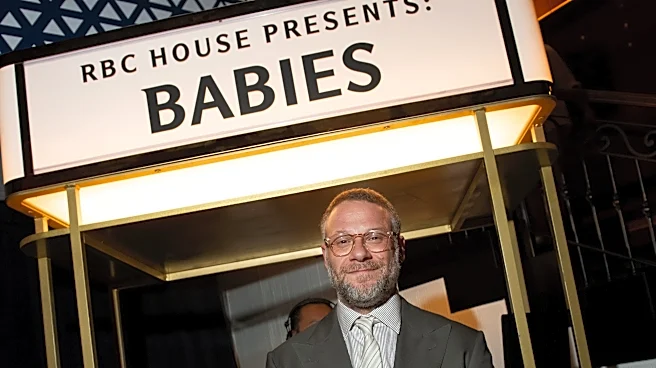
Prior to the ceremony, Rogen sat down for a career-spanning talk with Geoff Macnaughton, TIFF’s vice president of market programming at theatrical, at the fest’s John Bassett Theatre. The multi-hyphenate has two films at this year’s fest — “Babies,” an ensemble comedy directed by his wife Lauren Miller Rogen, and “Tangles,” an animated film which the Rogens produced. And it was quite the hot ticket (though that’s to be expected for the hometown hero).
The talk began with Macnaughton asking about Rogen’s beginning as a teenage stand-up in clubs around Vancouver.
“My first show was at a lesbian bar called The Lotus. It went very well,” he laughed. “I don’t know. I think I’m very lucky that from a very young age, I kind of knew what I wanted to do. As soon as I realized you could be funny for a living, and I loved films … and I wanted to make movies. I got a video camera and made movies with my dear friend Evan, who I still make movies with today. I was just very fortunate in that I had a very clear idea of what I wanted to do with my life, and my parents were very supportive of it.”
When it comes to the worst advice Rogen’s ever received, he pointed to an actor teacher he had when he was a kid — he entered adult acting classes as a youngster to challenge himself — and remembers her telling him, “Your voice is terrible. You should change your voice because you’ll never have a career sounding like that.”
As for the best advice his mentor Judd Apatow ever gave him, Rogen recalled a moment that “is going to sound crude at face value, but there’s actually a lot of depth to the advice.”
“At one time, when we were shooting ‘Knocked Up,’ we would improvise a lot, and we were improvising and Judd screamed from the other room, ‘Less semen, more emotion!’” Rogen shared. “And honestly, as I’ve gone on to make films, it’s amazing how much I come back to ‘Less semen, more emotion,’ and how many times I’m writing with my friends and we’re making ourselves laugh and then we stop and go, ‘You know what? Less semen, more emotion.’” Those words from Apatow taught Rogen, “That understanding of how to balance humor and emotion and reality and comedy and how to navigate tone.”
As for how productive Rogen has been, he mostly chalks it up to the love of the game and his lack of fear due to decades of training.
“I mean, I love what I do, so it’s not hard to motivate yourself when you really enjoy what you do,” he offered. “And it’s just what I do. If I’m sitting around on a weekend and there’s a thing I’m working on, I work on it, because I want to work on it, not because I have, like, an obligation to work on it.”
He continued: “When you love what you do, it’s easier to motivate yourself. I know a lot of people who love what they do and they do get in their own way creatively. I started so young and I’ve written so much that I don’t pressurize the act of writing. I have no fear — the blank page does not intimidate me. I’m sometimes excited by the blank page.”
Midway through the discussion, the talk moved to “The Studio,” Rogen and his creative partner Evan Goldberg’s Apple TV comedy series about a green studio head (Rogen) navigating the chaotic Hollywood landscape while trying to balance creative fulfillment and the profit motive.
When Rogen was asked if the Emmy-winning show, which satirizes a number of his real-life interactions with Hollywood figures, has complicated his relationship with the industry and its power players, Rogen paused.
“Um … I don’t … Not … I’ve felt it change a little bit my role in Hollywood, I think because we’ve made this thing that is so referential to the specific people that we work with and the specific people in our world,” he reasoned. “It’s funny making a thing where I think, ‘Oh, everyone in Hollywood watches this.’”
“I think in general everything’s the same, but people probably treat us very differently,” he added. “I think for 20 years people just didn’t think we were paying that much attention, like, ‘Oh, these guys are stoned.’”