
Click here to read the full article.
It’s the end of the world as we know it in “The Dog Stars,” and everyone feels — well, not fine exactly, but, you know, fine? Alive, hanging in there, taking it one day
at a time. Things could be better, which goes without saying in the aftermath of a flu pandemic that has wiped out most of the planet’s human population, but the four principals here could also be dead, so there’s that. That shrugging, slightly bereft air of just-getting-by is the prevailing mood of Ridley Scott’s post-apocalyptic survival story, and it’s a tough one to sustain dramatically, much less with any sense of intrepid adventure. Somewhat aptly released at the tail end of a long, loud movie summer, this is a surprisingly low-energy, low-incident blockbuster; you’d appreciate its mellow, character-oriented approach if it gave you any real characters to hold onto.
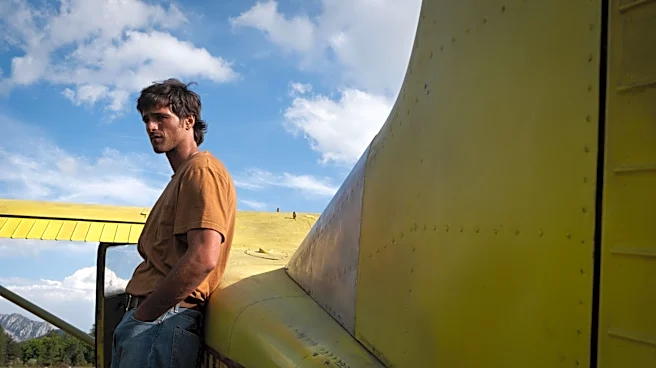
Peter Heller’s popular 2012 source novel largely did. Concentrated and eventful, it brought Jack London-style terseness and lyricism, as well as some mordant gallows humor, to the oft-solitary saga of Hig, a qualified mechanic eking out a life on an abandoned airstrip in rural Colorado, less than a decade after the fateful plague. (The year in the film is given, most pessimistically, as 2035. Start stockpiling now.) On the page, Hig’s first-person descriptions of his everyday adventures, and of the waning natural world around him, had an honest, melancholy soul to them. That voice doesn’t carry over to the adaptation by screenwriter Mark L. Smith — something of a specialist in survivalist drama, having also scripted “The Revenant” and “The Midnight Sky” — which forgoes narration altogether; the film bets on Jacob Elordi’s blokey, slightly sad-eyed charm to fill in the gaps.
It’s not a bad bet; it just doesn’t quite pay off. Elordi’s gift as a performer is for mining deeper seams of humanity in unappealing characters, from the douchey trust-fund scion of “Saltburn” to the literal monster of “Frankenstein.” Given a simply dull one, as he is here, he fares less well. The film’s Hig is nice; he’s admirably practical and resourceful; he looks terrific in weathered Carhartt workwear. But even handed the sympathetic accoutrements of a faithful German shepherd sidekick and repeated silent flashbacks to his deceased wife, he remains a bit of a blank. The film’s strangely lackadaisical opening act, heavy on scenes of Hig flying his battered Cessna alone, desperately needs the gruff friction provided by Josh Brolin as Bangley, his fellow survivor turned reluctant platonic life partner.
Hig and Bangley have an established routine that keeps them alive, if not all that elated to be so. Hig regularly flies to Denver, now a bombed-out ghost town, to pick up supplies from sundry abandoned stores, bars and hospitals. On their compound, they alternate guard duty, on the alert for sporadic bands of intruders, whom Bangley insists be shot on sight. When Hig can’t take it anymore, desperate for any kind of escape, he winds up crash-landing his plane near the spartan farm of grizzled rancher Jack (Guy Pearce) and his lonely daughter Cima (Margaret Qualley), whose routine is similarly, joylessly focused on existence and endurance: The grass, of course, is always greener on the other side of the Rockies. A thin romance ensues. The dramatic tempo stays much the same.
At its most interesting, “The Dog Stars” mimics the structure and stakes of a classic frontier Western, echoed quite literally in its two liveliest action setpieces: a briefly spectacular yet unperilous buffalo stampede, and a faceoff with a marauding tribe of feral, thickly made-up men on horseback, rather incuriously positioned by the film as an outright enemy force. The old-fashioned cowboys-and-Indians dynamic of this sequence is hard to ignore, as is the shared whiteness of the film’s leading characters: In this dog-eat-dog world, whose brutal survival strategies get to be heroic, and why?
Smith’s spare, episodic script doesn’t risk such introspection, or indeed much else — save for one whopper of a departure from the novel, late in the proceedings, that sharply wrests the tone from ruggedly earnest wilderness drama to macabre, borderline-camp horror-comedy, only to reverse course so abruptly you wonder if either you or the film dropped out for a quick fever-dream. It certainly yanks your attention amid the generally homey, lolloping rhythm of the film. It also more or less demolishes whatever credibility this future-rustic story world has built up to this point. In this case, Scott’s famously catholic genre interests come at some cost to the integrity of the whole enterprise; you sense he might feel as impatient with these sturdy, morose, faintly drab characters as we do.
All four stars ably play the stoic and sorrowful notes required of them, without finding many secondary or contrasting ones in their dialogue. “The Dog Stars” winds up coasting on their collective capabilities and charisma, as well as on Scott’s autopilot proficiency. If the tirelessly prolific director never seems more than intermittently invested in this material, the strongest passages here thrive on his muscular command of scale, and he can still pick a landscape with the best of them: Northern Italy fills in robustly for the Centennial State here, even though Erik Messerschmidt’s consistently charcoal-washed lensing suggests there’s no magic hour in this unforgiving dystopia. This isn’t a future to be prettified, and fair enough, but that impulse also falls in line with the film’s stubbornly un-fun, eat-your-greens demeanor: Can’t something here thrive rather than survive?