

Click here to read the full article.
When an “Amadeus” revival opened at Pasadena Playhouse in February, it was such a spectacular success on every level that you wouldn’t have minded if the keepers of the venerable San Gabriel Valley venue just turned
over the keys to the place for a while to the two Tony winners most responsible for making it a smash: star Jefferson Mays and director Darko Tresnjak. And that’s kind of what the Playhouse has done. That dynamic duo is already back in Pasadena with “The Visit,” which has opened a mere seven months after “Amadeus” first hit the boards there. With a good number of cast and crew members carrying over from the previous production to rock us again after “Amadeus,” this looks, for the moment, like as close a thing to an official house company as you can get in a major theater nowadays.
But is “The Visit” as much fun as “Amadeus”? Let’s just say for the moment that this followup production is destined to be more polarizing than that across-the-board crowd pleaser, although it’s not even a bit less lively. Like Peter Shaffer’s play before it, it is a vintage black comedy — even more vintage, as it was written by Swiss playwright Friedrich Dürrenmatt in 1956, although it’s been subject to a lot of Engligh adaptations and re-writes in subsequent decades. It loosely belongs to the theater of absurdism, which means that there is increasing room as the tragicomedy proceeds for Tresnjak to play around with the initially realistic trappings and have some fun with surrealist, grotesque and/or anachronistic elements. But what it really belongs to is the theater of fatalism, where things line up along the way to increasingly convince us that society, government and individua people themselves are inevitably subject to corruption and venality. So your enjoyment of the play may finally be subject to how much you feel you already do or don’t know that.
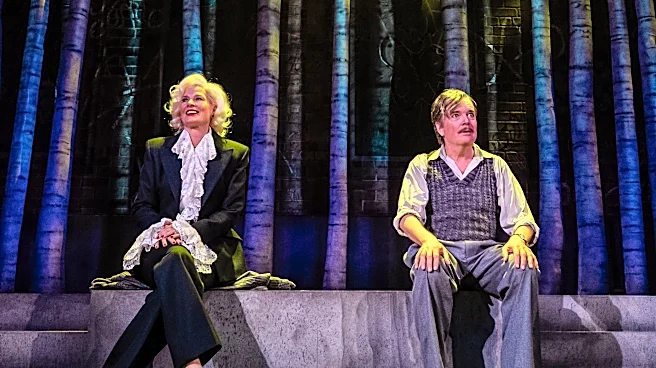
Given that Mays is widely regarded as one of the most charismatic and capable actors in modern theater, would it surprise you to learn that he is not really the star of “The Visit”? Well, he is, certainly in billing, and in the fact that he is the clear protagonist, as Anton Schill, a humble shopkeeper in postwar (or is it 2020s?) Europe whose past comes back to haunt him. But Mays is playing almost more of a mouse than a man. So, talk about a turnaround from Salieri. As much scenery-chewing as the actor was doing in “Amadeus” — and it was a glorious meal — that’s how little he’s doing here. Mays admitted in a recent interview that he wasn’t sure he was right for the role, and you can see why he might have thought so, given the character’s passivity. But it takes a skilled actor to successfully put his mojo on mute, too. So if you know what he’s capable of, there’s some pleasure in watching him at first seem to embody the milk of human kindness, before he succumbs more of an emblem ofBut the the milquetoast of human depravity.
But the obvious centrifugal force of “The Visit” is the female lead, a character named Claire Zachanassian who may be the richest woman in the world, and who has an even greater surfeit of personality than money. She’s played here to perfection by Melinda Page Hamilton, whose stage appearances and recurring TV roles have not made her a household name — yet she has such presence that, from her first scene forward, you’re convinced that she must be one anyway. She gets off a train and breezes into the downtrodden European town where she spent her impoverished girlhood like she is some charming ane cunning combination of Lauren Bacall, Madonna and a demonically possessed Daisy Buchanan. Her intentions for the hometown she is nostalgically revisiting are cloaked at first, but her barbed banter is so much fun, you can almost half-wish she doesn’t mean anything sinister with her visit, even if she clearly does. After all, her musclebound handlers have brought along with them an empty casket, and this is the sort of play where a coffin that appears in the first act is definitely going to go off in the third. (Not literally; although “The Visit” has been produced in as a hefty three-parter in some productions, it’s mercifully cut down to a single act in Pasadena.) You can never take your eyes or ears off Hamilton, even when the plot gives her increasingly schematic things to say and do in the second half.
About that plot. There is a big revelation less than halfway into the show, one that might even count as a plot twist, and thus something not to be spoiled… if not for the fact that virtually every synopsis in the last 70 years has included it in the first sentence. So we’ll assume most patrons know it going in and won’t hold a discussion of it against us here, though stop right now if you think you might. Cutting to the chase, Claire has earmarked the aforementioned casket for Anton, despite the fact that he was her lover in their youthful days, and they are sharing sweet memories of their lusty romps in the woods within minutes of her arrival. After some more talk of the bucolic days gone by, Claire suddenly announces at a town meeting that she will rescue this on-the-skids burg with a donation of one billion (what the currency is goes unspecified), with one condition: that they deliver her a dead Anton. For reasons eventually to be revealed, she represents pure vengeance, even if she does talk like someone out of a ’30s screwball comedy, or “Truth or Dare.”
Up to the point that she delivers the townspeople this ultimatum — a deal with the devil, or with an especially cocktail-party-friendly Cruella de Vil — “The Visit” has kind of been a rollicking good time. For much of the audience, it will remain that all the way to the end, even with some somber moments along the way that aren’t played for laughs. But the basic problem with the play — if you’re spoilsport enough to see it as one — is that once Claire makes her modest proposal to save the town, there won’t likely be any doubt in a single audience member’s mind that things are going to pan out exactly as she wants them to. Because it’s that kind of a show: one that is just a little too self-pleased with itself for offering the bleakest possible vision of what civilized people can and probably will do, offered a way out of their misery or mundanity. So there’s not that much to happen in the last two-thirds of the drama than for your ribs to be constantly nudged with the idea of how easily the most respectable citizens among us will give in to modest proposals and, indeed, murder. It rings true, don’t get me wrong! But it also rings awfully predictable, in a way that maybe it didn’t in the late ’50s and ’60s, when it was a little easier for defiantly grim morality tales to seem transgressive in the mainstream.
The story might have at least a modicum of suspense if any of the upstanding townspeople were seen as struggling with the idea of murdering a trusted friend. But after an initial vote of “no way” to Claire’s offer, everyone seems to have become completely transformed by the next morning. The program notes reference “Invasion of the Body Snatchers,” which seems like an apt analogy, except that that film would be a lot less riveting if the entire city turned into pod people instantly, followed by an hour of Kevin McCarthy slowly deciding he should accept his fate. To give some credit here, there is one scene in which a cleric openly debates with himself whether to go along with the greedy mob or not, but within a couple of minutes he’s come to terms with the creeping evil, too. It’s realistic, sad to say, that a population would find a way to justify throw all of its collective principles away and commit a horrific crime; it’s just a little less realistic — or good for the purposes of a full-length drama — that this would all happen in a virtual instant.
There are other huge dramatic implausibilities, if we want to get picky about it. The opening scenes of “The Visit,” when it is in its most realistic mode, have the townspeople convinced that Anton is actually their ticket to riches, not a future scapegoat, because of his past romance with Claire. And he seems to be firmly convinced of this, too, as they get together alone in the woods and share reminiscings of those tender or erotic moments of yore. But once Claire reveals the backstory of why she is out to bring the wrath of God down on him, her reasoning seems… well, still a little psychopathic, but somewhat justified, by the standard of modern feminist morality tales. To say he did her wrong is an understatement. So is Anton supposed to be mentally compromised or deranged, rather than the harmless soul we first meet him as, to have imagined that Claire would have come back after all these decades with a positive picture of him, instead of a lust for blood? It makes no sense. Maybe that’s a fault of the condensation, and the picture would be clearer in the three-and-a-half-hour version (!) Tony Kushner adapted for the London stage at the turn of the decade. But there’s some basic sense missing here that can’t be explained away with the idea that it’s just a surrealist fable.
With all that said, there are still a lot of pleasures in this production that remain failsafe, even after the ride toward a way-too-inevitable outcome is firmly on its tracks. For instance, the way that Tresnjak, wardrobe designer Charlotte DeVaux Shields and set designer Alexander Dodge have conspired to make sneakers into the embodiment of complicity and evil is fairly ingenious. Somehow, the show’s supporting cast members manage to make their way onstage without giving away their footwear until, at some key moment, their colorful shoes are lit up in what looks like a flurorescent glow, revealing that they, too, have gone along with the body snatchers. (Everyone should see it coming a mile away, but even I LOL-ed when the town cleric showed that he, also, has succumbed to the Air Jordan pandemic.) There are an increasing number of moments like that throughout the production in which it seems to have suddenly jumped into the present day, and some work, some don’t. It is a little jarring when, still pretty early in the show, you hear the first example of disco bumper music, like they suddenly piped in a little bit of David Byrne’s score for “Here Lies Love” to cover the scene change. But by the end, the use of modern-day cameras and video screens to bring the action fully into the 2020s seems justified enough, if you buy into Tresnjak’s time-tripping aesthetic at all.
The show’s creepiest characters — no contest here — are a couple of aging, balding, blind eunuchs (played by Jake Levy and Lauren Worsham)who seem to be part of Claire’s entourage for no good reason, other than to figure into the tale of woe she eventually tells, which finally explains why they know their way around the town so well despite being sightless visitors. Their presence brings “The Visit” almost right up to the edge of horror, which is where thematically it kind of belongs, despite all the zingers, smirks and guffaws. The play seems to want to flirt with the idea of Grand Guignol, even if remains more firmly rooted in the land of Samuel Beckett.
But the swing being taken here is bold enough that there’s no reason to want to take the Playhouse keys back from Tresnjak, if he has more offbeat revival aspirations where this one came from. And with lead performances like Mays’ and Hamilton’s, the production is — sorry to do this here — worth your visit. If the initial impulse is that Mays doesn’t have as much to do here as is worthy of his talent, he is so firmly enmeshed in the character of a nebbish caught up in a sub-Kafkaesque nightmare, he makes you feel deeply for his fate, even if Maurice Valency’s adapted script kind of seems to want you to not feel so bad about it. And Melinda Page Hamilton? She’s so captivating, in both her rages and her funnier, more casual cruelty, that I’d follow her Claire to just about any soiree where the multi-billionaire elite meet, even if I did spot a coffin there with my name on it.
“The Visit” runs through Oct. 4 at Pasadena Playhouse, located at 39 South El Molino Ave. in Pasadena. Phone: 626-356-7529. For tickets and more information, visit http://www.pasadenaplayhouse.org.