

Click here to read the full article.
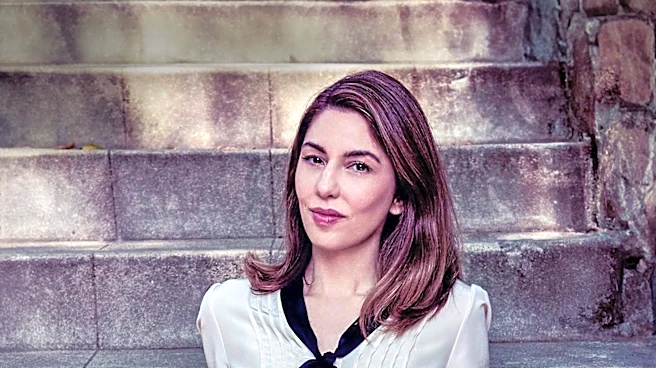
“Marie Antoinette” is back in Versailles.
To mark the 20th anniversary of her 2006 film, director Sofia Coppola has partnered with the Château de Versailles on an unusual exhibition of props, costumes and behind-the-scenes
materials, staged in the palace the real queen called home.
“It’s like Christmas for me,” Coppola says ahead of the exhibition’s opening. “You think of a museum as very serious, and [the curators] have brought some rock and roll to it.”
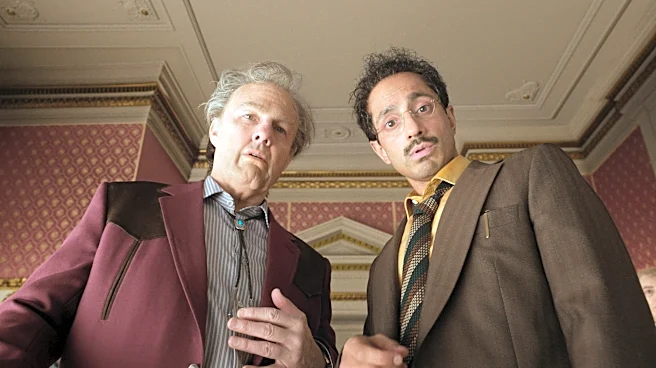
The filmmaker also drew an A-list crowd to the exhibition’s launch, reuniting “Marie Antoinette” stars Kirsten Dunst and Jason Schwartzman at the Versailles Orangerie. Friends and family including Francis Ford Coppola, Rashida Jones, Thomas Mars, Virginie Efira and Niels Schneider joined the party, with New Order providing the tunes.
Of course, Versailles has clearly been on Coppola’s mind for the past year. While working with the museum’s curators to put together the exhibition, she was also editing “Making Marie Antoinette,” a documentary drawn from 80 hours of on-set footage shot by her late mother, Eleanor Coppola. Now playing the fall festivals, the film will be released by Mubi on Nov. 9.
“It was such a gift to see all the memories of filming at that time, and to see them through my mom’s eyes, watching her daughter work, when now I have almost-grown daughters doing their own work,” Coppola tells Variety. “It was very touching. She really wanted this film finished at the end of her life, so finishing it is a tribute to her.”
Coppola had already dipped into nonfiction with 2025’s “Marc by Sofia,” but this project asked something different, if only because the filmmaker doesn’t really consider the film her own.
“Creatively it was challenging, because I wasn’t making something I had in mind,” she explains. “I was trying to finish [my mother’s] film the way she would have wanted, showing all the detail and beauty she cared about, while keeping in mind how she would have wanted it seen.”
Co-editor Aaron Matthews and advisor and family friend Davia Nelson offered ballast and perspective, helping Coppola cut a documentary in which she herself was the subject.
“It’s hard to tell what would be interesting to someone else when you’re so close to it,” she says. “Because I’m in it, and it’s embarrassing to see myself as a young director, I have no perspective. They helped me see what other people might want to watch.”
“I thought that if you love that movie, it would be fun to visit the film set, so the idea was to show what it was like there,” she continues. “I was also a young director, not quite sure of asserting myself, so it’s cringey for me. But I hope it’s helpful for young people to see that you have to evolve and find your way as a director, too.”
While developing her next feature, Coppola has spent this retrospective year taking stock, reflecting on the echoes and overlaps as she watches her own children pursue creative paths with a familiar pride. After all, she dove into this meta-textual documentary shortly after directing a music video for her daughter, Romy Mars.
“It’s fun to see my kids being creative, and it’s touching for me to see my mom watching her daughter make things,” she says. “Now, I can see it from a new perspective, as a mother too.”
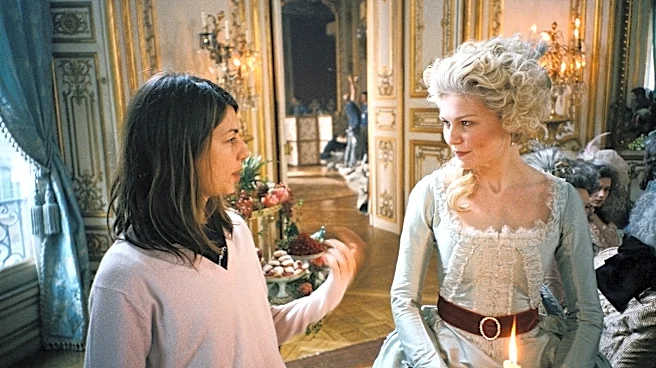
Spread over two floors of the Petit Trianon, which the real queen famously made her own, the exhibition brings the film’s impish spirit back to its source. Milena Canonero’s Oscar-winning costumes dress mannequins modeled on Kirsten Dunst and Jason Schwartzman, positioned beneath historical portraits and busts in the very rooms where the real figures once danced and broke bread.
Fact and fantasy mingle throughout: Visitors move through the Petit Trianon’s opulent halls to the faint pulse of New Order, past display cases holding priceless historical artifacts alongside an arguably just as valuable pair of Manolo Blahniks.
That playfulness channels the same artistic impulse that first drew Coppola to the project.
“I wanted the characters to feel relatable and alive, as if you were going back in time rather than looking from a distance, and I wanted them to feel like the teenagers they were,” she explains. “I wanted a modern audience to feel maybe what they felt, keeping it grounded in the period, but also having fun.”
Funnily enough, the exhibition, which runs from September through January, will stay far longer than Coppola’s crew. They filmed at Versailles for just 20 days in the spring of 2005, a typical crunch for a site this popular. Then as now, productions are allowed to film only on Mondays, when the palace is closed to visitors. That constraint bred some on-set ingenuity.
“Because we shot many different periods in a single day, Kirsten had to go from 14 to 28 in a matter of hours, and we tracked her age by the size of her hair,” Coppola laughs. “On the other days of the week, we recreated her bedroom and other rooms elsewhere. When you’re in a real place and see the real view out the window, it transports you, and the whole crew and cast feel it. On a soundstage, there’s no view of the gardens.”
Countless productions have since shot at the royal palace, always, as ever, on Mondays. But for Versailles museum director Laurent Salomé, “Marie Antoinette” stands above the rest. He sees that blend of fact and fantasy as key to understanding the site’s enduring appeal.
“Because Sofia doesn’t care so much about historical precision and is more interested in feelings and atmosphere, it helps you understand what the place means,” Salomé explains. “Making a film here means exploring the mystery of the relationship between people, the house, its decoration, beauty and harmony with nature. Filming here has nothing to do with filming on a studio set. The château is itself a work of art, something strange that Louis XIV invented to transform people, including diplomatically. We saw that again recently with the visit of a certain president!”