






Click here to read the full article.
Ireland’s ongoing artistic reckoning with the Catholic Church’s gross mistreatment of unmarried mothers and their children — as addressed in such films as “The Magdalene Sisters,” “Philomena” and “Small Things Like
These” — continues in “The Lost Children of Tuam.” A restrained but deeply affecting drama that keeps the horrors of the past largely unseen, instead tracing a contemporary woman’s growing awareness of vast tragedy buried in her hometown, Frank Berry’s film is ripped from recent headlines: Viewers may recall the international media coverage of local historian Catherine Corless’ discovery that hundreds of children had been buried in an unmarked grave on the former site of a Catholic mother and baby home in Tuam, Galway.
But while “She Said” writer Rebecca Lenkiewicz’s typically studious screenplay is primarily based on a 2017 article by New York Times journalist Dan Barry, it’s not a drama of dramatic journalistic scoops and revelations — instead opting for a patiently procedural study of the thankless grassroots legwork that goes first into uncovering hard truths in largely silent communities, before the matter of pursuing institutional acknowledgement and accountability.
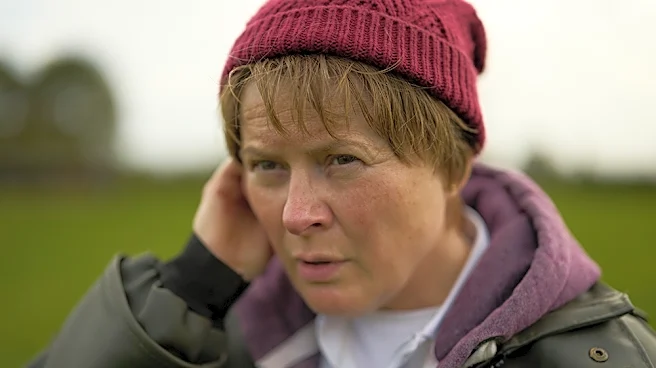
It’s somewhat fitting, then, that Berry’s film is fronted not by a movie star but by Monica Dolan, a redoubtable character actor who has steadily served the ensembles of films from “Topsy-Turvy” to “Pride” to “The Dig,” but rarely gets the kind of spotlight she’s granted here. Her unvarnished, heartsore turn as a woman unprepared to be the face of a movement, but shouldering that responsibility anyway, gives this otherwise stoic affair a nervy, sensitive spine.
Following a triumphant home-turf premiere earlier this month at the Galway Film Fleadh — where it took home the top prize for Best Irish Film — “The Lost Children of Tuam” should at least match the international festival reach of Berry’s last feature, the Josh O’Connor and Letitia Wright starrer “Aisha,” while specialist distributors and streaming platforms should take note of its direct appeal to audiences’ emotions, minus any distancing arthouse trappings. The presence of Liam Neeson as a producer — alongside Element Pictures honchos Ed Guiney and Andrew Lowe — should further raise its profile.
An unassuming wife and mother with a fraught history of clinical depression, Tuam resident Catherine is no academic: Her interest in local history begins at a hobbyist’s level in 2010, with a community-college night class that requires her to research a close-to-home subject for a final essay. At a loss, she chooses St. Mary’s, a Catholic-run shelter for unmarried mothers and their children that was shuttered in 1961; her interest in the matter stems principally from her own mother’s illegitimate parentage, and she hardly expects to discover anything untoward.
Yet the more she probes, with polite but unyielding persistence, the more a larger, untold story emerges. Bones discovered on the site in the 1970s were hastily explained away as dating from the famine, and examined no further; the local records office turns up an inordinate number of child death certificates from the home’s 36 years of operation, with no corresponding graves or burial sites to be found. And in time, elderly survivors of the home come forward with their own stories of abuse and trauma, their halting, shattered testimonies making for the film’s most plainly moving montage.
Unfolding over several years, Catherine’s investigation is slow and frequently frustrated by the non-cooperation of government and church bodies, and also by her own domestic and personal crises. Though the film runs just 84 minutes, Colin Campbell and Nathan Nugent’s deft, clean editing captures the cumulative weight and urgency of a project that gradually consumes our heroine’s unassuming life, escapes her control, and joins a wider national confrontation with the past.
Indeed, no individual contribution to “The Lost Children of Tuam” seeks to stand out from the whole, from the exactingly framed but unadorned lensing by DP Kate McCullough (“The Quiet Girl”) to the muted woodwind echoes of Hannah Peel’s score to the uniformly lived-in, attentive performances of the whole ensemble. At the center of proceedings, however, Dolan offers not so much a star turn as a moral and psychological anchor, playing Catherine with a fine, detailed sense of internal wear and tear from one day to the next, but also a grave conscience, bleeding into that of the film itself.
Lenkiewicz’s script offers only a bare-bones sense of her life, routine and relationships outside of this great, unexpected burden; some viewers may wish for more conventionally colored-in, character-driven drama. But that selflessness comes to feel like the point of this lingering, resonantly sad film — above all else, an elegy for lives unseen and unknown.