











Click here to read the full article.
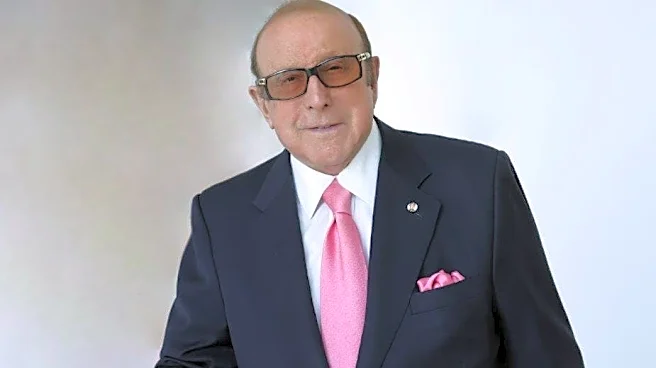
Clive Davis, the executive who steered Columbia, Arista and J Records to the pinnacle of the pop music business, died Monday at his Manhattan home, Variety has confirmed. He was 94.
Befitting a dramatic 50-year career
that accounted for the sale of millions of records, Davis’ life in the music industry divided into three distinct acts.
In the late ‘60s, Davis lucratively moved staid Columbia into the rock business, signing or developing such talents as Janis Joplin, Carlos Santana and Bruce Springsteen. But he was ejected from the company in 1973 for allegedly misusing corporate funds, and pleaded guilty to tax evasion.
He rebounded, famously, at Arista Records – an amalgamation of down-at-the-heels imprints owned by Columbia Pictures – where vocalist Whitney Houston was only the biggest and brightest star on a roster of top pop, rock and R&B acts.
A quarter century later, following an awkward merger between parent companies Sony and Bertelsmann, an attempt to push him out of Arista and into retirement resulted instead in his third act with J, a new imprint best known for launching singer-songwriter Alicia Keys.
Davis was so well known in the music industry that he was usually referred to, respectfully, by his first name alone, like such other renowned execs as “Ahmet” (Ertegun, of Atlantic) and “Mo” (Ostin, of Warner Bros.).
Noted for his personal elegance, extravagant style and love of the limelight, Davis for years hosted a lavish annual Grammy Week party that was the music business’ most coveted social ducat. The event, featuring live performances by marquee names and loquaciously MCed by Davis, became an official Recording Academy function in 2009.
Variety interviewed Davis multiple times, including an unusually free-form conversation on the occasion of his 90th birthday, and he also wrote two detailed if occasionally rose-colored autobiographies. But Davis’ career is arguably portrayed most vividly in a different article celebrating his 90th birthday: a lengthy, classic-anecdote-filled collection of interviewswith more than 25 executives who worked under him, which presents sides to him that most observers and artists rarely saw.
“Clive was never willing to give up,” said longtime executive Charles Goldstuck in the article. “No matter how tough or intractable a problem was, he always believed that there was solution. He would fight for the solution until he had it.”
Born in Brooklyn, NY, on April 4, 1932, Davis was a striving student who attended New York University on a full scholarship, and graduated magna cum laude. He also was awarded a full scholarship at Harvard Law School, graduating in 1956.
He entered the music business through the side door: legal affairs.
In 1960, after two frustrating years at a prominent New York law firm, he was hired as assistant counsel at Columbia, then owned by CBS. Within five years, he was promoted to administrative vp by CBS Records’ much-admired prexy Goddard Lieberson. He soon ascended to Columbia GM and in 1967 he was appointed president of the label.
When Davis took the reins at the company, Columbia was lagging behind in the ‘60s rock revolution. While its roster did sport the Byrds, it was better known for middle-of-the-road pop fare by acts like Johnny Mathis and Tony Bennett. The former attorney quickly proved he had that elusive, almost mystical record biz talent: “ears.”
Columbia waded into the rock vanguard after Davis attended the Monterey International Pop Festival in June 1967 at the behest of its organizer Lou Adler, whose Ode Records was distributed by CBS.
Davis personally handled negotiations to get one of Monterey’s breakthrough attractions, Big Brother and the Holding Company – a San Francisco band fronted by singer Joplin – out of its Mainstream Records contract and onto Columbia. Other festival acts – most notably Santana, led by their eponymous guitarist – also joined the label.
A host of prime talent signed to Columbia on Davis’ watch in the late ‘60s and early ‘70s: Blood, Sweat & Tears, Chicago, Neil Diamond, Billy Joel, Pink Floyd, Springsteen. For years, the label was knotted in a head-to-head battle with Warner Bros. for supremacy in the rock business.
However, Davis fell from grace, and it was a long and dizzying descent. In May 1973, following a federal investigation and an internal CBS probe, he was summarily fired for misappropriating $94,000 from the label. He had used some of the money to pay for his son’s bar mitzvah and for vacation lodging and airfare for his family.
Unbowed, Davis published an autobiography, “Clive: Inside the Record Business,” in 1975. In his 1990 book “Hit Men,” Fredric Dannen wrote that the tome “gives the impression that he, singly and alone, signed, molded, and marketed every major pop act CBS Records had during his eight-year reign. The people who worked for him at CBS did not love him for it.”
Davis was charged with six counts of federal income tax evasion in 1975. He pleaded guilty to a single count of failure to pay taxes and was fined $10,000; the other counts were dropped. He settled a civil suit lodged by CBS out of court in 1977.
However, by that time Davis’ reputation was well on the road to rehabilitation. In 1974, he accepted Columbia Pictures prexy Alan Hirschfield’s offer to combine the studio’s failing imprints – Bell, Colpix and Colgems – in a new entity.
Dubbed Arista (after the New York school system’s honors society), the label made its first score with “Mandy,” a No. 1 single recorded at Davis’ insistence by one of Bell’s few successful artists, pop singer Barry Manilow. A less likely signing to the pop-driven company was poet-punk rocker Patti Smith, who notched an even unlikelier 1978 hit with “Because the Night,” co-written by Springsteen.
Arista would find success with such established talents as Aretha Franklin and the Grateful Dead. However, Davis – who handsomely cashed out his label stock when Bertelsmann Music Group bought the firm in 1979 – worked overtime to mold an unknown singer he signed at the age of 19 in 1983.
Developed at a high cost by Arista, Whitney Houston became the label’s cash cow in the ‘80s and ‘90s. The singer released seven multi-platinum albums – including 1992’s record-shattering “The Bodyguard” soundtrack, No. 1 for 20 weeks with more than 16 million sold – on the label from 1985-2000.
A host of other pop talent – Air Supply, Kenny G, Sarah McLachlan, Annie Lennox – found a profitable home at the label. The company managed to weather the Milli Vanilli scandal of 1990, when it was discovered that the Grammy-winning duo did not sing on their multi-platinum album. In 1999, Davis savored a triumph when Carlos Santana’s album “Supernatural” reached No. 1, later collecting nine Grammys.
Among Davis’ most productive deals was a joint venture with producers Antonio “L.A.” Reid and Kenny “Babyface” Edmonds’ LaFace Records, which spawned TLC and Toni Braxton. However, the partnership ultimately proved fateful for Davis: In 2000, a year after LaFace was acquired by Arista, he was removed as head of the label he founded and replaced by Reid.
Nonetheless, Davis still found favor at BMG: The company supplied the veteran exec with $150 million in seed money to start a new distributed imprint, J Records. Within a year, the label turned a Columbia cast-off and one-time Arista act, Alicia Keys, into a fresh superstar; the singer-songwriter-pianist’s debut “Songs in A Minor” sold 6 million copies, and Keys would collect nine Grammys and sell millions more by 2005.
Davis’ Midas touch prevailed at J: He developed such new talent as Leona Lewis, and rejuvenated Rod Stewart’s career with the “Great American Songbook” series.
He took top executive roles at BMG and Sony Music Entertainment, CBS Records’ successor, during and after the two majors’ short-lived merger in 2004-08. After serving as chairman-CEO of BMG Music Group, he moved into his latter-day role as chief creative officer of SME after Barry Weiss took his job in 2008.
While he shepherded Oscar winner Jennifer Hudson’s Grammy-winning ’08 Arista debut, Davis’ greatest latter-day disappointment may have been Whitney Houston’s 2009 comeback album “I Look to You.” Scuttled by the troubled singer’s erratic public performances and rumors of her ongoing drug use, the collection failed to meet either artistic or sales expectations, despite a No. 1 debut.
The Davis era at Sony moved into eclipse in October 2011, when new chairman-CEO Doug Morris, folded the Arista and J imprints and assigned their artists to flagship label RCA Records. Ultimately, Davis settled into a chief creative officer role that he continued to occupy until his death.
Honored with the Recording Academy’s Trustees Award in 2000 and the President’s Merit Award in 2009, Davis was inducted into the Rock and Roll Hall of Fame as a non-performer in 2000.
Twice divorced, Davis is survived by three sons and a daughter.